


19th Century Demi Lune
A 19th century demi lune table brings half-circle elegance and practical surface space to a hallway or drawing room.
19th Century Demi Lune
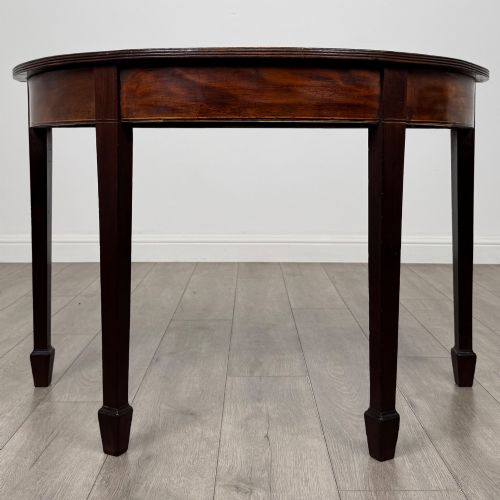
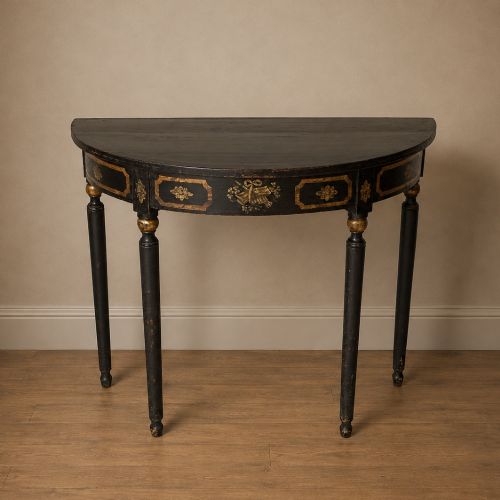
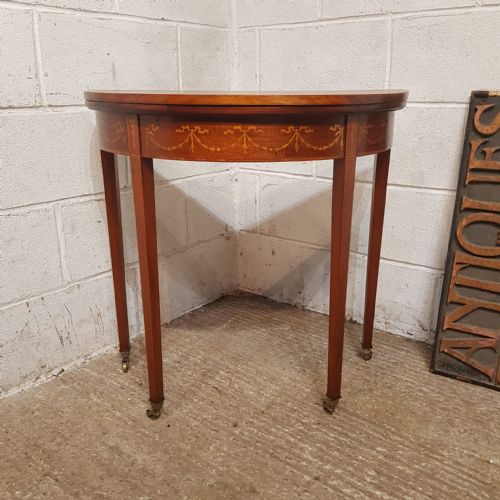
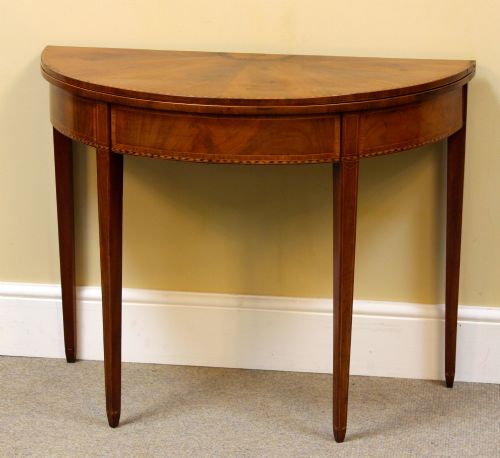
A 19th century demi lune encompasses a graceful family of semicircular furniture designed to stand flush against a wall. The selection ranges from simple console tables and side boards to clever fold-over card and games tables, as well as glazed display cabinets and occasional pieces.
Makers of the period adapted the half-moon shape to suit varied domestic needs, producing tea tables, dressing tables, and compact bedside chests. Mahogany remains the most common timber encountered, alongside warm satinwood, burr walnut, and painted finishes.
Originating across English, French, Chinese, and Italian workshops, these items reflect diverse stylistic revivals from Georgian and Regency lines to Louis XV and Neoclassical tastes. The typical piece provides a neat footprint while offering substantial surface presence.
How They Were Made
Cabinet makers utilised solid woods and intricate veneers, applying mahogany, satinwood, kingwood, and burr walnut over sturdy pine or oak carcases. Many surfaces display delicate marquetry, contrasting string inlay, or hand-painted decorative motifs.
Folding mechanisms on games and card tables relied on hinged tops and pivoting rear legs to support the expanded playing surface safely. Carved details, brass mounts, marble tops, and lacquered finishes added textural richness to console and cabinet designs.
The furniture spans utilitarian bedside chests, elaborate display cabinets, and versatile games tables with folding tops.
What Varies in Quality
The distinction between standard utility items and superior examples lies in the selection of timbers and the precision of the cabinetwork. Fine pieces exhibit book-matched veneers, crisp hand-carving, and well-executed marquetry rather than simple painted decoration.
Structural integrity and the smoothness of folding mechanisms for card and games tables separate workshop standards. Original mounts, undamaged marble inserts, and intact hardware elevate the standing of a console or cabinet.
Joseph-Emmanuel Zwiener·Gillows·Maple and Co·Filmer and Son
The 19th Century Demi Lune Glossary
- Demi-lune
- A half-moon shape applied to tables and cabinets designed to fit flat against a wall. This profile maximises floor space in narrow hallways and compact rooms.
- Console table
- A table supported by wall brackets or front legs, intended to stand against a vertical surface. These often feature decorative carving or marble tops.
- Card table
- A folding table designed for indoor games, featuring a hinged top that opens to reveal a baize or polished wood surface. Many examples include internal wells for counters or cards.
- Marquetry
- Decorative veneer patterns formed by fitting together small pieces of wood, shell, or ivory into a larger design. Craftsmen use this technique to create elaborate floral or geometric motifs.
- Satinwood
- A durable, yellowish timber prized for its lustrous grain and smooth finish. It serves as a primary wood or fine veneer in inlaid cabinetwork.
19th Century Demi Lune: Frequently Asked Questions
How were demi lune tables used?
These semicircular pieces functioned primarily as decorative console tables in entrance halls, holding lamps or ornamental objects against the wall.
Fold-over variants served as functional card and tea tables in reception rooms, opening up when guests arrived for social evenings.
Where should I place a demi lune table?
Their flat back makes them ideal for narrow spaces like hallways, landings, or tight alcoves where rectangular furniture protrudes too far.
They also sit effectively beneath a mirror or window in a drawing room to display decorative items without blocking traffic flow.
How do I identify the wood type?
Close inspection of the grain and colour reveals the primary timber, with mahogany showing deep reddish-brown tones and satinwood displaying a golden sheen.
Figured woods like burr walnut or kingwood feature distinctive swirling patterns created by natural growth anomalies in the tree.
What is a fold over mechanism?
The top leaf is hinged along the straight edge, allowing it to swing open and double the surface area for games or dining.
A rear leg or gate-leg swings out simultaneously from the frame to support the weight of the unfolded leaf.