

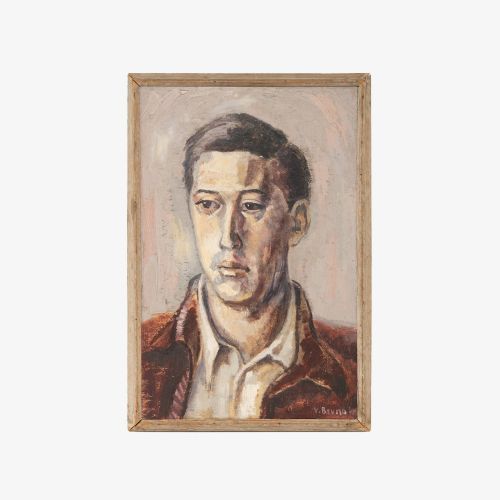
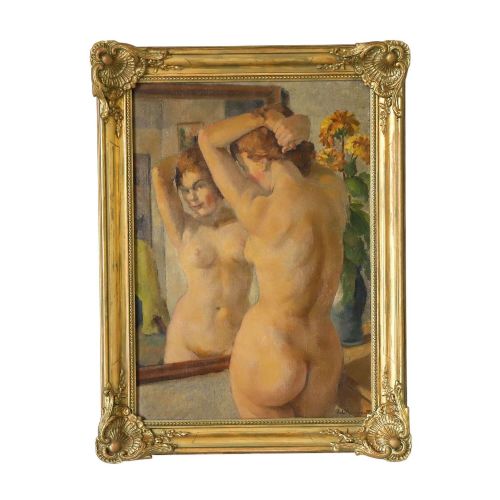


1940s Portrait Painting
These 1940s portrait painting works bring mid-century character and personal history directly onto your wall.
1940s Portrait Painting
When you search for a 1940s portrait painting, you encounter works capturing human faces, animals, and notable figures from the war and post-war years. These oil paintings reflect mid-century realism, expressionism, and avant-garde styles.
The selections on this page span styles from British sporting art to Swedish modernism and 1940s realism. You will find continental male portraits, children with pets, and wartime witnesses rendered on canvas or board.
Materials and Methods
The works rely primarily on oil paint applied to canvas or wood board. Many pieces retain their original gilt or wood framing, preserving the physical context of the era.
Artists of this period utilised varied brushwork, shifting from precise realism to expressive new figuration and surrealist composition. The physical support typically consists of stretched canvas or rigid board.
1940s Portrait Painting Retail Price Guide 2026
Typical asking prices for 1940s portrait painting among the pieces listed under this phrase on Sellingantiques today, from the lower quarter to the upper quarter. They describe what is for sale here now, not the wider market.
Listings feature works executed in oil on canvas and oil on board, spanning realism, expressionism, and surrealism.
Assessing Quality and Execution
Quality rests in the confidence of the brushwork and the psychological depth of the subject. A stronger painting demonstrates assured handling of light and pigment, whereas weaker examples lack structural conviction in the forms.
The preservation of the paint surface and the integrity of the canvas or board determine the longevity of the piece. Works retaining their original framing and untouched paint layers command greater visual coherence.
V. Bruno·Philippe de Rougemont·M.E. Hankinson·Molly Maurice Latham·John Gilroy·Tschacbasov
The 1940s Portrait Painting Glossary
- Oil on canvas
- Pigment mixed with drying oil applied to a woven fabric stretched across a wooden frame. This remains the primary medium for most works from the decade.
- Oil on board
- Pigment applied directly to a rigid wooden panel or composition board rather than fabric. This substrate appears frequently in wartime and mid-century pieces.
- Mid-Century Modern
- A design and art movement spanning the middle decades of the twentieth century. It embraces simplified forms and progressive compositions.
- New Figuration
- An avant-garde return to figurative subject matter following World War II. It reinterprets human and animal forms with strong colour and expressive brushwork.
1940s Portrait Painting: Frequently Asked Questions
How do I identify a 1940s portrait painting?
Look for stylistic cues such as mid-century realism, wartime subjects, or expressionist brushwork characteristic of the decade. Signatures, dates, and stretcher construction often provide corroborating evidence of the period.
Examine the materials, as oil on board and canvas from this era carry specific ageing characteristics in the paint layers and grounds.
Where should I hang a portrait painting?
These works suit dining rooms, studies, or living areas where adequate wall space allows the composition to anchor the room. Avoid direct sunlight to protect the oil pigments from fading.
Pairing a mid-century portrait with complementary period furnishings enhances the visual impact of the canvas.
Are these paintings usually framed?
Many retain period gilt or wood frames that complement the aesthetic of the era. Original frames often show honest wear consistent with their age.
Framing choices vary from simple moulded wood to ornate gilt surrounds depending on the origin of the piece.
What subjects are common in these portraits?
Subjects range from formal human likenesses and children with pets to sporting champions and wartime figures. Artists also explored surrealist and avant-garde interpretations of the human form.
Animal portraits, particularly dogs and horses, feature prominently alongside human sitters.