


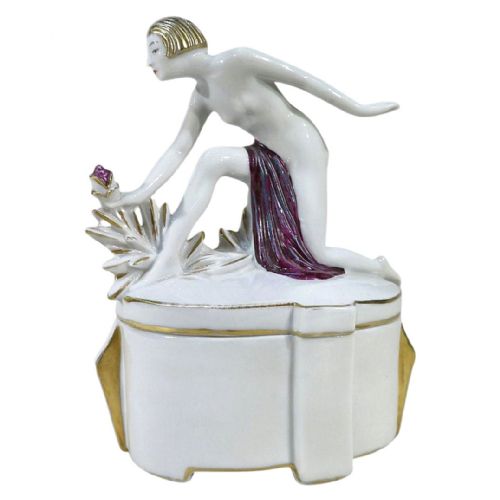

1930s Porcelain Powder Jar
A 1930s porcelain powder jar is a charming vanity accessory that brings period glamour to a modern dressing table.
1930s Porcelain Powder Jar
A 1930s porcelain powder jar sits firmly within the Art Deco style, taking the form of powder boxes, powder bowls, trinket boxes, and vanity sets. These pieces often serve as decorative objects or powder puff stands for the dressing table.
The most common version met on this page is the figural or half doll powder box depicting a flapper girl, bathing belle, jester, or pierrot. These figural pieces are ceramic or porcelain creations originating from makers and workshops in France, Germany, and Austria.
Materials and Technique
Makers utilised ceramic and porcelain as the primary base materials for moulding these vanity items. Glaze provides the smooth outer finish across the bowls and figural covers.
Decoration relies on enamel, gilt, and gold leaf applied to accentuate the distinct Art Deco details of the figures and bowls. Fabric also appears in some vanity accessories, working alongside the ceramic elements.
Originating primarily from France, Germany, and Austria, the items include half doll figures, bathing belles, jesters, and pierrots.
Judging Quality
Quality rests on the crispness of the moulding in the porcelain or ceramic, particularly on figural pieces depicting human faces and period dress. Finer examples show superior hand-painted enamel work and precise application of gilt or gold leaf.
The origin and maker influence distinction, with established factories in France and Germany often displaying greater refinement in glaze application and sculptural detail than anonymous productions.
Fasold & Stuach·Limoges
The 1930s Porcelain Powder Jar Glossary
- Half doll
- A ceramic figure modelled from the waist up, originally designed to sit atop a powder box cover or whisk broom. These figures are characteristic of the period.
- Flapper girl
- A cultural archetype of the era, frequently depicted on powder boxes with stylised cloche hats and period fashion. They define the aesthetic of the 1930s.
- Powder jar
- A lidded vessel intended to hold cosmetic face powder on a dressing table. They are often interchangeable in form with powder bowls and trinket boxes.
1930s Porcelain Powder Jar: Frequently Asked Questions
What is a powder jar used for?
These jars were designed to hold loose cosmetic powder on a dressing table or vanity surface during the early twentieth century. Women used them as a decorative and practical container within their daily grooming routine.
Today, they function as ornamental vanity accessories or small trinket boxes for storing jewellery and keepsakes. Collectors often display them as standalone decorative art objects.
How do I identify a 1930s piece?
Look for the characteristic Art Deco styling, which often manifests in geometric motifs or the depiction of flapper girls and bathing belles. The use of hand-painted enamel on porcelain is typical of this specific decade.
Many pieces originate from European kilns in France, Germany, and Austria, sometimes bearing maker marks on the base. The figural half doll lid is a strong indicator of the era's vanity items.
Are these items made of porcelain or ceramic?
Makers utilised both porcelain and earthenware ceramic depending on the workshop and region of production. French and German potteries produced fine examples in both mediums.
Glazes cover the ceramic and porcelain bodies, sometimes enhanced with gilt or gold leaf details. Fabric and enamel also appear as supplementary materials on specific vanity sets.
How do I care for my powder jar?
Clean the porcelain and ceramic gently with a soft, dry cloth to remove dust from the glaze and decorative enamel. Avoid abrasive cleaners that might damage the gilt or gold leaf details.
Keep the piece away from direct sunlight and damp environments to preserve the painted surfaces and any fabric components. Handle the figural lids with care as the upper portions are delicate.