


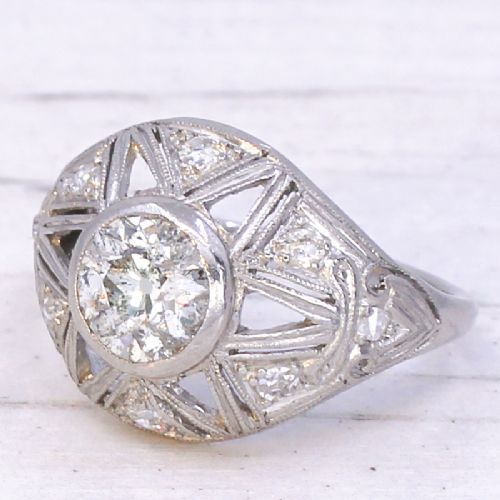


1930s Gold Cocktail Ring
A 1930s gold cocktail ring brings striking geometric presence and bold coloured gemstones to the hand, offering a distinct connection to interwar design.
1930s Gold Cocktail Ring
When you search for a 1930s gold cocktail ring, you encounter pieces dominated by the Art Deco style, frequently executed in 18ct white gold, yellow gold, and platinum. These statement pieces were designed to catch the eye during evening social gatherings, often centring on a substantial main stone.
The versions you are most likely to meet on this page include cluster rings, star clusters, and bold bombé silhouettes. Gemstones such as diamonds, rubies, sapphires, emeralds, aquamarines, and opals dominate the selection, spanning periods from the 1920s through to the 1940s.
Makers of the era utilised symmetrical arrangements and tiered mounts to maximise visual impact. The combination of bright diamonds with intense blue sapphires, red rubies, or yellow sapphires defines the typical visual vocabulary of these rings.
Materials and construction methods
Jewellers of the period combined precious metals like 18ct white gold, yellow gold, and platinum to set their stones securely while providing contrasting tones. Platinum was often chosen for top settings to hold diamonds firmly with minimal metal visibility.
Cut styles reflect the technological shifts of the era, moving from traditional old cut diamonds to transitional cuts. Stones were hand-set into intricate geometric galleries, often featuring millegrain edging along the platinum or gold borders.
Materials recorded across the inventory include platinum, 18ct white gold, 18ct yellow gold, and 9ct gold alongside diverse gemstones.
Distinguishing quality in interwar jewellery
Quality rests upon the calibre and natural origin of the central gemstones, alongside the crispness of the surrounding metalwork. Original settings that retain their sharp geometric lines and unpolished millegrain stand apart from worn examples.
The integration of the stones within the mount dictates the overall harmony of the piece. Superior examples display balanced proportions between the central collector stone and the supporting diamond cluster work.
The 1930s Gold Cocktail Ring Glossary
- Art Deco
- A design style spanning the 1920s and 1930s characterised by geometric symmetry, clean lines, and stylised motifs. It remains the defining aesthetic for interwar cocktail jewellery.
- Bombé
- A rounded, dome-shaped ring mount that projects outward from the finger. This profile creates a voluminous silhouette designed to showcase multiple diamonds and coloured gems.
- Millegrain
- A decorative technique featuring a fine line of tiny raised metal beads along the edges of a setting. It softens the transition between metal and stone while adding texture.
- Old Cut
- A precursor to the modern brilliant cut diamond, featuring a smaller table, higher crown, and larger culet. These cuts produce a distinctive, softer candlelight sparkle.
- Cluster Ring
- A ring design featuring a central prominent gemstone surrounded by a border of smaller stones, typically diamonds. This arrangement maximises the perceived size and brilliance of the jewel.
1930s Gold Cocktail Ring: Frequently Asked Questions
How do I wear a cocktail ring?
These bold statement pieces are traditionally worn on the right hand during evening events. Their size makes them the focal point of any hand, requiring little to no accompaniment from other rings.
To preserve the delicate claw settings and older gemstones, remove the ring during heavy manual tasks or sports. Routine checks by a jeweller ensure the structural integrity remains sound.
Are these rings genuinely from the 1930s?
The pieces listed originate primarily from the 1920s and 1930s, adhering strictly to the Art Deco aesthetic. The materials, cuts, and construction techniques match the manufacturing standards of the interwar period.
Examining the metal hallmarks, stone cuts, and mounting styles helps confirm the period authenticity. Old cut diamonds and hand-finished platinum-topped gold are strong indicators of genuine age.
What is the difference between white gold and platinum?
Platinum is a naturally white, dense, and durable metal that was widely used during the Art Deco period for secure settings. White gold is an alloy of yellow gold mixed with white metals to achieve a similar silvery hue.
Both metals provide a bright backdrop for diamonds, but platinum offers superior strength for delicate fine wirework and claw settings without losing mass over time.
Can I resize an antique cocktail ring?
Most rings in this category can be resized by a skilled jeweller who understands antique mountings. The process depends on the band material and whether the geometric shoulders or side engraving will be disrupted.
Consulting a specialist ensures the structural harmony of the gallery and any side stones remain undisturbed during the adjustment.