
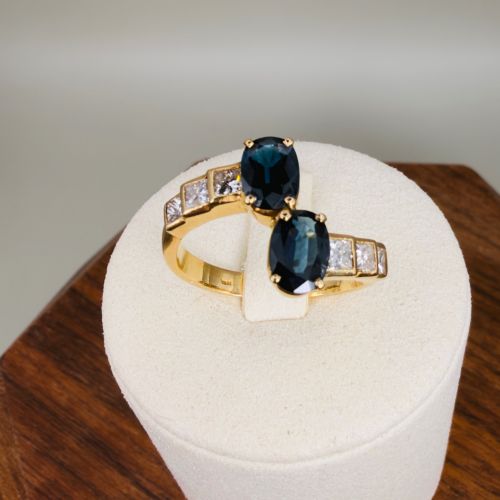


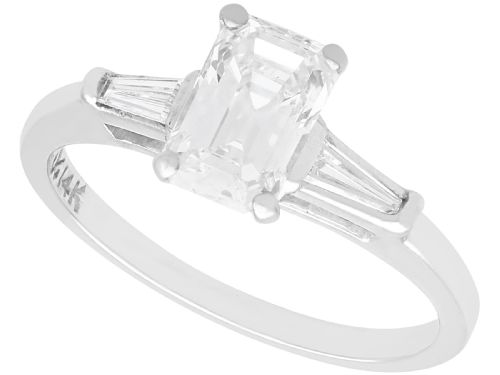


Stepped Art Deco Ring
A stepped art deco ring brings geometric architectural form to the hand, built for those who prize clean lines and period gemstones.
Stepped Art Deco Ring
A stepped art deco ring delivers the unmistakable geometry of the interwar years, pairing tiered mountings with bright diamonds and rich coloured stones. You will most frequently meet pieces from the nineteen twenties and nineteen thirties, structured around platinum or gold settings.
Dress rings and engagement rings dominate the selection, often taking the form of clusters, trilogy settings, or solitaire arrangements. The stepped silhouette relies on descending tiers of metal and stone to draw the eye towards the centre.
Makers utilised contrasting gemstones like emeralds, sapphires, and rubies alongside white metals to emphasise the architectural stepped effect. These jewels bridge the gap between the bold ornamentation of the past and modern minimalism.
How they were made
Platinum and white gold form the durable skeleton for these tiered designs, allowing jewellers to mount complex geometric arrangements securely. Yellow gold also appears in mounting bands, frequently paired with white gold top sections to frame the stones.
Gemstone cutting defines the structural silhouette, employing princess cuts, baguette cuts, emerald cuts, and old European cuts. Master lapidaries shaped these stones to fit precise channel and claw settings that create the signature stepped profiles.
Listings feature periods spanning from nineteen twenty through to nineteen sixty, utilising platinum, yellow gold, white gold, diamond, sapphire, and emerald.
What varies in quality
The precision of the metal tiers separates exceptional examples from ordinary ones, demanding exact symmetry and crisp right angles in the mounting. Superior work maintains structural integrity across multiple levels without excess metal obscuring the stones.
Stone selection dictates the upper tier of the market, where natural Colombian emeralds or bright sapphires accompany well-matched diamonds. The clarity and colour saturation of these secondary stones determine the overall visual harmony of the ring.
The Stepped Art Deco Ring Glossary
- Baguette cut
- A rectangular step-cut gemstone with straight parallel facets, commonly used as side stones in geometric mounts.
- Cluster ring
- A ring featuring a central stone surrounded by a border of smaller gems, creating a larger visual footprint on the finger.
- Old cut
- A vintage diamond cutting style characterised by a smaller table, higher crown, and deep pavilion that produces broad, warm light reflection in candlelight.
- Trilogy ring
- A three-stone ring traditionally symbolising the past, present, and future, often arranged with a larger centre gem flanked by two smaller stones.
- Platinum
- A dense, strong, and naturally white precious metal favoured in twentieth-century jewellery for secure, fine-line settings.
Stepped Art Deco Ring: Frequently Asked Questions
How do I spot a true period ring?
Examine the construction methods and metal patination under magnification to check for period hand-working techniques rather than modern casting. Genuine pieces from the nineteen twenties and thirties exhibit wear consistent with age and specific claw configurations.
Compare the gemstone cuts with known historical standards, as older stones often possess deeper pavilions and hand-cut facets that differ from contemporary laser precision.
Are these rings suitable for daily wear?
Platinum and gold settings from this era offer robust durability, though the delicate stepped edges require sensible care during heavy manual tasks. Regular checks by a jeweller ensure the claw settings remain secure around the diamonds and coloured stones.
Consider removing the ring when swimming or gardening to protect softer gems like emeralds from accidental impacts and abrasive surfaces.
What is the difference between old cut and modern cut diamonds?
Old cut diamonds feature asymmetrical hand-polished facets designed to catch candlelight, resulting in a softer, chunkier sparkle. Modern cuts utilise computer-calculated geometry to maximise direct brilliance under artificial lighting.
This distinct facet arrangement gives vintage rings a character entirely separate from contemporary jewellery.
How should I clean my platinum ring?
Wash the piece gently using warm water, mild washing-up liquid, and a soft-bristled toothbrush to remove accumulated daily oils from beneath the settings. Avoid harsh chemical dips, particularly if the ring contains emeralds that have undergone traditional oil treatments.
Dry the mounting thoroughly with a lint-free cloth to maintain the polished finish of the platinum or gold.