


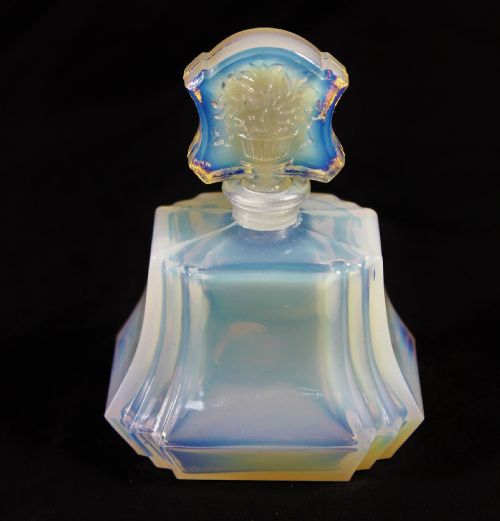


1930s French Scent Bottle
These 1930s French scent bottle designs capture the geometric spirit of Art Deco, offering tactile charm for the dressing table.
1930s French Scent Bottle
When you search for a 1930s French scent bottle, you encounter refined dressing table vessels created during the height of the Art Deco movement. These examples reflect the French penchant for blending everyday utility with modernist elegance.
The versions you are most likely to meet on this page take the form of opalescent glass perfume bottles and atomisers. Makers from this period focused on sculptural silhouettes that catch the light from multiple angles.
How they were made
Glassmakers utilised pressing techniques to achieve heavy, tactile forms featuring distinct patterns and dimensional depth. This method allowed workshops to produce sophisticated motifs in high volume while retaining sharp sculptural details.
Makers incorporated specialist materials such as chrome, crystal, and early plastics like Bakelite for mounts, stoppers, and hardware. Paper labels occasionally survived on the base, recording original retail details.
A dusting of French face powder from the 1930s occasionally leaves a scented trace inside recovered atomiser bottles.
What varies in quality
The clarity and opalescence of the glass distinguish finer examples from standard production pieces. Superior items display a distinct milky blue or fire glow when turned in the light.
Signatures etched into the glass indicate higher workshop standards and direct attribution to prominent designers. Crisp moulding along the seams also denotes superior execution.
Rene Lalique·Sabino
The 1930s French Scent Bottle Glossary
- Opalescent Glass
- Glass that diffuses light to display a milky, translucent quality with characteristic blue or amber highlights. This effect was highly prized by French makers of the period.
- Atomiser
- A spray mechanism fitted to a perfume bottle for misting fragrance. These metal and rubber fittings often incorporate chrome components.
- Bakelite
- An early form of synthetic phenol formaldehyde resin used for bottle caps and bases. It brings a dense, dark contrast to clear or opalescent glass bodies.
- Art Deco
- The dominant design style of the 1930s characterised by stylised motifs and geometric symmetry. This aesthetic defined the silhouette of French dressing table wares.
1930s French Scent Bottle: Frequently Asked Questions
What materials are typical for these bottles?
These vessels are predominantly formed from pressed glass, crystal, and opalescent glass. Metal mounts in chrome and synthetic elements like Bakelite frequently complete the design.
Paper details also appear on surviving examples, marking original maker distribution.
How do I identify a 1930s French scent bottle?
Look for the characteristic geometric lines and opalescent finishes associated with the Art Deco period. Many pieces bear signatures or mould marks attributed to French makers.
The combination of heavy pressed glass and functional atomiser hardware points directly to this era.
Were these bottles used for display?
These pieces served as functional dressing table accessories designed to hold personal fragrance. Their sculptural forms meant they remained on display when not in active use.
Many retain working spray mechanisms or matching glass stoppers intended for daily service.
How should I display opalescent glass?
Place these vessels near a light source to activate the milky, glowing quality of the opalescent glass. Side lighting highlights the moulded details and depth of the material.
Keep them away from direct heat to protect any original paper elements or vintage fittings.