
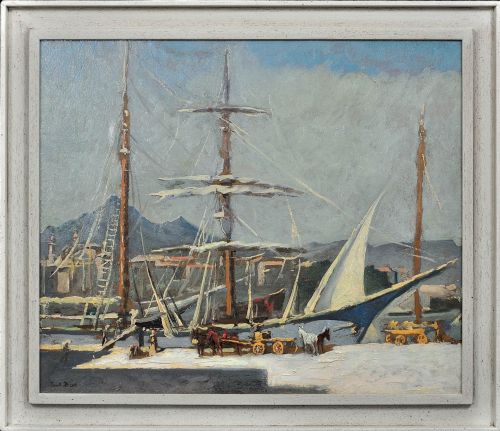


1930s French Impressionist Painting
A 1930s French impressionist painting captures the bright light and lively brushwork of the Mediterranean and northern coasts, bringing historic colour into a room.
1930s French Impressionist Painting
When searching for a 1930s french impressionist painting, you encounter works created during a vibrant era of twentieth-century art. These pieces frequently record scenes of daily life, harbours, and sunlit landscapes across France.
The most common examples on this page are oil paintings executed on canvas or board, often retained within their original wood frames. Subjects range from quiet rural farmhouses and coastal views to lively floral still lifes.
How they were made
Artists built these compositions primarily using oil paint applied to stretched canvas, wooden panels, or board supports. Thick impasto techniques appear alongside fluid brushwork to build texture and describe shifting natural light.
Finished works found housing in bespoke wood frames, sometimes accented with gilt details that complemented the rich palettes of post-impressionism and fauvism.
The listings on this site feature oil paint on both canvas and board, framed in wood.
What varies in quality
The distinction between ordinary and exceptional works rests upon the confidence of the brushwork and the handling of light. Stronger pieces demonstrate a deliberate command of colour that gives depth to atmospheric scenes.
Preservation of the original paint surface and the integrity of the period wood frame also influence the character of each work, reflecting how carefully the piece has been kept over decades.
Paul Bret·Edouard Julien·Elisabeth Bardon·Henri Vincent-Anglade·Gustave Vidal·Claude Jousset
The 1930s French Impressionist Painting Glossary
- Impasto
- Paint applied thickly to a canvas or board, standing out in relief from the surface. This technique emphasises the physical gesture of the brush.
- Post-Impressionism
- An artistic movement extending impressionist methods while rejecting its limitations, often employing vivid colours and expressive forms. Many works from this period embrace these bolder stylistic choices.
- Gilt
- A thin layer of gold leaf applied to wood frames. It provides a reflective border that highlights the tones within the painting.
- Board
- A rigid wooden or fibrous panel used as a painting support instead of woven fabric. Artists frequently utilised this material for smaller plein air studies.
1930s French Impressionist Painting: Frequently Asked Questions
What subjects do these paintings show?
These works typically depict French landscapes, coastal harbours, marine views, and intimate domestic interiors. Artists captured scenes ranging from bustling southern ports to quiet rural farmhouses.
Floral still lifes and figurative studies also appear frequently among the available works.
Are the frames original to the paintings?
Many pieces are paired with their period wood frames, which often feature gilt details characteristic of the era. These surrounds complement the painting style and help anchor the artwork to its decade of creation.
Inspect individual listings to confirm whether a frame dates from the same period as the canvas.
How do I care for an oil painting on canvas?
Keep the artwork away from direct sunlight and fluctuating humidity to protect both the canvas and the oil pigments. Dust the surface gently with a soft, dry cloth without applying pressure.
Avoid using water or liquid cleaners on the paint layer or the antique frame.
What is the difference between canvas and board supports?
Canvas is a flexible woven fabric stretched over a wooden frame, allowing for larger compositions and responsive brushwork. Board provides a rigid, flat surface that artists often preferred for smaller, portable studies.
Both materials support oil paint effectively and appear across various regional French scenes.