


18th Century Style Games Table
An 18th century style games table brings functional period craft into a modern interior with folding tops and fitted surfaces for play.
18th Century Style Games Table
An 18th century style games table encompasses fold-over card tables, tea tables and occasional tables built across Georgian, Victorian and twentieth century revival periods. These pieces serve primarily as console or side tables until opened to reveal baize-lined playing surfaces and candle corners.
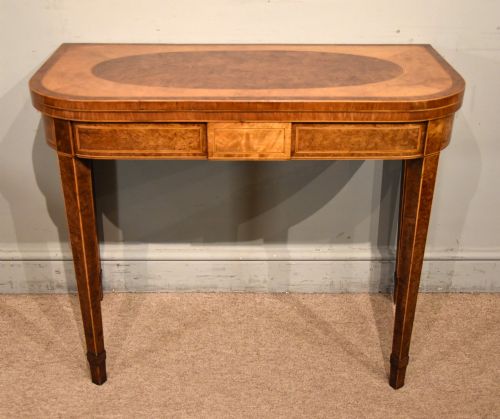
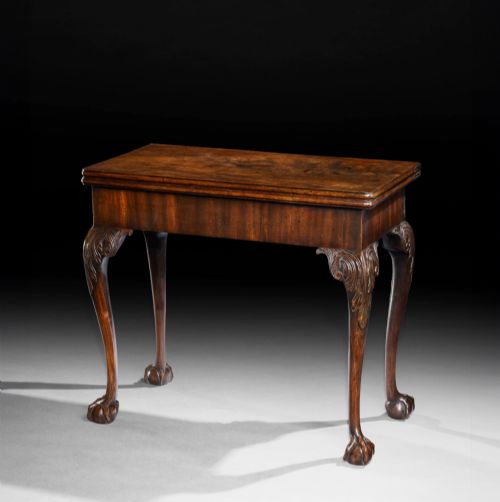
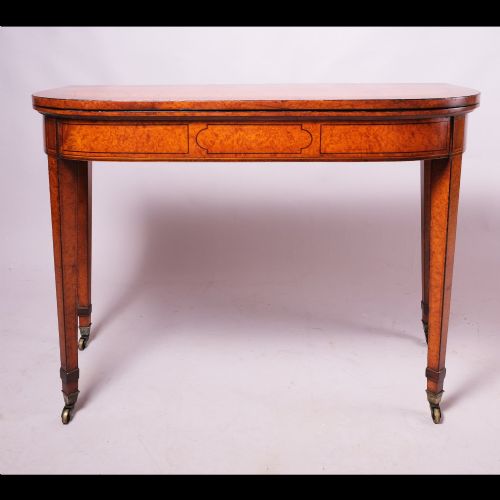
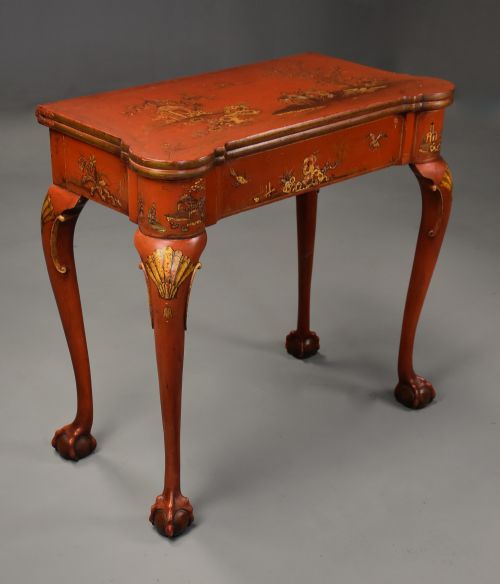
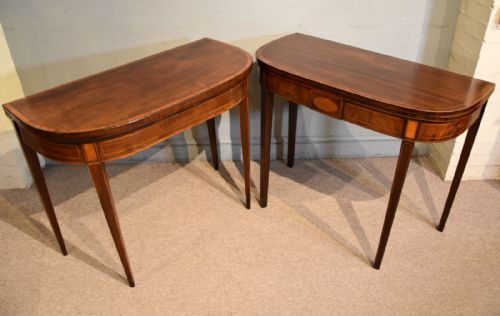
The selections appearing on this page range from solid walnut George II forms to inlaid satinwood and mahogany pieces following Hepplewhite and Sheraton designs. Twentieth century interpretations also emerge alongside original eighteenth century items, spanning red lacquered Chinoiserie and burr walnut constructions.
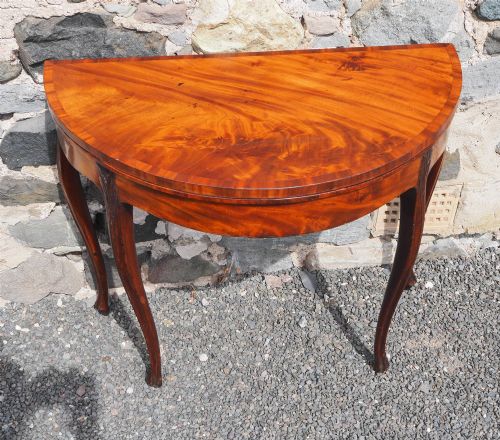
Buyers encounter demilune, serpentine and rectangular formats designed to sit against a wall when closed. The dual purpose of these surfaces made them essential household fixtures for entertaining across multiple historical eras.
Materials and construction
Cabinetmakers utilised dense hardwoods such as mahogany and walnut for structural stability, often applying veneers of burr walnut, satinwood, amboyna or burr yew wood across the folding tops. Boxwood and ebony stringing frequently define the borders of inlaid geometric or marquetry panels.
Concertina actions, swing legs and gateleg frames support the heavy fold-over leaves when extended for play. Secondary timbers provide the internal framing for folding mechanisms and secret compartments.
Listings feature mahogany, satinwood, walnut and rosewood alongside specialised veneers like amboyna and burr yew wood.
Distinctions in quality
Quality depends on the crispness of carved details on the legs and aprons, alongside the selection of veneer figures on the top surfaces. Grain continuity across folded leaves distinguishes superior cabinetwork from simpler constructions.
The engineering of the concertina frame or swing leg mechanism dictates how smoothly the table transforms from a console to a playing surface. Superior examples maintain structural alignment and tight joints through centuries of use.
Giles Grendey
The 18th Century Style Games Table Glossary
- Demilune
- A half-moon shape popular for console and card tables designed to stand flat against a wall.
- Concertina action
- An expanding frame mechanism that allows all four legs of a card table to move outward when the top opens, providing symmetrical support.
- Marquetry
- Decorative veneer work created by fitting together pieces of various coloured woods to form pictorial or geometric designs.
- Baize
- A coarse woolen material used to line the playing surface of card tables.
- Serpentine
- A curved line featuring a convex centre flanked by concave sides, common on Georgian table aprons.
18th Century Style Games Table: Frequently Asked Questions
How do I open an antique games table?
Most pieces utilise a fold-over top supported by a swing leg or a concertina frame that pulls outward.
Care must be taken to lift the top cleanly past its hinge pivot before rotating or extending the supporting leg.
Were these tables used only for cards?
While designed primarily for card games like whist or ombre, many featured plain timber interiors or dual-purpose baize surfaces suitable for general writing and tea.
Tea tables often doubled as occasional surfaces when not holding porcelain sets.
How do I distinguish an 18th century original from a revival piece?
Examination of timber shrinkage, secondary woods inside the frame and hand-cut joinery helps determine the period.
Twentieth century revival items often display different machine-tool markings and standardised internal hardware compared to Georgian originals.
Where should I place a games table in a room?
These pieces function best placed flat against a hallway or living room wall in their closed console configuration.
Opening them requires clearance space around all sides for seating during use.