


18th Century French Bureau
An 18th century french bureau is a writing cabinet with a sloping lid, offering hidden compartments and fitted drawers that suit a traditional study.
18th Century French Bureau
An 18th century french bureau encompasses writing desks, cylinder bureaux, and writing tables styled in Louis XV and Louis XVI designs. These pieces function as personal writing desks with fitted interiors and concealed compartments.
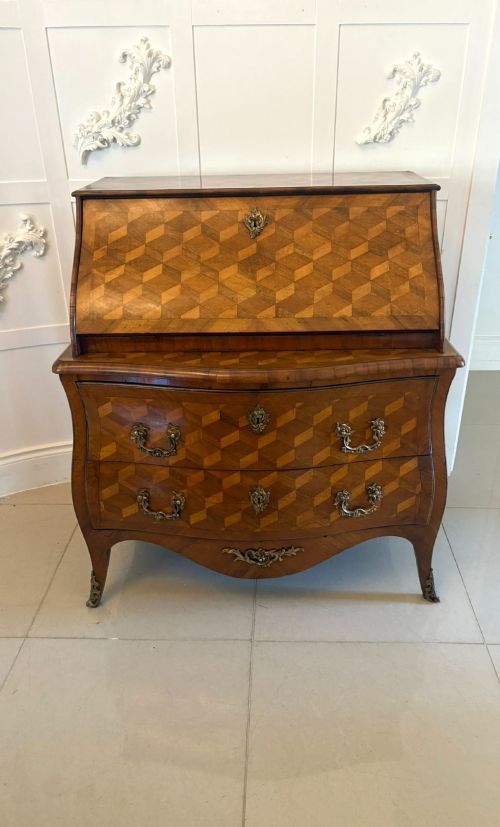
The version most commonly met on this page is the walnut or kingwood bureau featuring bombe shaping or parquetry inlay. Walnut and kingwood examples appear frequently alongside oak and tulipwood variants.
Originating primarily from French workshops, these pieces also reflect Dutch Baroque influences and later revival periods from the nineteenth and twentieth centuries. The selection ranges from petite secretaire en pente forms to larger bureau bookcases.
Materials and Construction
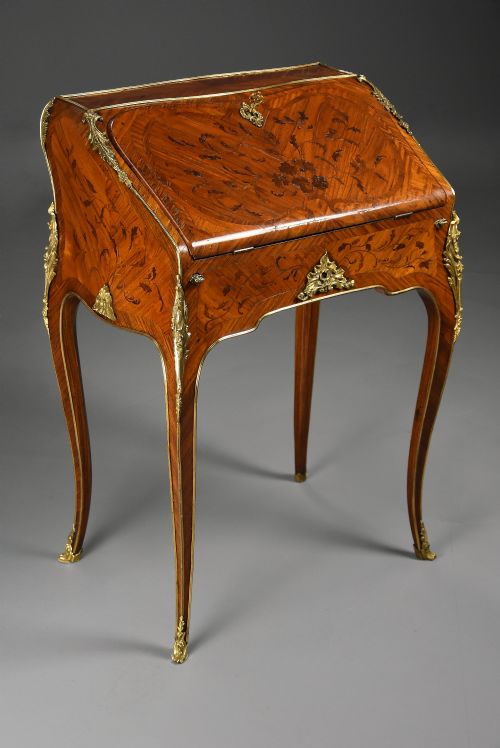
Cabinet makers built these bureaux using solid hardwoods such as walnut and oak as a structural carcase, overlaid with decorative veneers like kingwood, rosewood, and tulipwood. Parquetry and marquetry patterns were meticulously cut and fitted across the sloping lids and drawer fronts.
Metal mounts in brass, ormolu, and gilt bronze provide structural reinforcement and decorative framing for corners, handles, and key escutcheons. Selected pieces also incorporate porcelain plaques from Sevres mounted directly into the woodwork.
Several bureaux hide tiny secret compartments originally designed for love letters and smuggled chocolate.
Evaluating Craftsmanship
The distinction between average and exceptional pieces lies in the precision of the veneer work and the crispness of the bronze or ormolu mounts. Finer examples display continuous, balanced grain patterns across the parquetry without mismatched sections.
Interior configuration dictates a higher grade of craftsmanship, where small drawers, secret compartments, and fitted ledges exhibit the same attention to detail as the exterior facade. The integration of original metalwork and authentic fixings elevates the integrity of the piece.
BVRB
The 18th Century French Bureau Glossary
- Bombe
- A swelling, outward-curving contour found on the front and sides of furniture chests and bureaux. This bulbous shape requires advanced woodworking skill to veneer accurately.
- Parquetry
- A geometric mosaic of wood pieces used for decorative veneering on furniture surfaces. The small wooden tiles form patterns like cubes, chequers, or basket weaves.
- Ormolu
- Gilded bronze used for decorative mounts and feet on high-end furniture. The technique involves applying a gold amalgam to bronze before firing.
- Secretaire en pente
- A small sloping-front desk designed for writing. This French form conceals internal letter slots and drawers beneath the angled lid.
- Bureau plat
- A flat-topped writing table with drawers in the frieze, unencumbered by a superstructure. These tables stand free in a room with finished backs.
18th Century French Bureau: Frequently Asked Questions
What is an 18th century french bureau?
An 18th century french bureau is a dedicated writing desk featuring a sloping lid that opens to reveal internal compartments and small drawers.
Cabinet makers constructed these pieces primarily in walnut, kingwood, and oak, often embellishing the surfaces with parquetry and ormolu mounts.
How were these desks used originally?
These desks served as private writing cabinets for correspondence, keeping financial records, and storing important documents in secure compartments.
The sloping lid doubled as a firm writing surface when closed or opened during daily administrative tasks.
How do I live with a bureau?
Placing a bureau in a study or living room provides both a functional writing space and concealed storage for modern stationery or laptops.
Keep the wood conditioned and away from direct heat sources to protect the delicate veneers and antique polish.
How do I tell periods apart?
Distinguishing between periods involves examining the decorative motifs, such as the asymmetric curves of Louis XV design compared to the straighter, neoclassical lines of Louis XVI.
Later nineteenth-century revival pieces often display different construction techniques and secondary woods beneath the surface veneers.