
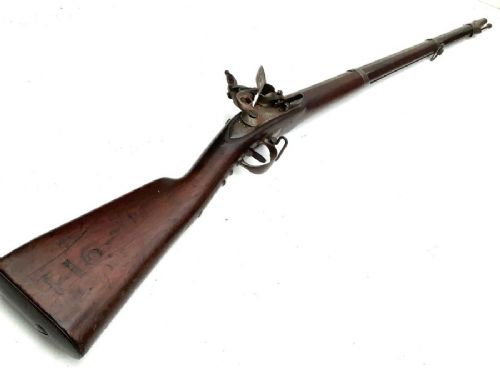


18th Century Flintlock Musket
An 18th century flintlock musket is a historic shoulder arm driven by flint and steel, sought after by collectors for its role in global warfare and frontier history.
18th Century Flintlock Musket
An 18th century flintlock musket represents the standard military and civilian long gun of the Georgian and Napoleonic eras. Buyers searching for an 18th century flintlock musket will encounter examples spanning European military arsenals, colonial conflicts, and regional Ottoman or Indo-Persian variations.
The inventory on this page ranges from British Brown Bess arms and French Charleville models to Balkan frontier carbines and North African toe-lock long guns. These pieces encompass military service weapons alongside decorated regional arms featuring distinct regional mechanisms.
Most pieces date from the mid-18th century through the Napoleonic period, showing the evolution of smoothbore infantry arms and specialised cavalry musketoons. Each type reflects the technological and tactical requirements of its specific theatre of conflict.
How they were made
Gunmakers built these arms using forged iron and steel for barrels and lock mechanisms, paired with stocks shaped from dense hardwoods like walnut. Metal components were shaped by hand at the forge, while lock plates, cocks, and frizzens underwent careful hardening to produce a reliable spark.
Stocks were carved to house the barrel and mechanism, often secured with brass or iron furniture including trigger guards, butt plates, and ramrod pipes. Finer arms incorporate decorative brass, bone, or mother-of-pearl inlay into the woodwork to denote status or regional aesthetic preference.
Some frontier muskets feature hidden compartments in the buttstock meant for storing extra flints and tallow.
What varies in quality
The standard of an 18th century flintlock musket depends on the crispness of the lock action and the original integrity of its components. Strong springs and clean mechanics distinguish arms intended for rigorous military service from more decorative regional pieces.
Craftsmanship in the stock carving and metal chasing separates standard ordnance from elite officer or presentation pieces. Preservation of original surface finishes and legible markings on lock plates also influence the standing of an arm.
The 18th Century Flintlock Musket Glossary
- Flintlock
- Ignition mechanism utilising a piece of flint held in a cock to strike a steel frizzen, creating sparks to ignite the priming powder. This system dominated firearms technology for over two centuries.
- Smoothbore
- Barrel lacking internal rifling, designed to fire lead balls or shot over moderate distances. Most military muskets of this era utilised smoothbores for rapid reloading in formation.
- Miquelet
- Distinctive flintlock mechanism common in Spain, Italy, and the Ottoman world, featuring an external mainspring and combined steel and frizzen. It offered robust reliability in frontier environments.
- Blunderbuss
- Short firearm with a flared muzzle designed to scatter shot at close range. These arms saw use by coach guards and naval boarding parties.
- Musketoon
- Shorter, lighter version of the musket intended for cavalry or artillery use. Its reduced length made it easier to handle from horseback or in confined spaces.
18th Century Flintlock Musket: Frequently Asked Questions
How do I clean an 18th century flintlock musket?
Maintenance requires gentle removal of surface dust and application of appropriate museum-grade conservator wax to metal and wood surfaces.
Avoid aggressive scrubbing of historic finishes or internal lock components to preserve the original patina and structural integrity.
Can I still shoot an 18th century flintlock musket?
Firing antique firearms from this era is generally discouraged due to degraded metal fatigue and structural ageing.
Most collectors treat these pieces as historical artefacts rather than operational weapons for the modern range.
What is the difference between a musket and a rifle?
Muskets feature smooth bores intended for rapid reloading and mass volley fire by infantry units.
Rifles incorporate spiral grooves inside the barrel to spin the projectile for improved accuracy over distance.
How can I tell British and French muskets apart?
British arms typically feature distinct crown inspection marks and brass furniture, best exemplified by the Brown Bess.
French military pieces, such as the Charleville, display lighter iron furniture and specific arsenal stamps on the lock plate.