




Dark Wood Flintlock Gun
A dark wood flintlock gun brings tangible history to your wall or collection, uniting period mechanics with rich timber stocks.
Dark Wood Flintlock Gun
When you search for a dark wood flintlock gun, you encounter arms spanning the eighteenth and nineteenth centuries, taking the form of muskets, rifles, blunderbusses, and holster pistols. These pieces originate from various global traditions, ranging from English military production to Afghan tribal craftsmanship and Ottoman workshops.
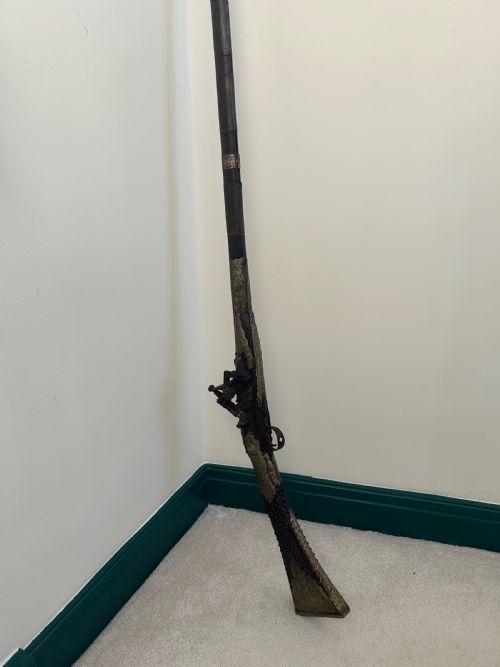
The most common examples you meet on this page include long arms like the Afghan jezail rifle alongside European military muskets and pistols. Stocks are shaped from sturdy timbers, frequently accented with functional brass or iron mounts and decorative inlays.
These items function historically as defensive, military, or tribal arms, and today they serve as striking wall art and collector pieces. Their forms reflect the specific tactical and cultural demands of the Georgian period, the Napoleonic era, and broader eighteenth and nineteenth century manufacturing.
How they were made
Makers shaped stocks from dense timber varieties including walnut and general dark wood, providing a robust foundation for the metal lock mechanisms. These wooden chassis were often carved and channelled to house barrels securely.
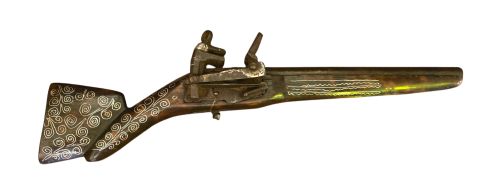
Mechanisms rely on forged steel and iron for locks, triggers, and barrels, combined with brass furniture for structural plates and ramrod pipes. Many pieces feature ornamental additions such as bone, mother-of-pearl, and silver inlay set directly into the timber stocks.
Some nineteenth-century Afghan long pieces utilised repurposed flintlock mechanisms combined with distinctively curved wooden stocks designed for mounted tribesmen.
What varies in quality
The standard of a dark wood flintlock gun depends heavily on the crispness of the lock mechanism and the integrity of the stock. Finer examples display precise metalwork alongside deliberate, clean woodcarving rather than crude assembly.
Detailing differentiates standard martial arms from high-status presentation pieces. The presence of intricate bone, silver, or mother-of-pearl inlay elevates a piece beyond basic service issue, reflecting the skill of the original workshop.
Sargant and Son
The Dark Wood Flintlock Gun Glossary
- Flintlock
- An ignition mechanism utilising a flint held in a cock to strike a steel frizzen, creating sparks to ignite the priming powder. This system dominated firearm design through the eighteenth and early nineteenth centuries.
- Jezail
- A type of long-barrelled firearm common in the nineteenth-century Afghan regions, typically featuring a distinctive curved stock. These arms were widely used for both tribal warfare and hunting.
- Blunderbuss
- A muzzle-loading firearm with a flared barrel designed to scatter shot at close range. It saw significant use during the eighteenth century by coach guards and military units.
- Miquelet
- A form of snaplock firearm mechanism originating in Spain and spreading across the Mediterranean and Ottoman territories. It uses an external mainspring and a combined steel and frizzen.
- Frizzen
- The vertical steel plate struck by the flint to produce sparks in a flintlock mechanism. The grooved design guides sparks directly down into the priming pan.
Dark Wood Flintlock Gun: Frequently Asked Questions
What periods do these guns cover?
The pieces span the eighteenth and nineteenth centuries, including specific contexts such as the Georgian period and the Napoleonic era. Manufacturing styles range from late eighteenth-century European workshops to nineteenth-century Afghan tribal production.
Dates are determined by the stylistic traits of the lock mechanisms, barrel shapes, and overall stock architecture characteristic of those decades.
How were these firearms used?
These arms served military, naval, and tribal roles for defence, warfare, and hunting. Service pistols equipped armed forces, while long muskets and jezails fulfilled infantry and irregular combat requirements.
Today, these objects function primarily as historical artefacts and wall art for collectors of militaria and antique arms.
What materials make up the stocks?
Stocks are constructed from durable timbers, notably walnut and general dark wood, selected for their strength under recoil. These wooden foundations absorb the stresses of the firing mechanism.
Many stocks feature decorative enhancements, incorporating bone, mother-of-pearl, and silver inlay set into the timber surface.
How do I identify regional styles?
Regional origins reveal themselves through distinct stock shapes, metal furniture, and decorative techniques. For example, Afghan pieces often show elongated curved stocks with bone or metal inlay, while English military arms display standardised brass furniture and inspector marks.
Ottoman and Indo-Persian variations introduce specific lock types like the miquelet alongside elaborate surface ornamentation.