
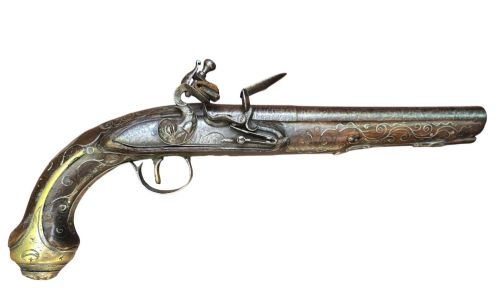


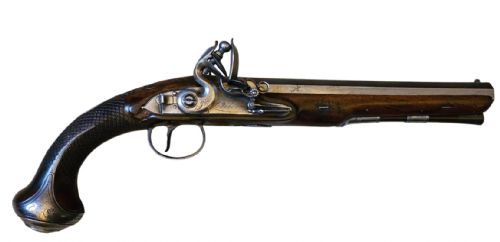


Dark Walnut Flintlock Gun
These dark walnut flintlock gun examples span the eighteenth and nineteenth centuries, offering collectors authentic tactile connections to military history and duelling culture.
Dark Walnut Flintlock Gun
A dark walnut flintlock gun represents the historical evolution of personal and military firearms from the eighteenth century into the nineteenth century. Buyers searching for a dark walnut flintlock gun encounter martial muskets, heavy blunderbusses, and holster or duelling pistols originating from English, French, Italian, and Belgian workshops.
The selection here ranges from Georgian military muskets like the Brown Bess to refined officers' pistols and continental cavalry pieces. Most items date from the seventeen-fifties through to the Napoleonic period, with occasional nineteenth-century percussion conversions and arms.
These antique firearms reflect the utilitarian demands of warfare alongside the precise craftsmanship required for civilian protection and duelling. Each piece displays the distinct characteristics of its era, whether built for colonial campaigns, continental cavalry service, or domestic defence.
How they were made
Makers constructed stocks using dense dark walnut, chosen for its structural stability and rich grain when oiled and handled over decades of service. Gunsmiths shaped the wood to accommodate the lock mechanisms and barrel tangs with snug precision.
Metal components relied on forged steel and iron for barrels, trigger guards, and lock plates, complemented by cast brass furniture on many holster pistols and muskets. Craftsmen engraved plates and cast mounts to reinforce stress points while adding understated visual decoration.
Current listings demonstrate a geographical spread ranging from English military muskets to Italian Brescia-type holster pistols and Belgian sea service arms.
What varies in quality
Quality in these firearms rests upon the crispness of the lock mechanism's internal parts and the original integrity of the dark walnut stock. Superior examples retain clear maker signatures, legible proof marks, and minimal timber replacement or restoration.
The refinement of brass furniture casting and the depth of steel engraving distinguish standard military ordnance from bespoke officers' duelling arms. Preserved surface finishes and untouched wood patination elevate pieces above those suffering from excessive cleaning or structural degradation.
Sargant & Son·Barber of Newark
The Dark Walnut Flintlock Gun Glossary
- Flintlock
- An ignition mechanism that uses a piece of flint held in a cock to strike a steel frizzen, creating sparks to ignite the priming powder. This system dominated military and civilian firearms from the seventeenth well into the nineteenth century.
- Musket
- A muzzle-loading shoulder gun designed for infantry use during the eighteenth and nineteenth centuries. These long arms formed the backbone of military firepower before the general adoption of rifled barrels.
- Blunderbuss
- A muzzle-loading firearm featuring a flared muzzle designed to scatter lead shot effectively at close range. These weapons saw frequent use by coach guards and naval boarding parties.
- Holster pistol
- A large handgun carried in a saddle holster by cavalrymen and officers during campaigns. Their substantial size provided greater stopping power than pocket-sized alternatives.
- Brown Bess
- The common nickname for the standard-pattern British muzzle-loading smoothbore flintlock musket used by the land forces for over a century. It remains one of the most recognizable military arms of the Georgian epoch.
Dark Walnut Flintlock Gun: Frequently Asked Questions
What is a dark walnut flintlock gun?
A dark walnut flintlock gun is an antique firearm utilising a flint ignition mechanism set into a wooden stock of dark walnut timber. These pieces include military muskets, cavalry carbines, and civilian pistols produced across Europe during the eighteenth and nineteenth centuries.
Collectors prize them for their historical association with conflicts such as the Napoleonic Wars and the American Revolutionary era. They demonstrate the transition from early hand cannons to standardised military weaponry.
How were flintlock pistols used?
Flintlock pistols served primarily as secondary self-defence weapons for officers, travellers, and cavalrymen who required portable firepower at close quarters. They were also the weapon of choice for formal duels regulated by strict codes of honour.
Users loaded them by pouring measured gunpowder down the barrel, followed by a lead ball and wadding pushed home with a ramrod. Priming powder was placed in the pan before closing the frizzen ready for firing.
How should I care for a flintlock gun?
Caring for a flintlock gun requires maintaining a stable indoor environment away from excessive humidity and direct heat sources to protect the dark walnut stock and steel metalwork. Light applications of appropriate museum wax or conservation oil help stabilize the timber and prevent active corrosion on iron parts.
Handling should be minimised, and pieces ought to be supported properly if displayed on stands. Regular gentle dusting preserves the historic surface patination without removing traces of age.