






Antique Militaria Firearms
These antique militaria firearms comprise pistols, muskets and powder flasks forged for combat and defence across the eighteenth and nineteenth centuries.
Antique Militaria Firearms
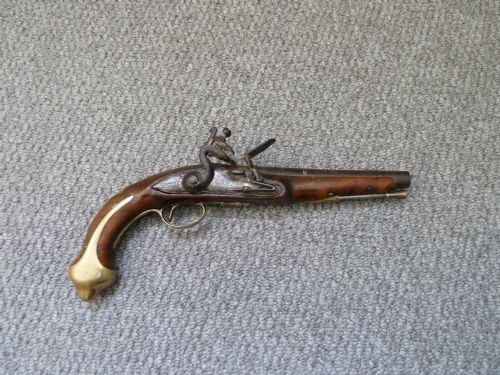
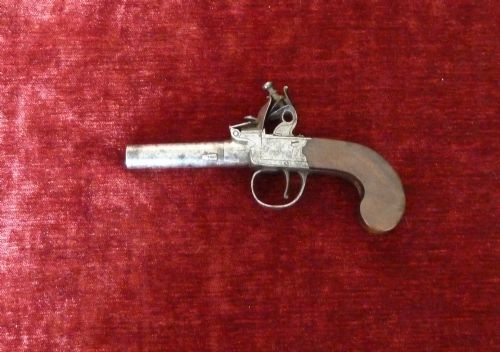
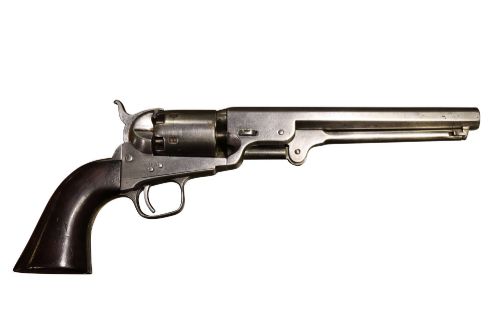
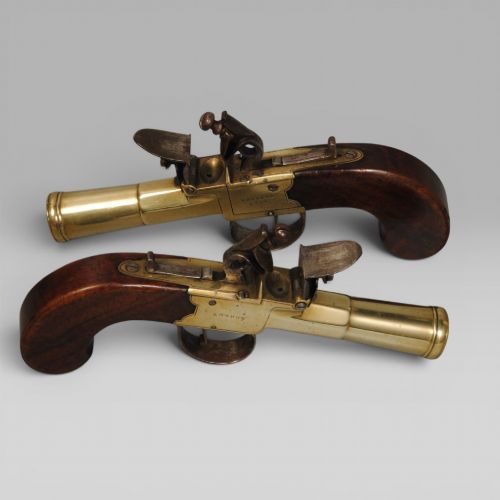
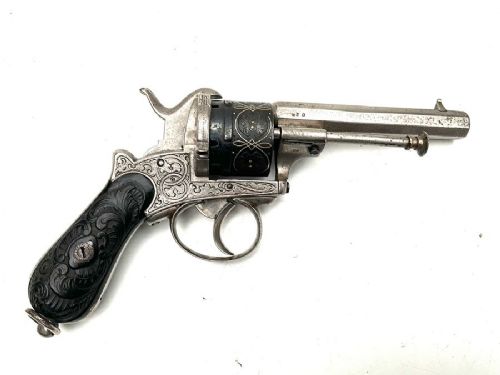
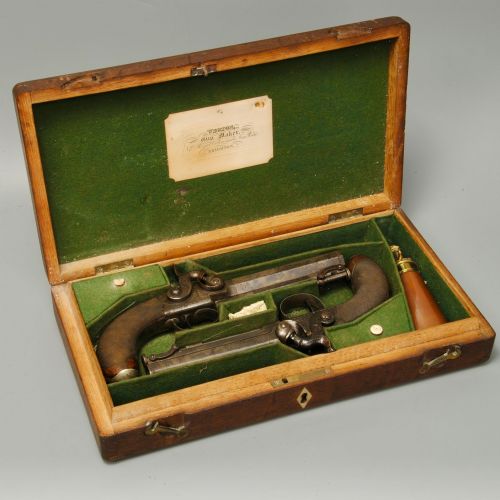
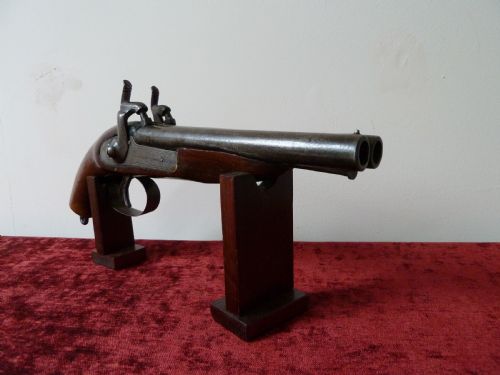
When searching for antique militaria firearms, you encounter military and civilian pieces spanning the eighteenth and nineteenth centuries. The selection encompasses flintlock and percussion pistols, blunderbusses, muskets and powder flasks.
You meet examples originating from British, American, French, Balkan and Ottoman workshops. These range from pocket and greatcoat pistols to heavy cavalry arms and service muskets.
How they were made
Makers shaped barrels and mechanisms from steel and iron, pairing them with stocks carved from dense walnut, oak and standard wood. Brass and iron appeared on mounts, trigger guards and barrel bands.
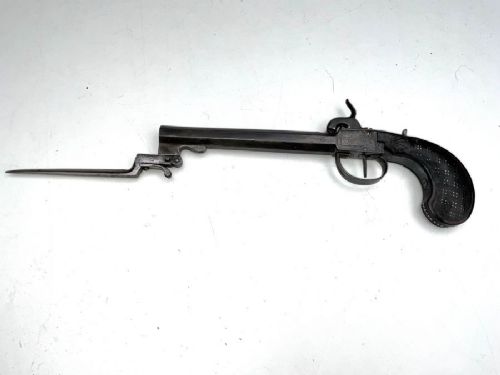
Interiors and exteriors relied on mechanical ingenuity, incorporating flintlock, snaphaunce, miquelet and percussion ignition systems alongside folding bayonets and adjustable powder flask charges.
Some pocket pistols concealed spring-loaded bayonets that snapped forward at the touch of a catch.
What varies in quality
The standard of execution depends on the precision of the lock mechanism and the crispness of metal engraving or brass casting. Master gunmakers signed their work, elevating the status of the piece through refined proportions.
Survival of original matching serial numbers and auxiliary accessories such as fitted boxes or matched pairs dictates the desirability of the firearm. The integration of mechanical improvements like flick bayonets marks superior workshops.
Colt·Mortimer·I Parr·John Rimes·Barber of Newark·Dutton·Wilson
The Antique Militaria Firearms Glossary
- Flintlock
- An ignition mechanism utilising a piece of flint struck against a steel frizzen to create sparks that ignite the gunpowder charge. This system dominated military and civilian arms for centuries.
- Percussion cap
- A small metal cup containing fulminate of mercury placed on a nipple, detonated by the hammer fall to ignite the main charge. It replaced flintlock systems during the nineteenth century.
- Blunderbuss
- A muzzle-loading firearm with a flared barrel designed to scatter lead shot at close range. These weapons saw extensive use by coach guards and naval officers.
- Snaphaunce
- An early flintlock mechanism featuring a separate pan cover and steel, representing an important transitional stage in firearm development.
- Turn-off pistol
- A firearm where the barrel unscrews from the breech to facilitate loading from the front with a tight-fitting ball.
Antique Militaria Firearms: Frequently Asked Questions
How do I identify a flintlock firearm?
Look for an external hammer holding a piece of flint that strikes a curved steel plate called a frizzen. This action opens the priming pan and generates sparks to ignite the powder.
This system preceded percussion ignition and defines pieces originating primarily in the eighteenth and early nineteenth centuries.
What is the difference between a flintlock and percussion pistol?
Flintlocks rely on flint striking steel to create sparks for ignition, whereas percussion pistols use a hammer striking a small cap placed on a nipple.
Percussion mechanisms emerged later in the nineteenth century, offering greater reliability in wet weather compared to earlier flint systems.
Were blunderbusses used by the military?
Blunderbusses served primarily in civilian defence, coach travel and naval engagements rather than standard infantry warfare. Their flared barrels facilitated rapid loading of multiple projectiles at close quarters.
Examples appear across the eighteenth and nineteenth centuries with brass or iron barrels.
How should I clean my antique firearm?
Preserve the historical surface by avoiding abrasive polishes on metal and wood components. Apply light conservation oil to steel parts to prevent active oxidation.
Keep wooden stocks treated with appropriate museum-grade wax to maintain the grain and prevent drying.