
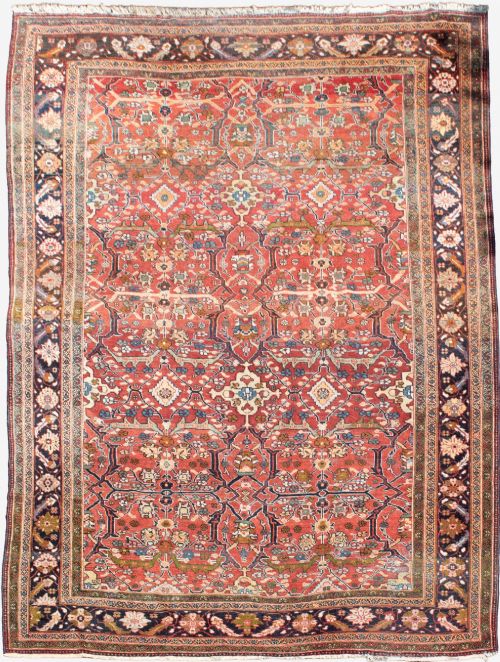


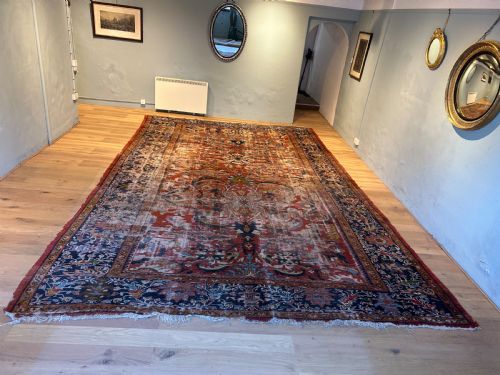


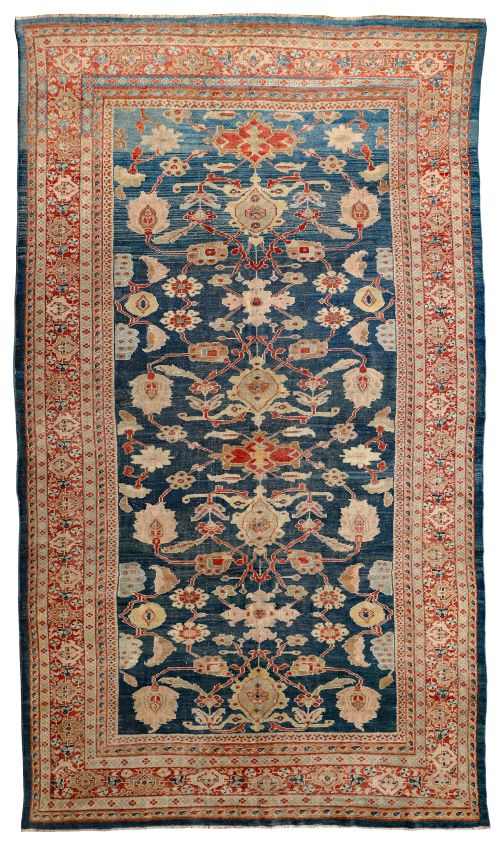


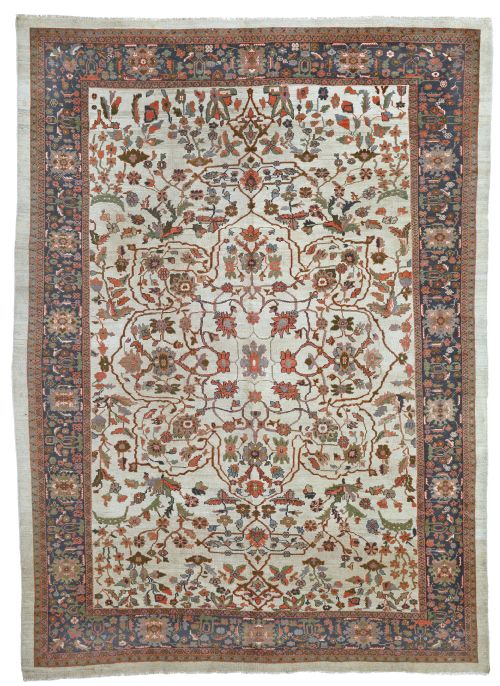

Ziegler Mahal Rug
A ziegler mahal rug brings large-scale Persian design into a room, offering muted palettes and grand proportions that ground a sophisticated interior scheme.
Ziegler Mahal Rug
When searching for a ziegler mahal rug, you are looking at large-scale carpets originating from Persia during the nineteenth century. These pieces encompass specific regional designations including Mahal, Sultanabad, and Fereghan, reflecting the major weaving centres of the era.
The versions you are most likely to encounter on this page date predominantly from the 1880s, 1890s, and 1900s. They frequently appear in substantial dimensions, ranging from standard area rugs to palace and country house proportions exceeding five metres in length.
These floor coverings demonstrate the intersection of traditional Persian craftsmanship with Western decorative tastes of the late nineteenth century. Their enduring appeal lies in their expansive scale and subdued colourways, which suit both historic and contemporary spaces.
How they were made
The construction of a ziegler mahal rug relies on traditional textile materials, employing hand-spun wool for the pile and cotton for the foundational warps and wefts. This combination provides both the necessary structural stability for large formats and a soft surface texture.
Weavers utilised natural dyes to achieve the characteristic muted palettes seen across these nineteenth-century Persian carpets. The careful preparation and application of these colourants resulted in the subtle tonal variations that define the aesthetic of the type.
Formats available range from standard area rugs to palace-sized carpets measuring over five metres in length.
What varies in quality
Quality in a ziegler mahal rug is determined by the fineness of the knotting and the precision of the large-scale floral and botanical drawing. Superior examples maintain crispness in their expansive field patterns across palace and country house formats.
The handling of the wool and the depth of the dye saturation further separate individual pieces within this group. Finer examples exhibit a greater harmony in their muted colour schemes and better preservation of the original cotton foundation and wool pile.
The Ziegler Mahal Rug Glossary
- Mahal
- A designation for rugs and carpets originating from the district surrounding Sultanabad in Persia. These pieces are noted for their larger-scale patterns tailored for Western markets.
- Sultanabad
- The primary market town and weaving centre in nineteenth-century Persia associated with commercial carpet production. Carpets from this region share stylistic traits with Ziegler and Mahal productions.
- Fereghan
- A specific sub-region known for producing finely knotted Persian carpets with distinctive classical motifs. Pieces bearing this attribution often show particularly tight construction.
- Pile
- The upright or looped yarn of a carpet that forms the usable surface. In these nineteenth-century pieces, it is composed of hand-spun wool.
- Warp
- The stationary longitudinal threads stretched on a loom upon which the knots are tied. In these rugs, cotton serves as the primary structural material for this component.
Ziegler Mahal Rug: Frequently Asked Questions
What is a ziegler mahal rug?
A ziegler mahal rug is a large nineteenth-century Persian carpet made for Western export. These pieces are characterised by expansive botanical designs and subdued colour palettes.
They bridge traditional Persian weaving with European interior design tastes of the 1880s and 1890s.
How do I style a large antique carpet?
These grand floor coverings act as a visual anchor for spacious rooms. Their muted tones allow them to sit comfortably beneath various furniture styles without overwhelming the space.
Ensure the room has sufficient lighting to highlight the subtle variations in the wool pile and natural dyes.
How do I care for nineteenth-century wool rugs?
Regular gentle vacuuming without a rotating brush helps prevent dust accumulation in the wool pile. Professional cleaning should be undertaken periodically by specialists in antique textiles.
Keep the carpet out of direct, prolonged sunlight to protect the integrity of the natural dye colours.
How do I distinguish Mahal and Sultanabad carpets?
Mahal and Sultanabad carpets both hail from the same broader Persian district and share similar design vocabularies. Distinctions often rest on the scale of the pattern and the density of the weave.
Both types reflect the commercial production overseen by European firms in the late nineteenth century.