


Vintage Sultanabad Carpet
A vintage sultanabad carpet brings large-scale Persian floral design and muted colour into a room, offering durability and historical depth.
Vintage Sultanabad Carpet
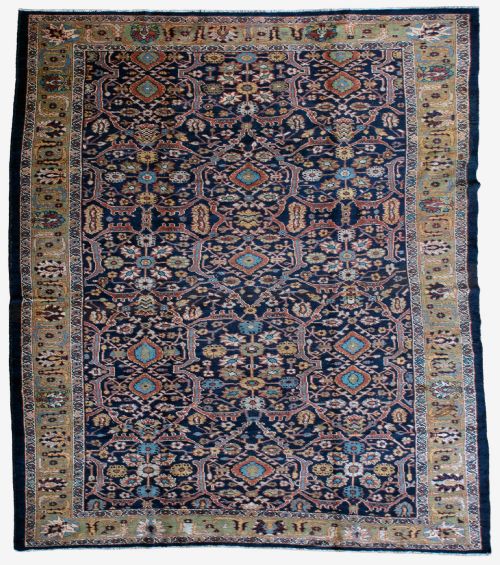
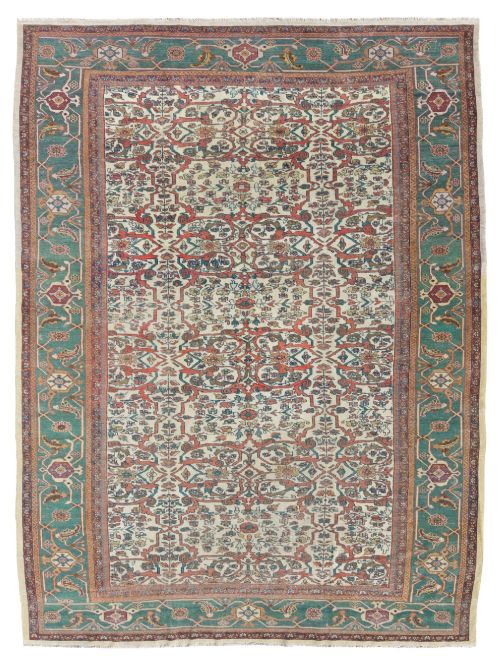
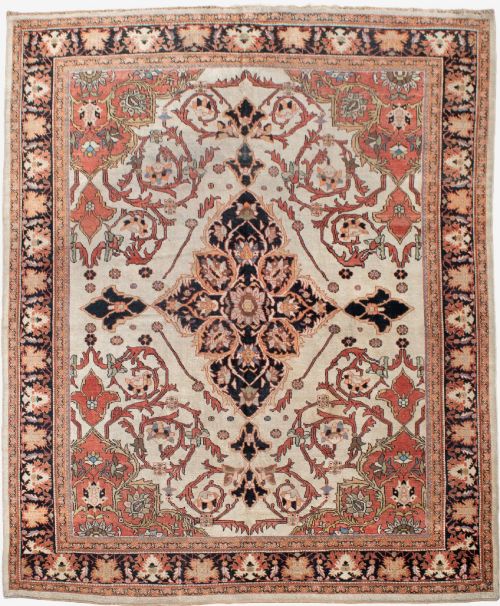
When you search for a vintage sultanabad carpet, you encounter woven floor coverings originating from West Persia during the late nineteenth and early twentieth centuries. These pieces encompass related regional classifications such as Mahal and Ziegler, sharing broad floral patterns and room-scale proportions.
The version most commonly met on this page is the room-size or area carpet dating from the 1880s to the 1930s. These floor coverings bridge traditional Persian weaving methods with Western decorative tastes of the period.
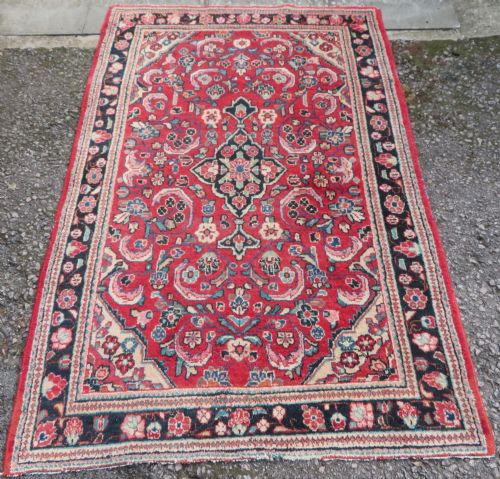
The forms span from smaller village rugs measuring around two metres in length to expansive carpets exceeding five metres. Each piece reflects the output of West Persian looms operating across the nineteenth and twentieth centuries.
How they were made
The construction relies on wool pile knotted onto a foundational warp and weft of cotton. This material combination provides both structural stability and a soft surface texture across large formats.
Weavers utilised natural dyes to colour the wool, producing balanced tones that mellow gracefully over decades of use. The execution combines West Persian knotting techniques with large-scale curvilinear designs tailored for export.
Nineteenth-century West Persian weavers occasionally integrated expansive floral motifs so large that a single blossom spans half a metre.
What varies in quality
The standard of a piece depends upon the precision of the drawing and the balance of the scale within the field and border. Superior examples display harmonious proportions where large floral motifs flow naturally across the expanse without crowding.
Pile density and the handling of the wool also distinguish finer examples from standard production. A well-preserved pile maintains the crispness of the original design while showing the soft handle expected from nineteenth-century West Persian weaving.
Ziegler and Co
The Vintage Sultanabad Carpet Glossary
- Sultanabad
- A carpet style and regional centre in West Persia known for large-scale floral patterns created for the Western market.
- Mahal
- A West Persian weaving village and regional term closely associated with Sultanabad carpet production.
- Ziegler
- A nineteenth-century firm that commissioned carpets in Persia, known for refined room-size designs with muted palettes.
- Pile
- The upright loops or cut ends of yarn that form the usable surface of the carpet.
- Warp and weft
- The vertical and horizontal threads that form the foundational grid of a woven carpet.
Vintage Sultanabad Carpet: Frequently Asked Questions
How do I clean my carpet?
Professional specialist cleaning is essential for antique wool and cotton floor coverings. Regular gentle vacuuming without a beater bar removes surface dust safely.
Avoid household detergents or water saturation, which can damage the natural dyes and historical foundations.
Where should I place it?
These large-scale floor coverings suit reception rooms, dining areas, or living spaces where the intricate floral design can remain visible. Placing the piece away from direct, strong sunlight preserves the subtlety of the natural dyes.
Using a quality underlay prevents slipping and cushions the cotton foundation against hard flooring.
Are these carpets durable?
The dense wool pile and sturdy cotton structure make these pieces resilient under normal domestic foot traffic. Centuries of traditional West Persian knotting ensure the foundation holds together reliably.
Rotation prevents uneven wear patterns in rooms with heavy daily movement.
How do I date a carpet?
Dating relies on examining the specific wool texture, dye palette, and structural characteristics recorded in the listings. Pieces from the nineteenth century often display softer vegetable dye combinations compared to later twentieth-century work.
Comparing the design motifs to documented examples from periods like the 1880s or 1900s provides a reliable chronological bracket.