





Yorkshire Dales Landscape Painting
A yorkshire dales landscape painting captures the distinctive limestone scars, rolling valleys and dry stone walls of northern England through the eyes of artists working across the early and mid-twentieth century.
Yorkshire Dales Landscape Painting
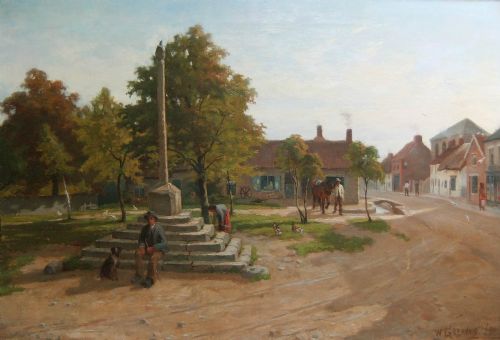
When searching for a yorkshire dales landscape painting, collectors encounter original works produced across several decades spanning the Victorian era through the mid-twentieth century. These pieces record familiar local landmarks, upland farms, rivers and village views across Wensleydale, Swaledale and Wharfedale.
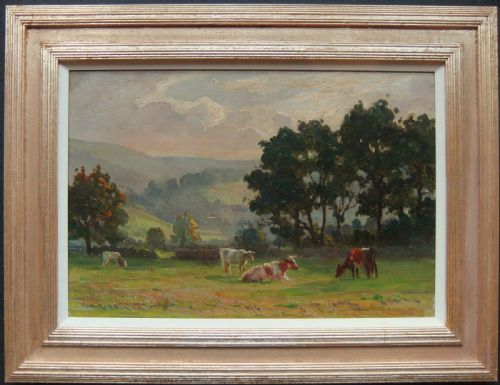
The works appear primarily as watercolours on paper or oil paintings executed on canvas, timber panels or board. Artists working in the region applied these mediums to capture changing seasonal light, from winter snow scenes to golden autumn moorlands.
The selection reflects the output of regional painters influenced by British Impressionism, Victorian realism and modern British landscape traditions. Many pieces concentrate closely on specific Yorkshire locations, naming bridges, becks and dales directly in their titles.
Materials and Technique
Painters utilised traditional supports including stretched canvas, primed timber panels and heavy watercolour paper. Oil paint was applied with brushes or palette knives to build textured surfaces, whilst watercolours relied on fluid washes and ink outlines.
Works on paper were frequently executed <i>en plein air</i> to record direct observations of Yorkshire weather and topography. Studio oil paintings combined field sketches with heavier pigment layers to develop tonal depth across hillsides and skies.
The listings demonstrate a strong concentration of works produced on paper using watercolour, alongside oil paintings executed on canvas and wood panels.
Evaluating Quality
Quality rests upon the artist's handling of local atmosphere, light and spatial depth rather than mere topographical accuracy. Stronger examples demonstrate confident brushwork and a coherent palette that conveys the bleak beauty of upland pastures and river valleys.
Compositional balance distinguishes superior works from routine topographical recording. The finest paintings integrate human elements like barns, bridges or dry stone walls naturally into the broader Yorkshire topography.
Fred Lawson·Ernest Higgins Rigg·Herbert Royle·Reginald Grange Brundrit·Arthur Reginald Smith
The Yorkshire Dales Landscape Painting Glossary
- Watercolour
- A paint consisting of pigment suspended in a water-soluble binder, traditionally applied to paper supports. It allows for translucent washes that suit the soft light of northern skies.
- Oil Paint
- A slow-drying paint made with pigments particles suspended in drying oils such as linseed. It provides rich colour saturation and varied surface texture.
- British Impressionism
- An artistic movement focusing on light, brushwork and everyday subject matter. Practitioners in the north applied these principles to rural scenery.
- Ghyll
- A steep, narrow valley or stream ravine common in the Yorkshire Dales. It provides a frequent focal point for regional landscape studies.
- Provenance
- The documented history of a painting's ownership and origin. It helps verify attribution and exhibition records.
Yorkshire Dales Landscape Painting: Frequently Asked Questions
What periods do these paintings date from?
The available works span from the late nineteenth century through to the mid-twentieth century. Most examples cluster around the Edwardian period and the interwar decades.
Artists active during these times frequently returned to specific dales locations over many years, creating a documented visual record of the changing rural landscape.
How should I care for a watercolour painting?
Watercolours require careful placement away from direct sunlight to prevent the pigments and paper from fading. Framing under UV-protective glass offers essential protection against environmental degradation.
Humidity control is equally important to prevent foxing and paper warping over time in domestic settings.
Are these paintings signed by the artists?
Many examples feature signatures or initials applied by the artist directly onto the front of the canvas or paper. In several instances, titles and signatures also appear inscribed on the reverse.
Unsigned works are occasionally attributed based on distinct stylistic traits, exhibition labels or documented provenance.
What subjects besides villages appear in the art?
Painters frequently focused on natural landmarks including waterfalls, limestone scars, riversides and high moorland tracks. Agricultural scenes such as hay harvesting and sheep farming also feature prominently.
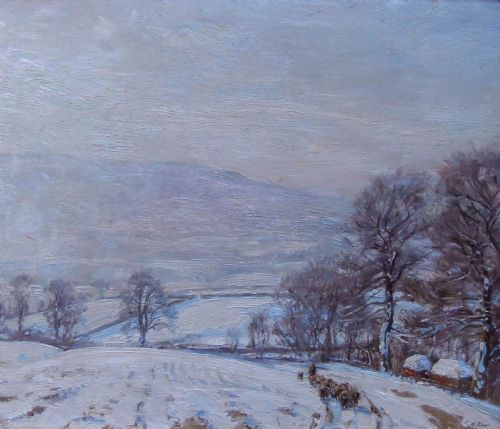
Winter landscapes depicting snow-covered dales and frozen becks represent another major category within the regional school.