
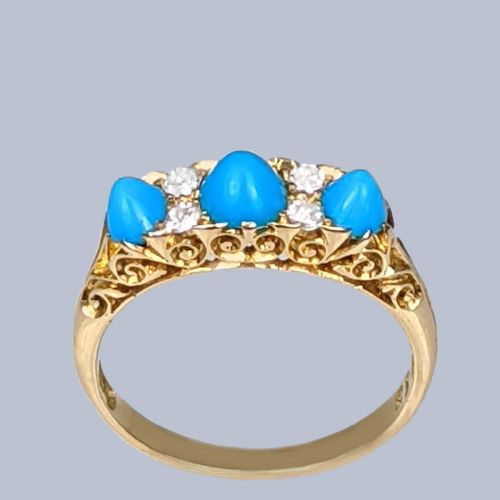
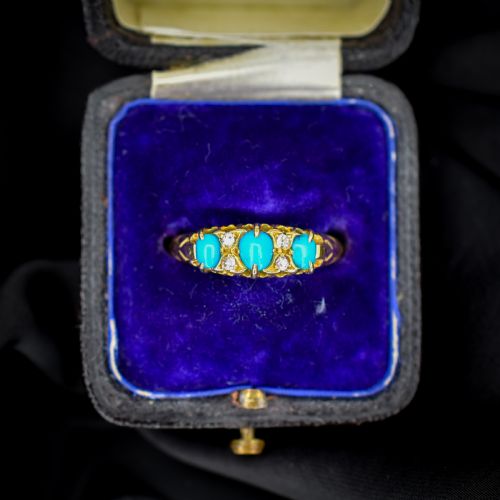


Yellow Gold Turquoise Band
A yellow gold turquoise band brings together vibrant blue stones and rich golden metal in ring forms spanning the Victorian, Edwardian, and mid-century periods.
Yellow Gold Turquoise Band
A yellow gold turquoise band encompasses ring designs created across the Victorian, Edwardian, and mid-century eras, focusing on the combination of gold and turquoise stones. These pieces frequently feature accompanying diamonds or pearls set alongside the primary turquoise elements in formats ranging from simple bands to multi-stone arrangements.
The most common examples on this page are Victorian designs, particularly buckle rings, star motifs, and multi-stone settings executed in 15ct or 18ct yellow gold. Alongside these, buyers encounter Edwardian and 1950s modernist interpretations that demonstrate how jewellers adapted the core combination across successive decades.
Materials and construction methods
The foundation of every yellow gold turquoise band relies on gold alloys graded at 12ct, 15ct, or 18ct, shaped into substantial shanks and secure settings. Jewellers combined turquoise cabochons with accents of diamond and pearl, integrating them into scrolling boat shapes, trilogy layouts, and double rows.
Workshop practices from the nineteenth and twentieth centuries involved hand-forging the yellow gold components and meticulously mounting individual stones by hand. Hallmarks stamped into the metal often record regional assay offices such as Chester and Birmingham alongside specific dates.
Victorian jewellers carved solid gold into functional belt buckles, wrapping turquoise fingers securely around the hand for eternity.
Distinguishing quality in older rings
Quality in a yellow gold turquoise band rests on the weight and purity of the gold metal, moving upward from 12ct to denser 18ct compositions. The selection and matching of the turquoise stones also dictate the tier of the piece, with uniform colour and stable matrix patterns commanding attention.
Superior execution shows in the crispness of detailing, whether in the carved shoulders of a scroll boat ring or the precise formation of a buckle motif. The integration of supporting diamonds and pearls further elevates the standard of the workmanship.
The Yellow Gold Turquoise Band Glossary
- Cabochon
- A gemstone shaped and polished with a smooth, rounded surface rather than faceted. This style highlights the natural colour and texture of turquoise.
- Trilogy ring
- A ring featuring three primary stones set in a row. In these pieces, turquoise often pairs with old-cut diamonds.
- Buckle ring
- A ring designed to resemble a fastened belt. The Victorian era favoured this motif as a symbol of loyalty and connection.
- Old-cut diamond
- A diamond shape hand-cut during the nineteenth century or earlier. These stones display smaller tables and broader facets than modern brilliant cuts.
Yellow Gold Turquoise Band: Frequently Asked Questions
How do I care for a turquoise ring?
Turquoise is a softer stone that absorbs moisture and oils easily. Remove the ring before washing hands or applying cosmetics to protect the surface.
Store the piece separately from harder jewellery to prevent scratching the gold and the stones. Clean gently with a soft, dry cloth rather than liquid immersion.
What periods do these rings date from?
The listings span the Victorian and Edwardian eras through to mid-century modernist designs. Victorian examples often incorporate rich 15ct or 18ct yellow gold with pearls and diamonds.
Later mid-century pieces reflect changing aesthetic preferences while retaining the central combination of turquoise and gold.
Are these bands suitable for daily wear?
While these rings were built for everyday use by their original makers, antique turquoise requires mindful handling due to its natural composition. Thicker 18ct gold shanks offer greater durability for regular wear.
Selecting a design with secure bezel or flush settings helps protect the stones from daily impacts.
How can I tell the gold purity?
British pieces often carry hallmarks stamped inside the band indicating the specific gold carat, such as 15ct or 18ct. Assay office marks can also reveal the location of manufacture.
Maker's marks and date letters provide additional context for verifying the age and composition of the metal.