
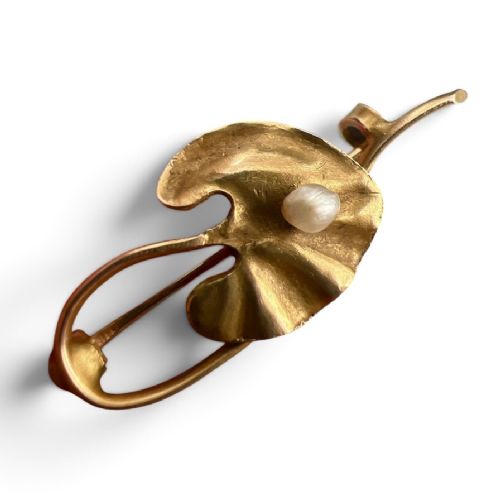
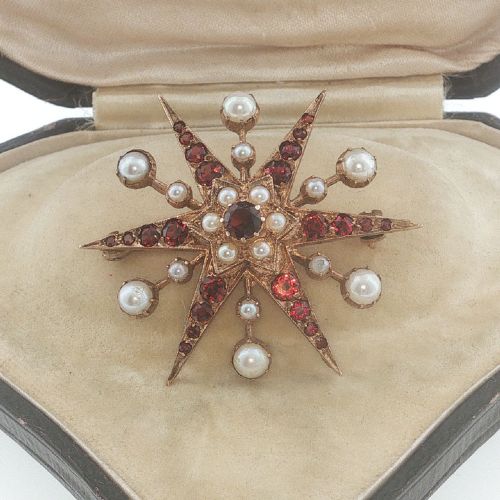
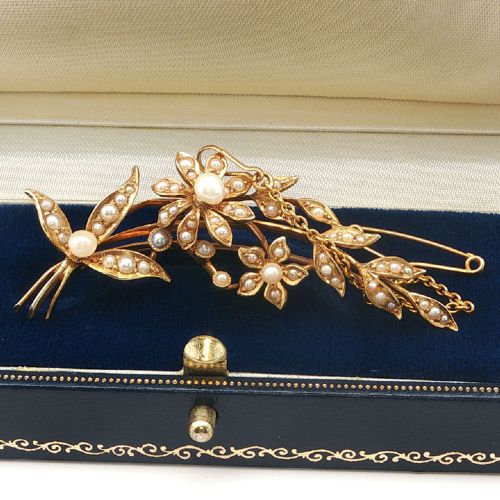
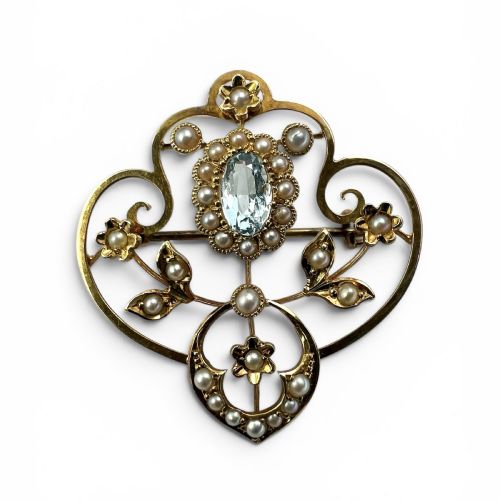
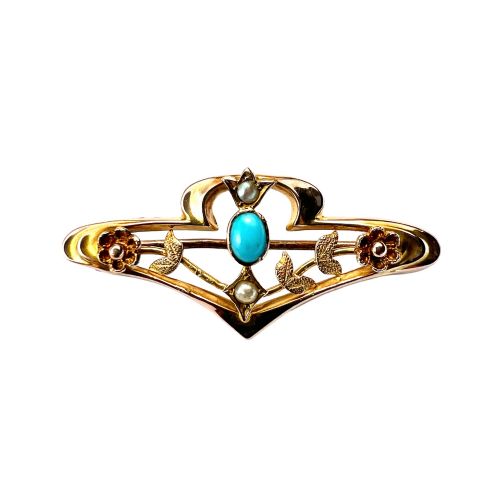
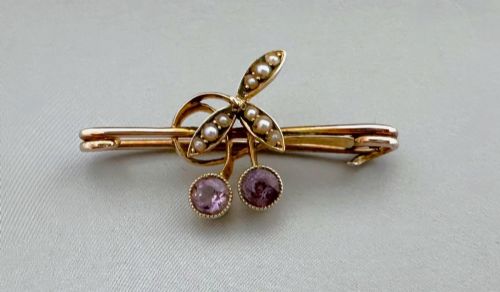


Yellow Gold Pearl Pin
A yellow gold pearl pin brings together the warm glow of gold and the quiet lustre of pearls in forms spanning the Victorian and Edwardian periods.
Yellow Gold Pearl Pin
A yellow gold pearl pin encompasses brooches, pendants, bar brooches, and stick pins created during the Victorian, Edwardian, and subsequent periods. These items range from delicate floral spray brooches and starbursts to crescent moons, bows, and heart designs.
The versions most commonly met on this page include Victorian and Edwardian pieces formed from nine-carat or fifteen-carat yellow gold, often combining pearls with turquoise, peridot, garnet, or diamonds. Formats span convertible pendant brooches, stick pins, and secure bar brooches intended to be worn on lapels or collars.
How they were made
The construction relies heavily on nine-carat, fifteen-carat, and eighteen-carat yellow gold, shaped into wirework, cast settings, and pierced plate. Goldsmiths soldered intricate galleries and collets to hold the stones securely.
Pearls and seed pearls are paired with gemstones such as peridot, turquoise, amethyst, and diamonds, set alongside rose-cut diamonds and occasionally natural or baroque pearls. Metalwork techniques include hand engraving, granulation, and claw or bezel settings.
Listings feature yellow gold pearl pieces spanning the Victorian, Edwardian, and mid-twentieth-century eras, incorporating materials from turquoise and peridot to diamonds.
What varies in quality
Quality depends on the precision of the metalwork, the uniformity and lustre of the pearls, and the skill involved in setting associated gemstones like diamonds and peridot. Finer examples display meticulous piercing, well-matched seed pearls, and balanced proportions.
The substance of the piece is also determined by the gold carat weight, ranging from nine-carat up to eighteen-carat, alongside the complexity of the design, such as convertible pendant mechanisms or multi-gem clusters.
The Yellow Gold Pearl Pin Glossary
- Seed pearl
- Very small, naturally formed pearls often utilised in clustered Victorian and Edwardian jewellery designs. They are typically drilled and threaded onto fine wire or gold hair.
- Bar brooch
- A slender horizontal bar of metal, frequently mounted with gemstones or pearls in the centre. This form was widely worn on collars and lapels during the nineteenth and early twentieth centuries.
- Stick pin
- A long pin topped with an ornamental head, designed to secure cravats, scarves, or lapels. The decorative terminal often incorporates pearls and coloured gemstones.
- Crescent brooch
- A piece shaped in the form of a waxing moon, heavily favored during the late Victorian and Edwardian eras. These are frequently set with graduated pearls and diamonds.
- Collet
- A raised metal collar or band that holds a gemstone in place within a piece of jewellery. It forms part of the structural setting for stones mounted in gold.
Yellow Gold Pearl Pin: Frequently Asked Questions
How do I wear a yellow gold pearl pin safely?
These items are generally worn secured to heavy fabrics like wool or linen rather than delicate silks. Utilising fitted safety chains where provided offers extra security during wear.
For stick pins, secure guards or stoppers prevent the long shaft from slipping free. Storing them flat in dedicated boxes protects the pearls from friction against other jewellery.
What is the difference between Victorian and Edwardian pearl pins?
Victorian designs tend to feature heavier yellow gold settings, often incorporating romantic motifs like hearts, hands, and horseshoes alongside rich-hued gems like garnet or turquoise. Pearls in this period are frequently combined with darker or more saturated stones.
Edwardian pieces lean toward lighter, airier platinum and yellow gold combinations with peridots, aquamarines, and diamonds. The overall aesthetic shifts to lace-like pierced work, garlands, bows, and natural motifs.
Are seed pearls natural or cultured?
The seed pearls found in Victorian and Edwardian pieces are natural saltwater or freshwater pearls formed organically without human intervention. Cultured pearls became widespread only later in the twentieth century.
These tiny natural pearls possess a distinct soft lustre and irregularity characteristic of organic growth before modern farming techniques. They are traditionally secured on fine gold wire within the jewellery.
Can these brooches be worn as pendants?
Many examples listed are designed as convertible pendant brooches featuring integrated loops or folding Bails. This allows the piece to transition from a lapel brooch to a neck pendant.
Examining the reverse reveals whether a hinge or loop is present for a chain. Using them in both capacities expands how the jewellery can be worn.