


Yellow Floral Watercolour
Yellow floral watercolour paintings bring bright botanical studies and garden scenes into a room through delicate pigment on paper.
Yellow Floral Watercolour
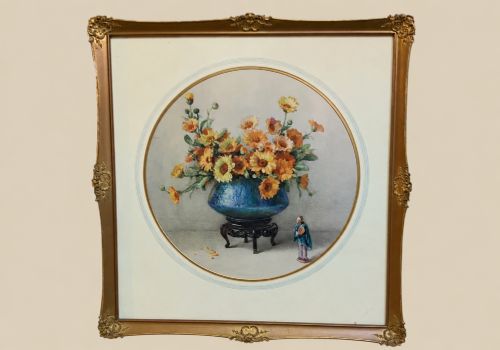
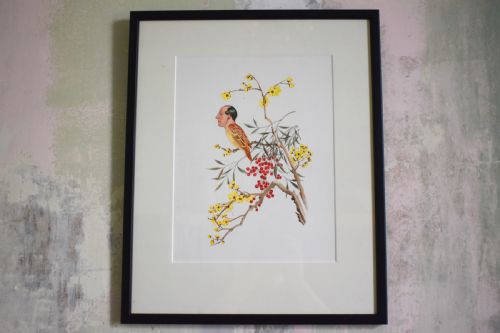
When you search for yellow floral watercolour, you are looking at works on paper spanning from the late nineteenth century through to the mid-twentieth century. These pieces capture botanical subjects, garden landscapes, and still life arrangements featuring flowers like marigolds, rudbeckia, wallflowers, primroses, and crocuses.
The versions you are most likely to meet on this page include Victorian naturalism studies alongside twentieth-century British compositions and botanical illustrations. Artists work within traditional genres of still life and garden painting, often framing the delicate paper behind glass with wood surrounds.
How they were made
The works utilise watercolour paint, watercolour pigment, and occasionally gouache or gold leaf applied directly onto paper supports. Artists build up translucent washes and fine details to render petals, leaves, and surrounding objects with botanical accuracy or expressive freedom.
Many of these surviving pieces are preserved within wooden frames behind glass, which protects the fragile paper surface from atmospheric moisture and handling over the decades.
Several artists preferred painting flowers resting beside bird's nests on mossy banks, proving that Victorian birds had very interior-designed front rooms.
What varies in quality
The distinction between standard works and finer pieces lies in the precision of brushwork and the vibrancy of the pigment preservation. Works by recognised artists demonstrate a confident handling of light and shadow, particularly in rendering the translucent quality of yellow petals against dark foliage or mossy banks.
Condition also plays a part, as paper can suffer from foxing or fading when exposed to light over time. Stronger examples retain their original colour intensity and paper integrity without heavy restoration.
Harry Wanless·Henrietta Creswell·Eloise Harriet Stannard·Rowland Henry Hill·Phyllis I Hibbert·Marian Chase·Alice Macallan Swan·John Sherrin·Beatrice Parsons·Owen Bowen
The Yellow Floral Watercolour Glossary
- Watercolour
- A painting method in which the paints are made of pigments suspended in a water-based solution. It relies on the transparency of the paper to let light pass through the translucent layers.
- Gouache
- An opaque water-based paint similar to watercolour but modified with a binding agent to make it heavier and reflective. It is often used to add highlights and solid areas of colour to a composition.
- Foxing
- Brown spots and discolouration that appear on old paper due to chemical reactions over time. It is a common occurrence in works from the nineteenth century and earlier.
- Still life
- A painting or drawing featuring an arrangement of inanimate objects, typically everyday items or natural subjects such as flowers, fruit, and nests.
Yellow Floral Watercolour: Frequently Asked Questions
How should I hang a watercolour painting?
Watercolours are sensitive to direct sunlight, which can cause the pigments to fade over time. Hang your framed piece on an interior wall away from bright windows and damp areas.
Ensure the frame is properly sealed to keep out dust and insects while keeping the paper from touching the glass directly.
What is the difference between botanical and still life works?
Botanical watercolours focus on the scientific or aesthetic accuracy of specific plant species, often showing stems, leaves, and petals in detail. Still life compositions arrange flowers within a broader decorative setting, such as vases, baskets, or mossy banks.
Both forms were popular throughout the Victorian and Edwardian periods, capturing the Victorians' fascination with natural history.
How do I date an antique painting on paper?
Dating relies on stylistic clues, framing techniques, and signatures linked to known artists working within specific decades. Victorian pieces often feature dense naturalism, while twentieth-century examples show broader impressionist or modernist tendencies.
Backings, paper texture, and handwritten inscriptions on the reverse also provide clues to the period of creation.
Are these pieces usually signed by the artist?
Many of the works carry signatures, initials, or studio attributions inscribed directly onto the paper or the mount. Signatures help connect a piece to documented artists and specific regional exhibitions of the era.
Unsigned works still appear, often attributed through style, subject matter, or provenance records.