


Yellow Floral Watercolour Art
Yellow floral watercolour art brings botanical detail and garden scenes into a room through delicate pigment on paper.
Yellow Floral Watercolour Art
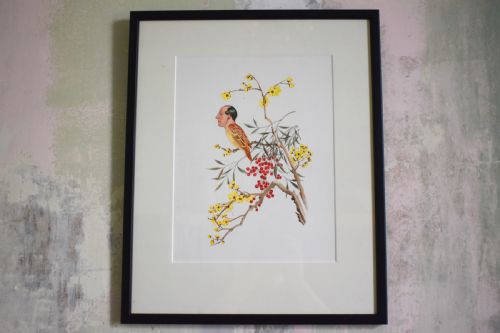
Yellow floral watercolour art encompasses botanical studies, garden landscapes, and still life paintings created across the nineteenth and twentieth centuries. These works range from tightly observed studies of primroses and wallflowers to broader depictions of spring blooms.
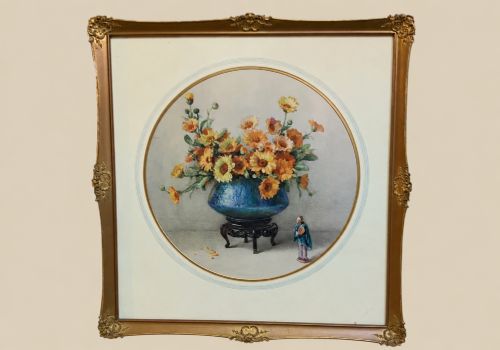
The pieces on this page lean heavily toward nineteenth-century Victorian naturalism and early twentieth-century British painting. Buyers encounter framed waterpaintings and wall art that capture specific botanical varieties like marigolds, crocuses, and rudbeckia.
Works attributed to artists such as Henrietta Creswell, Eloise Harriet Stannard, and Alice Macallan Swan represent the core of these offerings. Subjects extend from quiet garden corners to studio arrangements featuring baskets and Chinese objects alongside the flowers.
Materials and Techniques
These works rely primarily on watercolour pigment and gouache applied to paper supports. Artists built up the translucent washes to capture the luminous quality of petals, sometimes incorporating bodycolour to heighten specific highlights.
Framing typically involves wood and glass to protect the delicate paper surface from atmospheric moisture and dust. Gold leaf occasionally appears on frames from the period, complementing the warm yellow tones within the painted compositions.
The inventory spans the nineteenth century through the mid-twentieth century, featuring styles from Victorian Naturalism to Mid-Century Modern British.
Markers of Quality
Quality rests in the precision of the brushwork and the stability of the paper support. Superior examples display careful botanical accuracy in the rendering of stems, leaves, and petals without stiffness.
The handling of light distinguishes the finer works, where transparent washes create depth rather than muddying the yellow pigments. The condition of the paper, free from heavy foxing, preserves the intended brightness of the composition.
Harry Wanless·Henrietta Creswell·Eloise Harriet Stannard·Rowland Henry Hill·Phyllis I Hibbert·Marian Chase·Alice Macallan Swan·John Sherrin·Beatrice Parsons·Owen Bowen
The Yellow Floral Watercolour Art Glossary
- Gouache
- An opaque watercolour paint that provides solid areas of colour and sharp highlights. It is frequently combined with transparent watercolour in botanical studies.
- Foxing
- Brown spots and discolouration that develop on older paper over time due to chemical reactions. Careful conservation can arrest its spread.
- Still life
- A painting featuring inanimate subject matter, typically commonplace objects or natural items such as flowers, nests, and fruit. Artists arrange these elements to study form and light.
- Victorian Naturalism
- An artistic movement focused on the detailed, objective representation of the natural world. Works in this style show close attention to botanical specimens.
Yellow Floral Watercolour Art: Frequently Asked Questions
How do I care for antique watercolour art?
Keep works out of direct sunlight to prevent the pigments from fading over time. Ensure they hang away from damp walls and maintain stable indoor temperatures.
Conservation-grade framing with UV-protective glass shields the delicate paper and pigments from environmental damage. Regular checks of the sealed backing paper prevent dust and insect ingress.
Are these paintings original works?
The pieces listed are original hand-painted watercolours rather than modern reproductions. Artists applied pigment directly to paper during the periods indicated.
Signatures, brushstroke texture, and variations in the paper surface confirm their status as unique historical artworks.
What subjects appear alongside the flowers?
Compositions frequently incorporate natural elements such as mossy banks, bird nests, and baskets. Some still life arrangements include manufactured items like Chinese objects or ceramic vases.
Garden scenes place the blooms within public parks or domestic planting beds, providing context for the seasonal flowers.
How do I distinguish nineteenth-century pieces?
Nineteenth-century works typically display the tight, observant brushwork characteristic of botanical studies and Victorian naturalism. The paper often carries period watermarks and framing materials match nineteenth-century workshop practices.
Signatures or inscriptions on the reverse frequently record the date and artist name, anchoring the piece within the Victorian or Edwardian eras.