

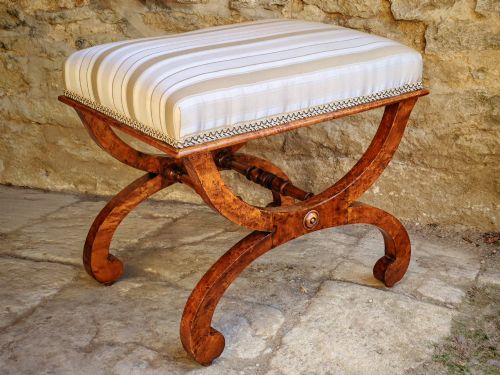


X Stretcher Stool
An x stretcher stool offers rigid underframe bracing beneath a seated surface, built from timber and upholstered in fabric.
X Stretcher Stool
When you search for an x stretcher stool, you are looking at seating supported by diagonal cross braces between the legs. The versions you meet on this page span the 18th century, 19th century, and early 20th century, drawing on Georgian, William and Mary, Regency, and Victorian styles.
The forms range from dressing table stools and music stools to joint stools and footstools. Oak and walnut dominate the timber choices, accompanied by mahogany, burr maple, and ebonized finishes.
Upholstery varies across the selection, featuring tapestry, linen, fabric, and kilim coverings. Some examples showcase decorative elements such as oyster veneers and spiral-carved or barley-sugar legs.
How they were made
Cabinet makers constructed these frames using solid hardwoods like oak, walnut, and mahogany, joined to withstand downward pressure. Diagonal stretchers were fitted between the legs to lock the underframe into a rigid shape.
Surfaces received treatments ranging from plain polished timber to intricate burr maple and ebonization with gilt highlights. Drop-in or fixed pads used linen, tapestry, and kilim fabrics stuffed over traditional webbing.
Periods represented span from the 18th century through the Georgian era and across the 19th century into the 1930s.
What varies in quality
The selection of timber grade and veneer determines the visual weight of the frame. Figured walnut, burr maple, and dense mahogany represent finer material choices compared to standard utility oak.
Joinery execution defines structural integrity, particularly where diagonal stretchers meet the vertical legs. Hand-carved details, such as spiral twist turning and precise cross-framing, distinguish more ambitious workshop output from plain utilitarian forms.
The X Stretcher Stool Glossary
- Cross stretcher
- A pair of diagonal bars intersecting between the legs of a stool to provide structural bracing. This configuration also adds decorative geometry beneath the seat.
- Joint stool
- A rigid wooden seat assembled with pegged mortise and tenon joints rather than turned legs alone. These sturdy pieces date back to early domestic traditions.
- Oyster veneer
- Thin slices of branch wood cut across the grain to create circular or oval patterns. Craftsmen laid these pieces edge to edge on flat surfaces.
- Kilim
- A flat-woven textile produced in the Middle East and Eastern Europe, often utilised as durable upholstery on nineteenth-century footstools.
- Barley-sugar twist
- A form of woodturning resembling a spiralling rope or column. This decorative technique appears frequently on legs and stretchers from revival periods.
X Stretcher Stool: Frequently Asked Questions
What is an x stretcher stool used for?
These pieces function primarily as seating at dressing tables, desks, or in music rooms. They also serve as footstools placed before larger armchairs.
The low profile and sturdy frame make them adaptable for occasional seating across different rooms in the house.
How do I identify a William and Mary style stool?
William and Mary style pieces often feature turned legs, such as spiral twist or barley-sugar forms, connected by diagonal cross stretchers. Walnut is the predominant timber associated with this aesthetic.
Upholstery on these examples frequently incorporates traditional textiles like tapestry or embroidered linen.
Are oak joint stools different from standard stools?
Oak joint stools rely on pegged mortise and tenon construction rather than glued turned joints. This method creates a rigid, box-like frame designed for heavy domestic use.
They typically present a simpler, more rustic appearance than walnut or mahogany dressing stools.
How should I care for antique wood and upholstery?
Keep wooden frames away from direct heat sources and sudden humidity changes to prevent timber splitting. Regular dusting preserves the polished finish on walnut and mahogany surfaces.
Upholstery in delicate fabrics like tapestries or kilims benefits from gentle surface vacuuming through a mesh guard.