
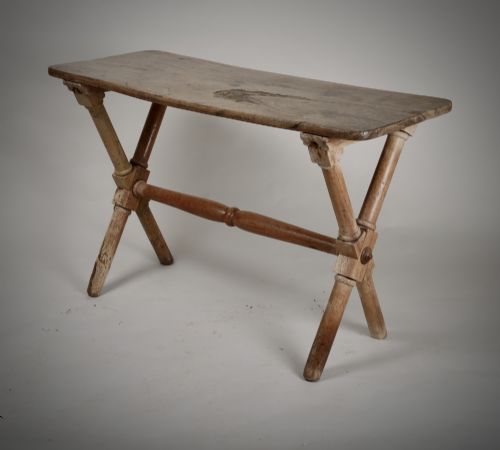


X Stretcher Oak Desk
An x stretcher oak desk or table brings honest timber and robust bracing into a room, offering a solid surface built to last.
X Stretcher Oak Desk
An x stretcher oak desk or table draws its defining characteristic from the diagonal cross-bracing that joins the lower legs, providing structural rigidity. Buyers seeking this form encounter pieces spanning the seventeenth century through to the Edwardian period and the nineteen-twenties.
The selection ranges widely across table forms, including side tables, refectory tables, library tables, and writing desks. Oak dominates the construction, accompanied by occasional variations in burr oak, elm, and pine.
Victorian and Edwardian iterations frequently display revivalist details such as Jacobean carving or Arts and Crafts simplicity. Earlier Georgian and seventeenth-century examples appear alongside twentieth-century rustic interpretations.
Assessing quality and character
Quality rests in the selection of timber grain, particularly where figured burr oak or dense seventeenth-century boards are employed. Finer pieces demonstrate crisp hand-carving and well-integrated stretchers that anchor the legs securely.
Proportion and integrity dictate the standing of a piece, distinguishing purpose-built library desks from simpler utilitarian tables. The depth of colour in the timber and the honesty of the joints separate standard workshop production from superior examples.
One historic public school library table spent decades absorbing ink stains from generations of distracted scholars.
The X Stretcher Oak Desk Glossary
- Stretcher
- A horizontal support connecting the legs of a table or desk to increase stability. In x stretcher designs, these timbers cross diagonally between all four legs.
- Refectory table
- A long, narrow dining table traditionally used in communal dining halls. These pieces often feature sturdy stretcher systems to support large spans of timber.
- Burr oak
- A growth deformity in the tree that produces highly figured, swirling grain patterns. Cabinet makers prized this wood for decorative table tops and drawer fronts.
- Arts and Crafts
- A design movement valuing handcraftsmanship and simple materials over industrial mass production. Pieces from this style often display exposed joinery and honest construction.
X Stretcher Oak Desk: Frequently Asked Questions
What is an x stretcher base?
An x stretcher base consists of four diagonal rails that intersect between the legs near the floor. This construction method braces the entire frame against lateral movement.
Carpenters utilised this design to reinforce heavy timber furniture without adding cumbersome aprons or skirts around the seating area.
How do I date an oak desk?
Dating relies on observing construction marks, timber selection, and stylistic details such as carving or hardware. Earlier periods show hand-cut joinery and darker patination accumulated over centuries.
Later Victorian and Edwardian revivals often incorporate machine tooling alongside historical motifs like Jacobean scrolling.
Where should I place a library table?
Library tables and writing desks suit studies, hallways, or spacious living rooms where their finished backs allow freestanding placement. Their robust construction supports heavy books and daily writing tasks.
Pairing them with appropriate seating creates a functional workspace rooted in traditional craftsmanship.
Are these desks suitable for daily use?
Solid oak furniture handles regular daily use exceptionally well due to the inherent toughness of the hardwood. Simple maintenance keeps the surface protected against minor spills and wear.
These pieces were originally built for heavy institutional or domestic service, making them practical for modern working environments.