
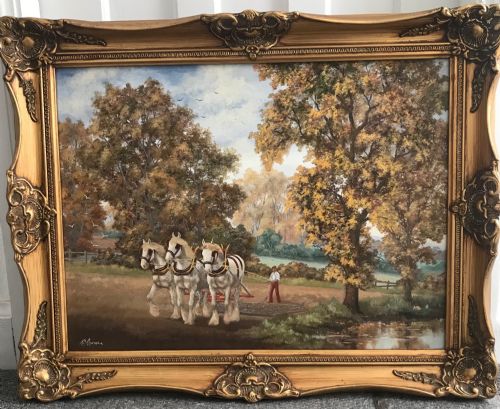


Working Horse Landscape Painting
When you search for a working horse landscape painting, you are looking at rural scenes of heavy draft animals at labour.
Working Horse Landscape Painting
A working horse landscape painting captures heavy draft animals engaged in agricultural and industrial tasks across rural settings. These works focus on shires, cart horses and plough teams working alongside labourers in fields, farmyards and coastal locations. You will find these pieces spanning the nineteenth and twentieth centuries, reflecting rural life through Victorian, Edwardian and impressionist styles.
The pieces on this page range from intimate watercolours on paper to large oil paintings on canvas and wood panels. Common subjects include ploughing, hay wagon transport, timber hauling and harvesting scenes set within British and European landscapes. Artists recorded the reality of rural labour before mechanisation displaced the heavy horse from daily farm operations.
Materials and techniques
Artists utilised oil paint on canvas, wood and gesso panels, alongside watercolour on paper, to capture the texture of fields and the weight of draft animals. Oil on canvas allowed for layered brushwork that built up the dense coats of shires and the churned earth of the plough team. Watercolours on paper offered a lighter medium for swift topographical records of farm work.
Frames of gesso and carved wood frequently complement these paintings, maintaining the period aesthetic of the nineteenth and early twentieth centuries. The handling of pigment ranges from the precise realism of Victorian portraitists to the looser brushwork of British impressionists and regional groups.
Listings feature works executed in oil and watercolour on canvas, paper and wood, created across the nineteenth and twentieth centuries.
Factors of quality
Quality rests in the anatomical accuracy of the horses and the integration of the animal forms into the surrounding landscape. Stronger examples demonstrate a confident handling of light across muscle and mud, conveying the physical effort of hauling timber or pulling the plough.
The distinction between standard works and superior pieces lies in the compositional balance and the fidelity of the rural atmosphere. Masterly brushwork captures the specific breed characteristics of shires and cart horses rather than relying on generic animal shapes.
John Frederick Herring·John Linnell·James William Booth·Herbert Royle·George Cole
The Working Horse Landscape Painting Glossary
- Oil on canvas
- A painting medium where pigments bound in drying oil are applied to a stretched canvas support. This combination permits rich colour saturation and varied surface textures.
- Watercolour
- A paint consisting of water-soluble pigments applied to paper. It creates transparent washes that suit rapid outdoor sketching.
- Gesso
- A plaster-like mixture applied to wood panels or frame mouldings to provide a smooth surface for painting or gilding. It gives traditional frames their rigid structure and decorative profile.
- Staithes Group
- A collective of northern artists working in a British impressionist style. Their output frequently records coastal and rural labour.
Working Horse Landscape Painting: Frequently Asked Questions
What periods do these paintings date from?
The works originate from the nineteenth and twentieth centuries, with examples spanning from the eighteen-fifties through to the nineteen-sixties.
This era covers Victorian pastoral art, Edwardian rural recording and later twentieth-century interpretations of agricultural work.
What materials were used by the artists?
Painters utilised oil on canvas, wood panels and gesso, alongside watercolour on paper. Canvas and wood served larger studio compositions while paper supported detailed watercolours.
Framing typically involved gessoed and moulded wood to protect and present the work.
How should I live with an oil painting?
Keep oil paintings away from direct sunlight and sources of extreme heat to prevent the canvas or wood panel from warping and the pigment from fading. Stable room temperatures protect the structural integrity of both paint and gesso frames.
Dust the surface gently with a dry, soft cloth and avoid chemical cleaning agents on the paint layer.
How do I identify a working horse subject?
Look for heavy draft animals such as shires and cart horses actively engaged in rural labour like ploughing, timber hauling, harvesting or pulling carts. These scenes place emphasis on the physical toil of farm animals and labourers.
They differ from pure portraits of leisure horses by their inclusion of agricultural equipment and working environments.