


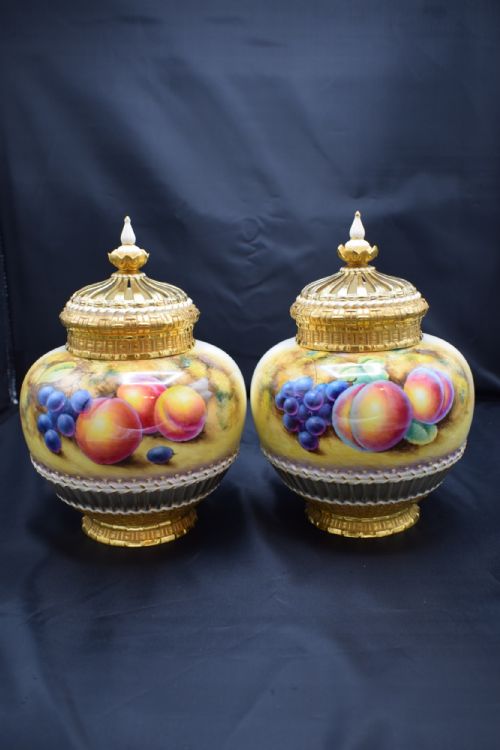
Worcester Fruit Jar
A Worcester fruit jar brings the height of mid-century British ceramic painting straight into a room through rich enamel and gold leaf.
Worcester Fruit Jar
When you search for a Worcester fruit jar, you are looking at fine bone china and porcelain vessels created in forms such as ginger jars, rose jars, and pot pourri vases. The pieces seen here span the 1940s, 1950s, and 1960s, capturing a distinct mid-century approach to traditional English decorative objects.
The physical format varies from single lidded jars to three-piece pot pourri sets and pairs, often topped with pierced or crown covers. These containers were designed primarily for display rather than domestic storage, serving as focal points in Edwardian-influenced traditional interiors.
What varies in quality
The distinction between pieces rests heavily on the complexity of the painted fruit subject and the identity of the artist who signed the work. Detailed, dense arrangements require a high level of brushwork skill compared to simpler fruit motifs.
The integrity of the gilding and gold leaf detailing across the covers and shoulders dictates the visual weight of the vessel. Complete sets, such as pairs and three-piece pot pourri assemblies, carry greater presence than isolated single jars.
Worcester Fruit Jar Retail Price Guide 2026
Typical asking prices for worcester fruit jar among the pieces listed under this phrase on Sellingantiques today, from the lower quarter to the upper quarter. They describe what is for sale here now, not the wider market.
Artists occasionally hid tiny clusters of blackberries and autumn leaves behind oversized peaches just to test if anyone was looking.
Royal Worcester·John Smith·Freeman·Kitty Blake·Ayrton·P Love
The Worcester Fruit Jar Glossary
- Pot pourri
- A decorative jar or vase featuring a pierced or openwork cover designed to let scented dried plant material diffuse into a room. These are frequently found in pairs or three-piece garniture sets.
- Ginger jar
- A ceramic vessel with a broad body and a domed cover, originating from oriental storage containers but adopted into traditional English porcelain manufacturing for purely decorative purposes.
- Gilding
- The application of gold leaf or powdered gold onto the surface of porcelain. It highlights the rims, handles, and shoulders of the jars.
- Bone china
- A type of soft-paste porcelain incorporating animal bone ash, providing high strength and a bright white translucency. It forms the base material for many mid-century pieces.
Worcester Fruit Jar: Frequently Asked Questions
What is a Worcester fruit jar used for?
These jars served primarily as decorative ornaments on mantelpieces and side tables rather than practical storage vessels. Many incorporate pierced covers specifically to hold scented pot pourri.
Today, they function as display pieces that showcase mid-century English ceramic artistry and hand-painted fruit compositions.
How do I know who painted the jar?
Artists frequently signed their painted fruit compositions directly onto the body of the porcelain near the base of the design. Names such as Freeman, John Smith, and Kitty Blake often appear on the surface.
Examining the signature helps connect the vessel to specific hands working within the porcelain factories during the mid-twentieth century.
Are these jars made of porcelain?
The listings comprise pieces made from porcelain, bone china, and fine bone china. These ceramic bodies provide a smooth, bright white ground ideal for detailed enamel painting.
Gold leaf and gilt accents are subsequently applied over the glazed porcelain body to frame the artwork.
What is a three piece pot pourri set?
A three piece set typically consists of a central lidded jar accompanied by a matching pair of smaller flanking vases. Each piece shares the same painted fruit motif and gilt detailing.
These balanced sets were manufactured to stand together as a cohesive decorative garniture on a large surface.