


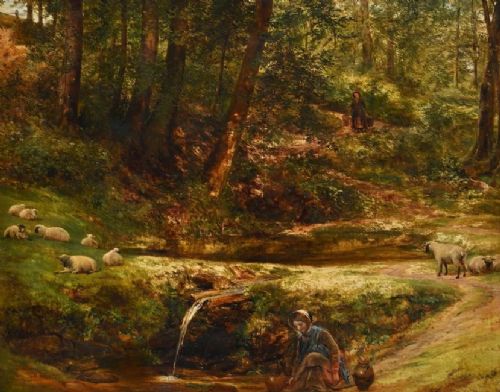


Woodland Scene Oil Painting
A woodland scene oil painting captures the quiet depth of trees and undergrowth through oil paint on canvas.
Woodland Scene Oil Painting
A woodland scene oil painting depicts trees, forest floors, and leafy paths through the medium of oil on canvas or wood. These works capture changing light, seasonal shifts, and pastoral figures within forest settings across the nineteenth and twentieth centuries.
The pieces on this page span from Victorian landscapes to mid-century examples. Common formats include pastoral views with cattle, figures gathering firewood, or quiet river glens framed by mature trees.
Origins range across British and French traditions, encompassing styles from Victorian Naturalism and Impressionism to English Country House aesthetics. Each piece records the specific handling of foliage and light favored by its period.
Materials and Techniques
The works rely upon oil paint applied to stretched canvas or wooden board. Artists built up texture using brushes and sometimes palette knives to render the density of leaves, bark, and earth.
Gesso and gilt frames often complete the presentation, providing a structured border that protects and highlights the painted surface. Pigments mixed with oils allowed painters to achieve deep greens, warm autumnal browns, and luminous sunset skies.
Recorded styles range from Victorian Naturalism and Impressionism to English Country House aesthetics.
Assessing Quality and Execution
Quality rests upon the artist's command of light, depth, and brushwork. Superior examples convey the complex atmosphere of a forest canopy and the play of sunlight on undergrowth with conviction.
The construction of the frame and the preservation of the canvas surface also contribute to the standing of a piece. Stronger works demonstrate confident handling of perspective and natural forms rather than mechanical repetition.
Sir Joseph Noel Paton·Richard Sebastian Bond·William H Myers·Thomas W Lascelles·Richard Redgrave·James Mallard Bromley·David Watts·John Wright Oakes·James Proudfoot·Edward H Holder·George F Wetherbee·J McIntyre·Lester Sutcliffe·Frederick Bartman·Benjamin Callow·Walter Emsley·Charles Edmond Rene His·William Mellor·Everett W Mellor·Charles Duval·George Neil·George Arthur Fripp·John Cuthbert Salmon·Owen Bowen·H Barnett
The Woodland Scene Oil Painting Glossary
- Canvas
- A heavy woven fabric stretched across a wooden frame to serve as a support for oil painting. It provides the tensile foundation for the brushstrokes.
- Gesso
- A plaster-like mixture applied to wood or canvas to prepare a smooth surface for painting or to adorn frames. It creates a durable base for the pigments and gilding.
- Impressionism
- A style of painting emphasising small, thin brush strokes and accurate depiction of light in its changing qualities. It often prioritizes open compositions and ordinary subject matter.
- Naturalism
- An art movement focusing on the depiction of objects and nature with minimal idealisation. These works record the physical world with strict attention to observed detail.
- Gilt
- A thin layer of gold leaf or gold paint applied to surfaces such as wooden picture frames. It adds a reflective border that frames the artwork.
Woodland Scene Oil Painting: Frequently Asked Questions
What periods do these paintings cover?
The listings span from the nineteenth century through the mid-twentieth century, including Victorian, Edwardian, and post-war periods.
Each era brings its own approach to rendering foliage, light, and rural architecture.
How were these framed originally?
Many works feature period frames constructed from wood and finished with gesso and gilt detailing.
These surrounds complement the palette and depth of the oil paintings within them.
Where were these artists working?
The pieces originate primarily from British and French artistic traditions, capturing local countryside and woodland views.
Artists often painted specific regional landscapes such as Yorkshire, Bushey, or river glens.
How do I care for an oil painting?
Keep the artwork away from direct sunlight and sharp fluctuations in room temperature and humidity.
Dust the surface gently with a soft, dry brush without applying pressure to the canvas.