



Woodland Scene Canvas
When you search for a woodland scene canvas, you seek oil paintings on canvas that capture trees, foliage, and rural light across different centuries.
Woodland Scene Canvas
A woodland scene canvas comprises oil paintings on canvas depicting trees, forests, and rural landscapes spanning from the nineteenth century through the mid-twentieth century. The selection includes works created in Victorian, Edwardian, and Impressionist styles, ranging from intimate forest interiors to broader pastoral vistas.
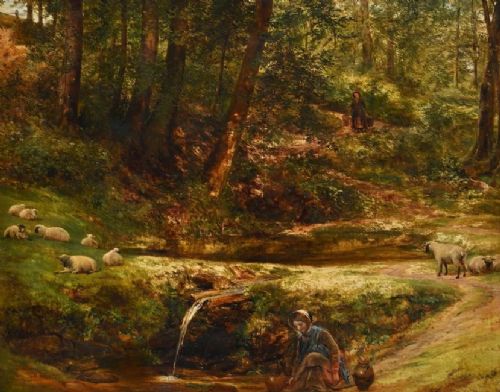
The version most commonly encountered on this page is the nineteenth-century oil painting on canvas, often framed in gilt and gesso, showing British or French rural environments. These works capture seasonal changes, from spring blossoms to winter snows, alongside rivers, figures, or grazing cattle.
Beyond the nineteenth-century examples, the listings extend into early twentieth-century and post-war modernist interpretations. These later pieces maintain the canvas support and oil medium while shifting towards impressionistic brushwork or mid-century atmospheric qualities.
How they were made
These artworks are created using oil paint applied to woven canvas supports, which are stretched over wooden frames. Artists built up compositions using layered oil pigments to achieve depth in foliage, shadows, and light.
Many of the canvases are housed within wooden frames finished with gesso and gilt, providing structural support and decorative framing that complements the period of the painting.
Listings feature canvases spanning from the nineteenth century to nineteen sixty, utilising oil paint on canvas and wood.
What varies in quality
Quality varies in the handling of light, brushwork finesse, and the artist's ability to render natural forms convincingly. Superior works demonstrate subtle tonal transitions in woodland canopies and convincing depth within the landscape.
The preservation of the original canvas and oil paint layer also distinguishes pieces, alongside the craftsmanship of the associated wooden and gilt gesso frames.
Sir Joseph Noel Paton·Richard Sebastian Bond·William H Myers·Thomas W Lascelles·Richard Redgrave·James Mallard Bromley·David Watts·John Wright Oakes·James Proudfoot·Edward H Holder·George F Wetherbee·Lester Sutcliffe·Frederick Bartman·Walter Emsley·Charles Edmond Rene His·William Mellor·Everett W Mellor·Charles Duval·George Neil·Frederick Golden Short·Robert Burrows·Emile Antoine Verpilleux
The Woodland Scene Canvas Glossary
- Canvas
- A heavy woven fabric used as a surface for oil painting. It is typically stretched tightly over a wooden frame before the artist applies paint.
- Gesso
- A plaster-like mixture applied to wooden frames as a smooth base for gilding. It provides a durable surface that accepts gold leaf or paint.
- Gilt
- A thin layer of gold applied to the surface of wooden frames for decoration. This finish enhances the visual weight of the presentation.
- Impressionist
- A style of painting focusing on transient effects of light and ordinary subject matter. Artists using this approach employ visible, rapid brushstrokes.
- Victorian Naturalism
- An art movement emphasising detailed observation of the natural world. Works in this style record flora, fauna, and rural life with careful precision.
Woodland Scene Canvas: Frequently Asked Questions
What periods do these paintings date from?
The selections span from the nineteenth century through the Edwardian era, the early twentieth century, and the post-war period up to nineteen sixty. Nineteenth-century examples form a substantial portion of the available artwork.
Later pieces reflect mid-century aesthetic developments while retaining traditional oil on canvas mediums.
Are the canvases framed?
Many listings include period wooden frames, often finished with gesso and gilt details. These frames complement the era of the individual painting.
Some works retain their original framing setup from the time of creation.
How do Impressionist pieces differ from Victorian ones?
Victorian naturalism focuses on detailed rendering of foliage, light, and rural narratives. Painters from this tradition document the natural world with precision.
Impressionist works prioritise atmospheric effects and loose brushwork over minute botanical accuracy.
What subjects appear alongside trees?
Compositions frequently incorporate figures, rivers, lakes, cattle, and cottages within the woodland setting. Seasonal elements like autumn leaves or winter snow also define the scenery.
Some canvases depict specific geographic locations in Britain and France.