


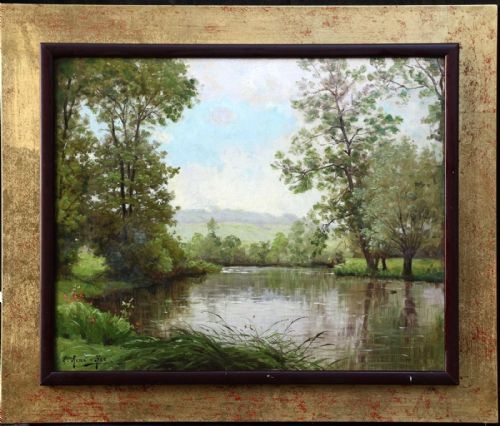


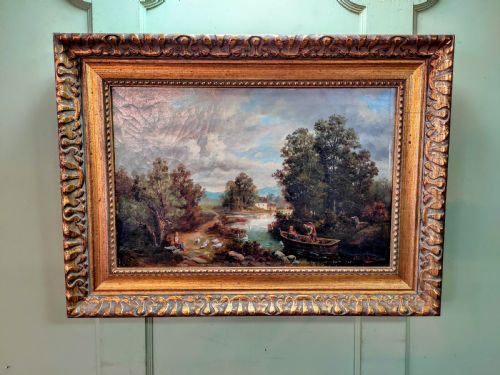


Woodland River Scene Canvas
These woodland river scene canvas works capture tranquil waterways and timbered banks in oils, offering a timeless window into pastoral landscapes.
Woodland River Scene Canvas
A woodland river scene canvas represents painted depictions of watercourses flowing through trees, rendered primarily in oils across various historical periods. The selections span Victorian, Edwardian, and mid-twentieth-century eras, capturing shifting light and rural tranquility.
Most pieces encountered on this page date from the late nineteenth century through to the mid-twentieth century, showcasing styles from Victorian Naturalism to Impressionism and Post-Impressionism. These works frequently depict British and Canadian landscapes, featuring pastoral rivers, glen settings, and sunset vistas.
Materials and construction
The primary medium across these works is oil paint applied to canvas, often supported by wooden stretcher frames and framed in ornate mouldings. Many pieces incorporate gesso and gold leaf within their decorative frames to enhance the visual presentation.
Artists built depth through layered oil paint applications, capturing the textures of woodland foliage and the reflective surfaces of rivers. The integration of canvas and oil allowed painters to achieve rich tonal variations from sunset glows to winter light.
Even rivers that stopped flowing a century ago keep running here, eternally caught at sunset.
Assessing quality in painted landscapes
Quality rests in the artist's handling of light, atmosphere, and natural detail, where confident brushwork distinguishes masterly compositions from simpler decorative efforts. Works by established painters demonstrate a superior command of perspective and colour harmony within the natural setting.
The preservation of the original canvas and the integrity of the associated frame contribute significantly to a piece's standing. Finer examples retain their original gilding and gesso details without extensive overpainting or structural compromise.
Arthur Herbert Rigg·David Watts·John Wright Oakes·George F. Wetherbee·Charles Edmond Rene His·William Mellor·Everett W. Mellor·Charles Duval·George Neil·Rene His
The Woodland River Scene Canvas Glossary
- Oil on Canvas
- A traditional painting medium where pigments suspended in drying oils are applied to stretched fabric. This combination allows for rich blending and textured brushstrokes.
- Gesso
- A plaster-like mixture applied to wooden frames as a base for gilding. It provides a smooth surface for gold leaf application.
- Gold Leaf
- Gold beaten into extremely thin sheets used for gilding frames. It adds a luminous border that complements the warmth of oil paintings.
- Impressionism
- A nineteenth-century art movement characterised by relatively small, thin, yet visible brush strokes. It emphasises accurate depiction of light in its changing qualities.
- Pastoral
- A genre of art depicting rural life and landscapes in a idealized and peaceful manner. These scenes often focus on shepherds, rivers, and woodland groves.
Woodland River Scene Canvas: Frequently Asked Questions
What is a woodland river scene canvas?
It is an oil painting on fabric depicting a watercourse running through trees, created by artists working in various historical periods from the Victorian era onwards.
These artworks capture the natural beauty of rivers, glens, and woodland interiors using traditional oil paints.
How do I date these paintings?
Dating relies on stylistic clues, artist signatures, framing techniques, and recorded biographical dates of the painters.
Victorian pieces often feature darker, more realistic palettes, while early twentieth-century examples lean towards impressionistic brushwork and lighter tones.
Where should I hang these artworks?
These landscape paintings suit traditional reception rooms, studies, or hallways where natural light complements the oil medium.
Avoid placing them in areas of high humidity or direct sunlight to protect the canvas and gilt frames.
How do styles differ across periods?
Nineteenth-century works tend toward meticulous realism and detailed foliage, while later twentieth-century pieces adopt looser impressionistic brushstrokes.
Changes in palette and framing also help distinguish early Victorian pastoral works from mid-century interpretations.