
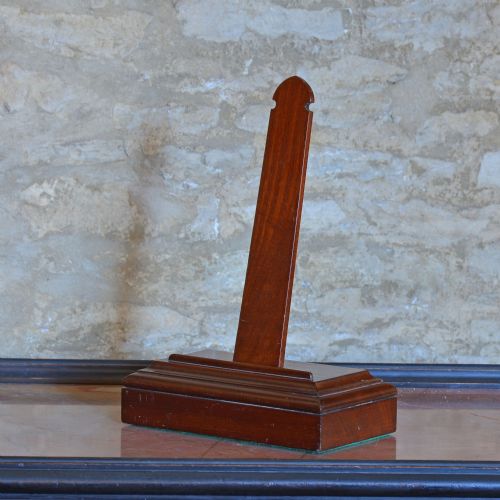
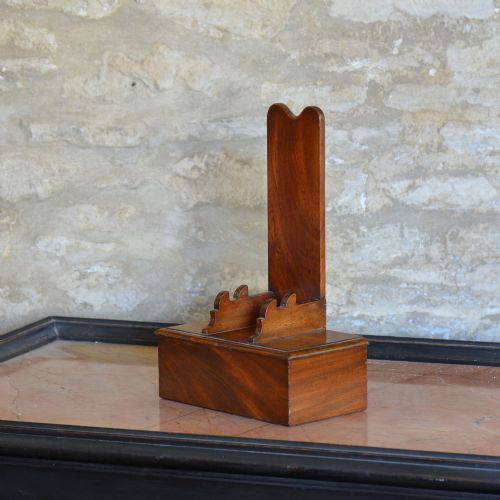


Wooden Plate Holder
A wooden plate holder keeps your finest ceramics upright and secure, offering a practical solution for displaying heavy chargers and domestic tableware.
Wooden Plate Holder
A wooden plate holder serves as a dedicated support for domestic crockery, holding individual dishes or multiple tiers for display on a sideboard or table. When you search for a wooden plate holder, you encounter items designed to keep ceramics secure while showing off their glaze and decoration.
The examples available here span several centuries and styles, taking forms such as folding tiers, weighted uprights, and wall-mounted racks. Georgian and Victorian workshops produced many of these utilitarian domestic items, fashioning them to meet the daily needs of large households.
Oak and mahogany dominate the items listed here, reflecting the preference for sturdy timbers that could bear the weight of heavy stoneware and porcelain. Pieces range from simple wall racks to elaborate folding stands featuring multiple tiers for cakes or plates.
Construction and materials
Cabinet makers built these domestic items using dense hardwoods like mahogany, oak, and fruitwood, selecting timber that could withstand the regular handling of heavy crockery. Joinery techniques such as mortise and tenon joints provided the structural integrity required to bear the weight of stacked ceramics without warping.
Secondary elements of brass, felt, and silver plate appear alongside the primary woodwork to add functional reinforcement or protective lining. Turning lathes shaped upright supports and central columns, while hand planes smoothed the flat surfaces of tiers and plate rails.
Judging quality in wooden plate holders
Quality in these domestic items lies in the selection of figured timber and the precision of the joinery rather than surface decoration. A well-constructed stand demonstrates tight joints and balanced weighting, ensuring the piece remains stable when loaded with heavy ceramics.
Finer examples show careful attention to the turning of upright supports and the smooth operation of folding mechanisms on tiered cake stands. Plain utility pieces prioritized function over ornament, whereas items intended for principal rooms received superior timber selection and refined shaping.
The Wooden Plate Holder Glossary
- Mahogany
- A durable, reddish-brown tropical hardwood prized by cabinet makers for its stability and fine grain. It frequently appears in 18th and 19th-century domestic furnishings.
- Oak
- A strong, heavily grained temperate hardwood utilised extensively in traditional English furniture and utility pieces for its load-bearing capacity.
- Fruitwood
- A dense, close-grained timber gathered from fruit-bearing trees such as pear or apple, often employed in treen and smaller turned objects.
- Treen
- Small, functional wooden household items fashioned by turners and joiners, ranging from tableware to stands.
- Tiered
- An arrangement featuring multiple levels positioned vertically above one another, commonly seen on cake and plate stands.
Wooden Plate Holder: Frequently Asked Questions
What is a wooden plate holder used for?
These items support and display plates, trays, or dishes safely on tabletops or sideboards. They allow households to exhibit decorative ceramics without risking damage from stacking.
Historically, they served dining rooms and pantries by keeping tableware organised and readily accessible during large meals.
How do I date a wooden plate holder?
Dating relies on examining the timber species, construction methods, and tool marks visible on the underside or inner joints. Earlier pieces from the 18th century often display hand-sawn surfaces and pegged joinery.
Later Victorian and Edwardian examples may incorporate machine-turned components or metal folding hinges characteristic of industrial production.
Are these plate holders strong enough for modern plates?
Most pieces were constructed from dense hardwoods like oak and mahogany specifically to bear the weight of heavy stoneware and porcelain. Their robust frames remain fully capable of supporting contemporary tableware.
Care should be taken with folding mechanisms on tiered stands to ensure the hinges support the load evenly.
How should I care for antique wood?
Maintain the timber by keeping it away from direct heat sources and sudden humidity changes that cause wood to split. Dust the surface regularly with a dry cloth and apply a quality beeswax sparingly when the finish appears dry.