




Wooden Gate Leg Table
A wooden gate leg table provides folding leaves held by swinging legs, offering compact storage that expands for dining.

Wooden Gate Leg Table
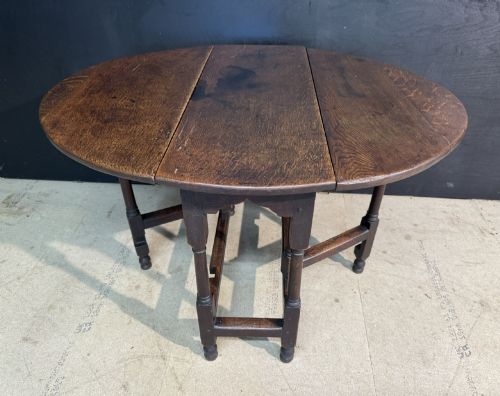
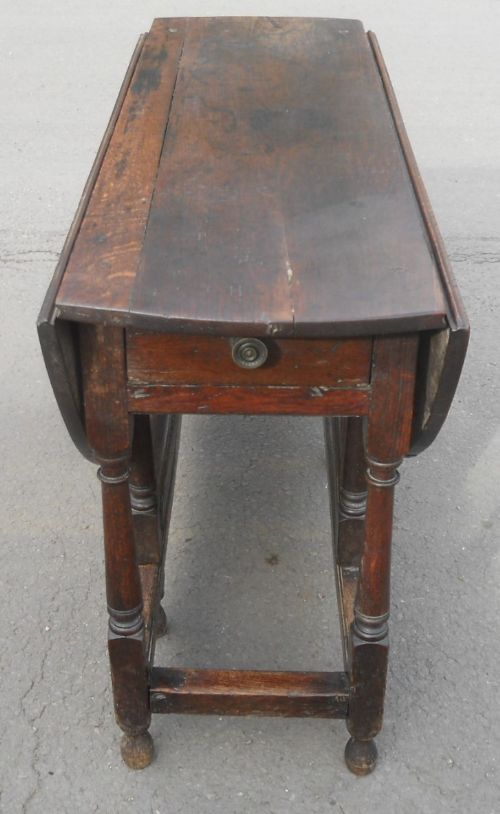
A wooden gate leg table represents a functional form found across multiple centuries, designed with hinged leaves and pivoting supports that swing outward to bear weight. The pieces seen here span periods from the seventeenth century through the Edwardian era, incorporating styles such as Georgian, Victorian, Jacobean Revival, and rustic farmhouse.
Buyers encountering this selection will most frequently meet examples fashioned from solid oak or mahogany, configured as dining tables, occasional tables, or smaller side pieces. Forms range from large multi-seater dining tables down to compact Sutherland and spider leg variants suitable for tighter spaces.
How they were made
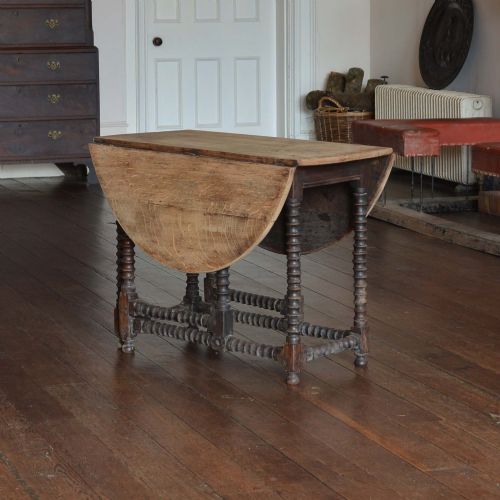
Construction relies heavily on timber selection, utilising durable hardwoods like oak, walnut, and mahogany alongside fruitwood and satinwood inlay for decorative contrast. Joints are typically pegged or mortised, whilst turning techniques produce distinct structural supports such as bobbin legs.
Hinged mechanisms allow the drop leaves to fold smoothly against the fixed central frame. Metal fixings like brass and iron appear in supporting hinges and occasionally on castors, working alongside ceramic elements where applicable.
Listings feature oak, walnut, mahogany, fruitwood, and satinwood inlay across pieces dated from the late seventeenth century up to the 1930s.
What varies in quality
The standard of a wooden gate leg table depends on the grade of timber selected for the top and the precise turning of the structural legs. Superior examples show careful timber matching across the folding leaves and solid framing that bears weight without sagging at the pivot points.
Refinement in the woodwork, from crisp bobbin turnings to subtle satinwood banding, separates standard utility pieces from finer formal examples. The integrity of the swing leg mechanism and the tightness of the original joints further dictate the overall merit of the piece.
The Wooden Gate Leg Table Glossary
- Gate leg table
- A table featuring hinged leaves supported by one or more legs that swing out like a gate. This design allows the surface area to expand or contract significantly.
- Drop leaf table
- A table with a fixed centre section and hinged flaps on either side. These flaps drop down when not in use to save floor space.
- Sutherland table
- A narrow form of drop leaf table with particularly slender legs and leaves that drop almost vertically. It was developed during the Victorian period for occasional use in parlours.
- Bobbin leg
- A turned leg shaped to resemble a string of wooden bobbins or spools. This decorative turning method appears frequently on seventeenth and nineteenth century pieces.
- Spider leg
- A style of leg characterised by extreme thinness and delicacy. It is often seen on Edwardian occasional and Pembroke tables.
Wooden Gate Leg Table: Frequently Asked Questions
How do I use a gate leg table daily?
Keep the leaves dropped against the sides for compact placement in a hallway or against a wall. Swing the supporting legs outward and lift the leaves whenever you require a larger surface for dining or writing.
Ensure weight is distributed evenly across the extended leaves to protect the pivoting hinges from strain. Avoid placing heavy items directly over the unsupported joins.
How can I tell an 18th century table from a Victorian one?
Examine the timber, construction methods, and hardware used in the frame. Eighteenth century examples frequently utilise solid oak with pegged joints and heavy turned supports characteristic of earlier domestic furniture.
Victorian and later pieces often incorporate walnut or mahogany, sometimes featuring decorative elements like bobbin turnings or satinwood banding. Machine-cut components and different hinge types also point towards the nineteenth century.
Where should I place a Sutherland table?
Position a Sutherland table in a sitting room or drawing room where floor space is limited. Its narrow profile when folded makes it suitable for tight corners or behind seating.
Because the leaves drop down almost vertically, the table occupies minimal depth until expanded for tea or display purposes.