
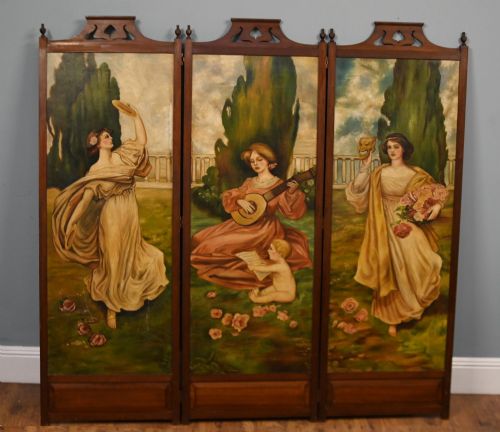
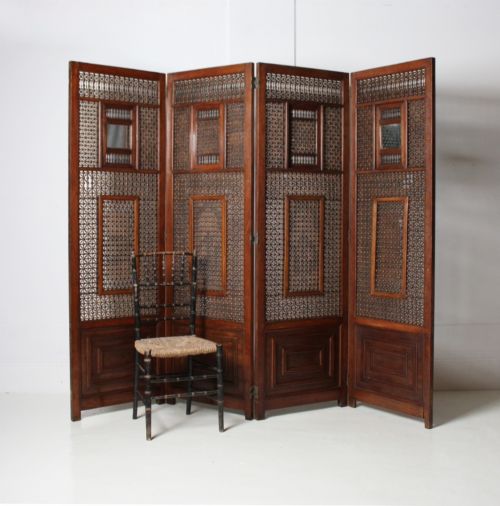


Wood Privacy Partition
A wood privacy partition divides a room with presence, offering architectural depth and quiet seclusion.
Wood Privacy Partition
A wood privacy partition serves to divide a space while introducing distinct period character and craftsmanship to an interior. Buyers hunting for a wood privacy partition encounter folding screens and room dividers spanning multiple panels, ranging from threefold vanity pieces to expansive sixfold barriers.
The pieces represented in current records stretch across diverse global traditions, including Chinese traditional carving, Burmese lacquer work, Anglo-Indian fretwork, and Islamic Revival mashrabiya designs. Alongside these eastern traditions, European examples emerge in Regency, Victorian, and French Rococo Revival styles.
Most items function as multi-panel folding screens constructed to segment a room or create a secluded alcove. These partitions rely on hinged wooden frames that allow the piece to angle across a floor plan and fold flat when not in use.
Materials and construction methods
Makers built these partitions using substantial timbers such as mahogany, teak, and various hardwoods, providing a sturdy framework for intricate decorative work. Carpenters combined structural joinery with surface treatments like gold leaf application, lacquer work, and painted finishes to enrich the visual weight of the timber.
Many partitions incorporate specialised textile elements and perforated panels, utilising silk cotton, needlepoint fabric, and brass hardware alongside carved fretwork and mashrabiya latticework. These combined elements required distinct artisanal skills, from wood carving to textile mounting, executed across multiple hinged panels.
At least one historic screen served as a photographic prop, framing Victorian sitters against silk cotton before finding its way to the marketplace.
Assessing quality in antique partitions
Quality rests upon the depth and precision of the carving, the integrity of the timber, and the sophistication of the surface decoration. Panels featuring deep relief carving, refined fretwork, or skilled lacquer work demonstrate a higher tier of workshop execution than simpler, plain frames.
The sophistication of the hardware and the stability of the folding mechanism contribute significantly to a partition's standing. Finer examples maintain structural balance across multiple heavy folds without relying on modern reinforcement to support their weight.
The Wood Privacy Partition Glossary
- Mashrabiya
- A projecting oriel window enclosed with carved wood latticework, adapted in larger pieces to create breathable decorative room screens.
- Fretwork
- Ornamental design created by cutting patterns through thin wood, frequently utilised in Indian and East Asian screens to filter light.
- Giltwood
- Timber that has been coated with gold leaf or gold paint, common in European revival styles to add luminous detail.
- Needlepoint
- Canvas work embroidery using yarn in a counted stitch, often stretched within the frames of Victorian and Regency screens.
Wood Privacy Partition: Frequently Asked Questions
What periods do these partitions come from?
The available selection spans the nineteenth and twentieth centuries, including Regency, Victorian, and 1950s examples. Each era brings distinct regional aesthetics, from Chinese dragon carvings to English needlepoint panels.
Stylistic markers help identify the origin, noting that Islamic Revival and Anglo-Indian works reflect distinct architectural motifs from their respective regions.
How do I care for antique wooden screens?
Maintain the timber by keeping the partitions away from direct heat sources and fluctuating humidity, which can affect the wood and lacquer surfaces. Dust the carved details regularly with a soft, dry brush.
Protect any fabric or silk cotton inserts by avoiding direct sunlight, which prevents fading and preserves the integrity of the original textiles.
Are these screens heavy to move?
Most multi-panel hardwood and lacquered screens possess substantial weight due to the dense timber and intricate carving used in their construction. Larger fourfold and sixfold pieces generally require two people to position safely.
The inclusion of brass hinges allows the panels to pivot smoothly, but lifting the entire assembly requires care to protect the joints and framework.