

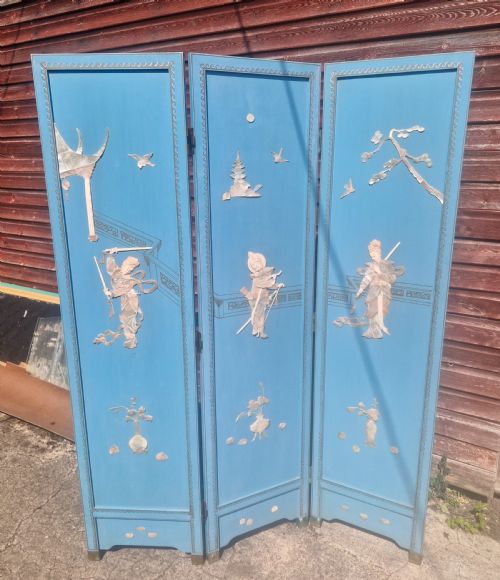


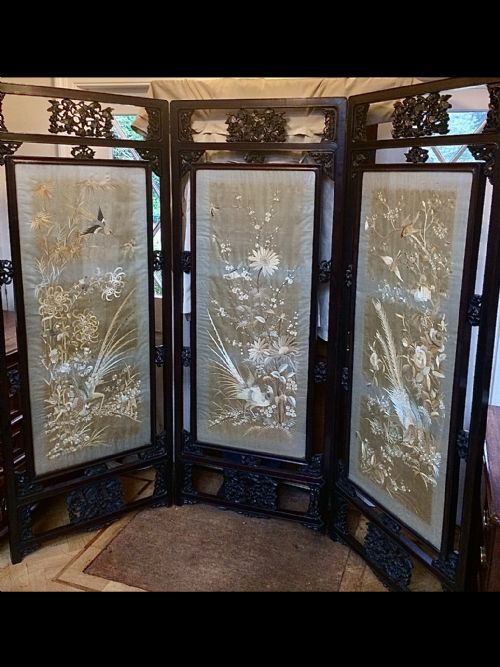

Oriental Carved Wood Partition
Oriental carved wood partition pieces are folding screens and room dividers that create division within a space while displaying elaborate carving.
Oriental Carved Wood Partition
An oriental carved wood partition functions as a movable screen or divider, shaping interiors with folded panels. When searching for an oriental carved wood partition, a buyer encounters folding screens and room dividers spanning multiple panels and eras.
The selections on this page include items from the Victorian period, the nineteenth century, and the twentieth century up to nineteen fifty. Forms range from three-fold and four-fold dressing screens to larger six-fold room dividers and table screens.
Origins represented in the evidence span Chinese Traditional, Chinese Qing Dynasty, Chinese Republic Era, Anglo-Indian, Burmese, and Japanese styles. Most examples serve as functional dividers or photographic props.
How they were made
Maker construction relies heavily on hardwood, teak, and general wood frameworks finished with intricate carving. Many pieces incorporate fretwork and deep relief carving depicting motifs such as dragons.
Surface decoration extends beyond bare wood into lacquer work, silk, silk cotton, and gold leaf applications. Certain panels feature inlay work utilising brass and mother-of-pearl to highlight the visual depth.
Current listings feature materials such as brass, hardwood, teak, lacquer, silk, and mother-of-pearl across pieces dated from eighteen sixty to nineteen fifty.
What varies in quality
Quality rests upon the depth and clarity of the wood carving, distinguishing sharp hand-chiselled details from softer execution. The complexity of the fretwork and the structural integrity of the folding hinges dictate the overall standard.
Finishing materials also drive distinction, where applied gold leaf, intact lacquer layers, and genuine mother-of-pearl inlay elevate a panel above standard painted or plain wood surfaces.
The Oriental Carved Wood Partition Glossary
- Folding screen
- A piece of furniture consisting of two or more panels that are connected by hinges. These panels can be folded back and forth to change the configuration or block sightlines.
- Room divider
- A larger vertical partition used to separate sections of a room. These objects typically comprise multiple hinged panels for freestanding stability.
- Fretwork
- Ornamental openwork created by cutting patterns through wood. This technique provides decorative lightness to heavy hardwood frames.
- Table screen
- A miniature version of a screen designed for placement on a desk or table. These decorative items often feature detailed carvings and stand on small bases.
- Lacquer
- A durable resin finish applied in multiple coats to wood surfaces. This technique produces a smooth, glossy protective coating.
Oriental Carved Wood Partition: Frequently Asked Questions
How were these folding screens used historically?
These screens divided large rooms into private areas, blocked drafts, and served as backdrops for dressing or photography.
They offered flexible room management without requiring permanent structural changes to interiors.
What materials appear in these screens?
Construction materials primarily include hardwood, teak, and general wood enhanced by brass, mother-of-pearl, and gold leaf.
Surface finishes frequently incorporate silk, silk cotton, and lacquer work.
How do I distinguish between regional styles?
Chinese examples often feature dragon carvings and traditional motifs, while Burmese pieces lean towards distinct lacquered finishes.
Anglo-Indian and Japanese items introduce specific fretwork patterns and alternative textile panels.
How do I care for antique wood partitions?
Keep wooden panels away from direct heat sources and fluctuating humidity to prevent wood splitting and lacquer cracking.
Dust gently with a dry cloth and avoid harsh chemical cleaners on delicate silk or gold leaf sections.