
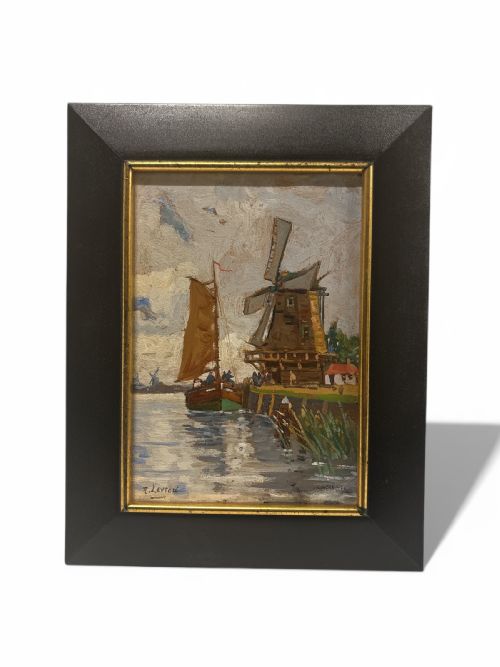
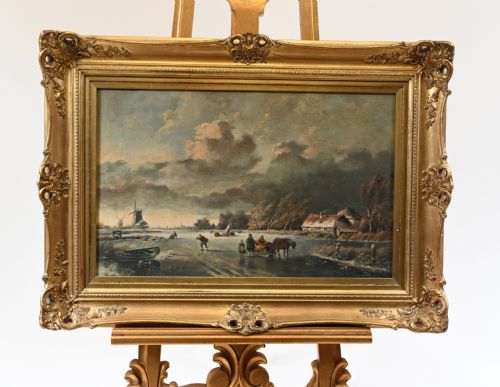
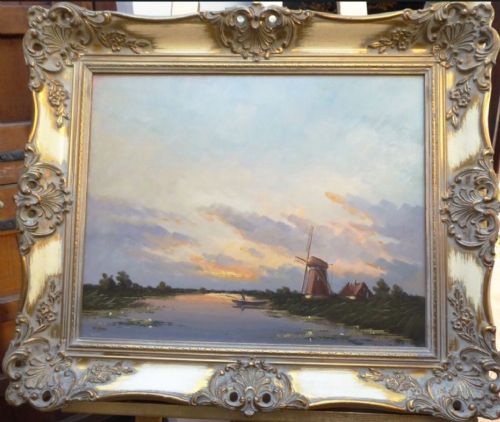


Windmill Oil Landscape Painting
A windmill oil landscape painting brings open horizons, quiet waterways and historic machinery into a room.
Windmill Oil Landscape Painting
A windmill oil landscape painting captures rural and coastal scenes, frequently centred on Dutch, English and French countryside views from the eighteenth century to the post-war period.
Buyers meet works executed in various regional manners, ranging from the Norwich School and Dutch Realism to mid-century naive interpretations and impressionist river views.
Canvases and wood panels show windmills beside canals, frozen waterways, flatland marshes and farming landscapes, framed by skies shifting from sunset warmth to winter chill.
How they were made
Artists painted primarily with oil paint on stretched canvas or wooden panels, sometimes employing board or oval wooden supports.
Brushwork varies from tight nineteenth-century academic detail to looser post-war impressionist strokes, often housed in decorative gilt or solid wooden frames finished with plaster details.
Several artists painted windmills with such enthusiasm they likely spent more time watching sails turn than attending to their dinner.
What varies in quality
Quality rests in the handling of light and atmosphere, distinguishing atmospheric depictions of skies and reflective water from flat topographical illustration.
The strength of composition and confidence of brushwork separate works by established regional schools or named painters from anonymous studio output.
R Leyton·T. Bergman·Edward Seago·Pieter Cornelis Dommersen·John Holland Snr·Kershaw Schofield·J Bell·Harry Kluge·John Falconar Slater·William Manners·Von Goring·Joseph Thors
The Windmill Oil Landscape Painting Glossary
- Norwich School
- A regional group of artists inspired by the Norfolk landscape, noted for observational truth in rural and river subjects. Their output forms a key part of nineteenth-century British painting.
- Wood Panel
- A rigid support used by artists before stretched canvas became dominant, frequently offering fine preservation for early landscape details. Panels were often prepared with a gesso ground before painting.
- Impressionism
- A style prioritising visible brush marks and the changing qualities of light over precise academic finish. Post-war examples apply this freedom to mid-century rural subjects.
- Naive Art
- Painting characterised by a childlike perspective, simplified forms and direct application of pigment. These works focus on charm and topographical detail rather than strict proportion.
Windmill Oil Landscape Painting: Frequently Asked Questions
How do I date a windmill painting?
Dating relies on canvas preparation, frame style, signature records and the costume of any figures included in the composition. Eighteenth-century and nineteenth-century works typically display different material ageing compared to 1950s or 1960s post-war pieces.
Examining the reverse of the panel or canvas often reveals inscriptions, artist stamps or old gallery labels that clarify the exact period.
What is the difference between Dutch and English windmill scenes?
Dutch scenes generally emphasise flat horizons, wide canals, frozen waterways and polder landscapes under expansive skies. English paintings frequently depict rolling countryside, thatched cottages and river navigation associated with the Norwich or regional schools.
Brush technique also guides attribution, with Dutch Realism focusing on light over water and English works leaning towards pastoral observation.
How should I hang and light an oil painting?
Oil paintings on canvas or wood require stable indoor humidity away from direct sunlight and heat sources to prevent cracking. Picture lights fitted with low-heat LED bulbs illuminate the impasto and varnish layers effectively.
Allowing sufficient wall space around decorative gilt frames ensures the artwork remains the focal point of the room.