
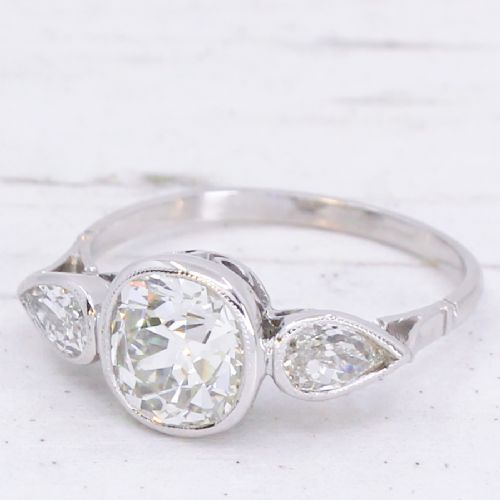
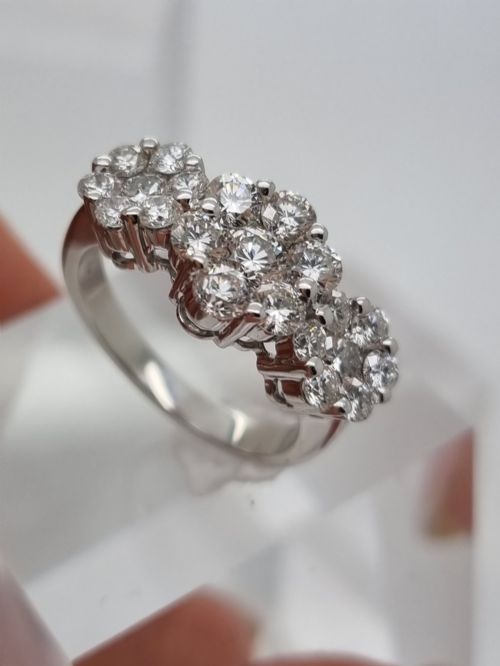
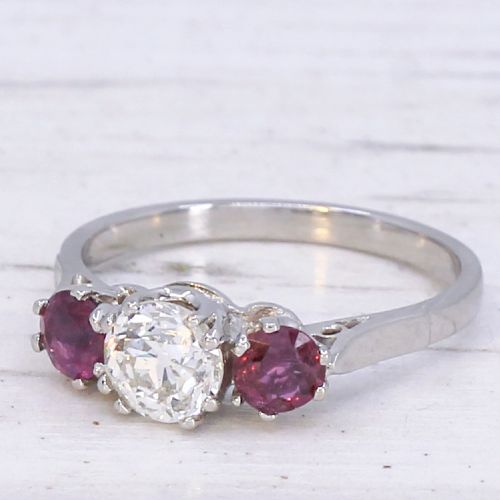


White Gold Trilogy Ring
A white gold trilogy ring gathers past, present and future into three stones, carrying the distinct geometry of the Art Deco and Victorian eras.
White Gold Trilogy Ring
A white gold trilogy ring presents a trio of gems aligned on a band, often associated with the past, present and future of a relationship. When you search for this phrase, you encounter pieces that range from late Victorian examples to mid-century modern designs, with the Art Deco period heavily represented.
The materials span white gold, yellow gold, and platinum settings, holding diamonds alongside opals, sapphires, emeralds, and aquamarines. The central stone typically commands attention while two flanking gems balance the composition along the finger.
Victorian and Edwardian iterations tend to pair diamonds with opals in yellow gold or platinum, whilst 1930s and Art Deco variations favour old cut diamonds or coloured gems mounted in 18ct white gold.
Materials and Construction
Goldsmiths utilised 18ct white gold, 9ct gold, and platinum to fabricate the mounts, often combining metals to support complex gemstone settings. Old cut diamonds, pear cuts, and cushion cuts were shaped by hand to fit geometric or claw settings characteristic of the periods.
Coloured gemstones such as aquamarine, ruby, emerald, and natural sapphire appear alongside pearls and opals, secured with detailed claw or bezel work. The physical structure relies on durable precious metals to support three distinct stones in a linear arrangement.
Listings feature periods from the 19th century through the 1960s, using 18ct white gold, platinum, and 9ct gold.
Distinctions in Quality
The standard of a piece rests on the calibre of the central and flanking gems, particularly the cut and clarity of the diamonds and the saturation of coloured stones like emerald and sapphire. Older pieces display the individual character of hand-cut stones rather than uniform modern machining.
The integrity of the metalwork, whether platinum or 18ct white gold, and the precision with which the three stones are secured determine the longevity and refinement of the ring. Superior examples maintain crisp geometric lines in Art Deco settings or harmonious proportions in Victorian floral clusters.
The White Gold Trilogy Ring Glossary
- Trilogy ring
- A ring featuring three principal stones set in a row on the band, traditionally symbolising the past, present and future.
- Old cut diamond
- A diamond cut by hand before modern machinery, characterised by a smaller table, higher crown and larger culet that catch candlelight.
- Art Deco
- A design style spanning the 1920s and 1930s defined by geometric symmetry, clean lines and stark contrasts between white metals and gemstones.
- Platinum
- A dense, durable white metal utilised in fine jewellery for its strength in securing delicate gemstone settings without tarnishing.
- Baguette diamond
- A step-cut diamond shaped into a narrow rectangle, frequently used as an accent stone in twentieth-century rings.
White Gold Trilogy Ring: Frequently Asked Questions
What is a white gold trilogy ring?
A white gold trilogy ring is a three-stone ring mounted in white gold, symbolising past, present and future.
These pieces feature prominently from the Victorian, Edwardian and Art Deco periods, showcasing diamonds and coloured stones.
How can I date my ring?
Dating depends on stylistic markers such as Art Deco geometric lines or Victorian floral arrangements.
Materials like platinum, 18ct white gold and specific gemstone cuts also help determine the era of manufacture.
Are these rings suitable for daily wear?
Most pieces constructed from 18ct white gold, platinum and diamond are durable enough for everyday engagement wear.
Softer gems like opal require greater care to avoid impact and scratching during regular use.
What stones are used besides diamonds?
Common companion stones include natural sapphire, emerald, aquamarine, ruby and opal.
These coloured gems appear alongside or instead of diamonds, particularly in mid-century and Art Deco designs.