

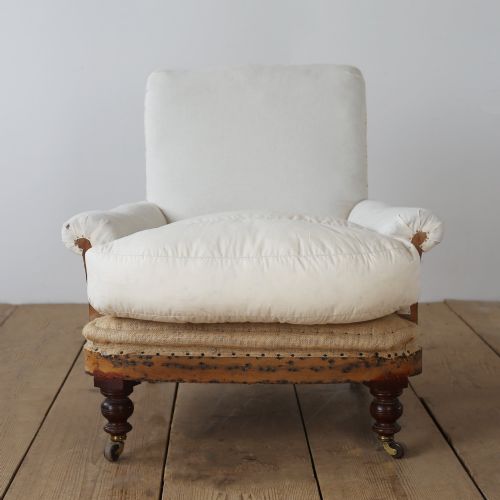
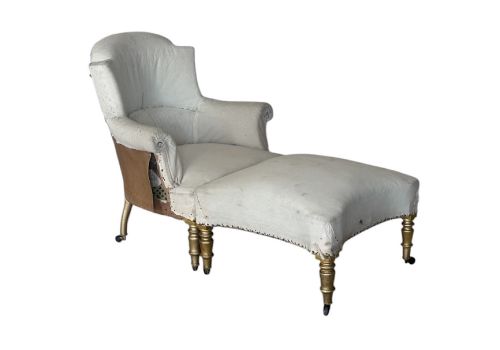
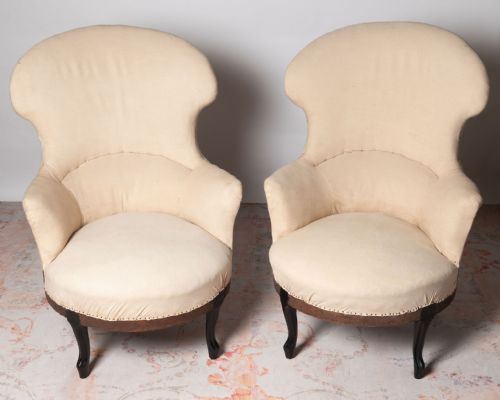


White Calico Armchair
A white calico armchair offers simple upholstered comfort, providing a clean canvas ready for final covering.

White Calico Armchair
A white calico armchair is an upholstered seat intended for domestic use, frequently found in styles spanning the eighteenth, nineteenth, and early twentieth centuries. These pieces appear in forms such as club armchairs, open armchairs, wingbacks, and square-backed designs.
The selections on this page include French nineteenth-century examples alongside English country house pieces, often upholstered in plain cotton calico. Buyers most frequently encounter nineteenth-century items prepared in calico as base covers awaiting final decoration.
Armchairs and chaise longues dominate the available inventory, reflecting traditional seating requirements of past centuries. Each piece displays the structural characteristics of its specific period, whether George III or Edwardian.
Materials and construction
Construction relies upon timber frameworks, with mahogany and walnut forming the structural support for traditional seating. These hard woods provide the rigid skeleton necessary to sustain heavy upholstery and daily use.
Upholstery techniques utilise cotton calico and hessian stretched over internal stuffing, secured with brass tacks where exposed. This foundational layering creates the firm yet resilient shape characteristic of period armchairs.
White Calico Armchair Retail Price Guide 2026
Typical asking prices for white calico armchair among the pieces listed under this phrase on Sellingantiques today, from the lower quarter to the upper quarter. They describe what is for sale here now, not the wider market.
Some nineteenth-century chairs arrive wearing calico like a ghost costume, patiently waiting for someone to give them a personality.
Assessing craftsmanship and condition
Quality in these armchairs rests upon the integrity of the underlying timber frame and the precision of its original joinery. Superior examples maintain rigid, stable structures without movement in the joints.
The standard of preparatory work and upholstery execution distinguishes finer pieces from ordinary stock. Careful tensioning of the calico fabric and robust internal webbing indicate higher workshop standards.
Howard and Sons·Sopwith
The White Calico Armchair Glossary
- Calico
- A plain-woven cotton textile used as a durable base upholstery or loose cover. It provides a neutral, tight surface on period frames.
- Wingback
- An armchair featuring protective side panels attached to the arms and back to deflect drafts. This form dates back to the seventeenth century and continued through the Georgian era.
- Hessian
- A coarse woven fabric, typically made from jute fibres, utilised inside upholstered furniture as a foundation layer for stuffing. It supports the internal padding.
- Duchess Brisee
- A two-part chaise longue or an armchair accompanied by a matching stool designed to form a continuous resting place. French nineteenth-century makers produced notable examples.
White Calico Armchair: Frequently Asked Questions
What is a white calico armchair?
A white calico armchair is a period seat upholstered in plain cotton fabric, functioning either as a finished utilitarian piece or as an intermediate stage before final covering.
These chairs span various historical eras from the eighteenth century onwards, showcasing distinct regional designs such as English country house or French Napoleon III styles.
How do I choose the right period?
Selecting a period depends on the architectural style of your interior and your preference for specific design lines. Eighteenth-century wingchairs offer formal silhouettes, whereas nineteenth-century club armchairs prioritise deep-seated comfort.
Examine the structural form, wood type, and leg style to determine whether a piece aligns with Georgian, Victorian, or Edwardian aesthetics.
Can I use calico as a final cover?
Calico functions effectively as a crisp, minimalist final covering for those who prefer an unpretentious, neutral aesthetic in contemporary interiors. Many buyers leave the calico exposed for its clean, understated appearance.
Alternatively, the calico serves as a sturdy foundation layer ready to receive decorative top fabrics of your choosing.
How should I care for cotton upholstery?
Regular gentle vacuuming with a soft brush attachment prevents dust from settling into the tightly woven cotton fibres of the calico. Promptly attending to minor marks with appropriate textile cleaners helps maintain the fabric.
Avoiding direct, prolonged sunlight protects the cotton from premature fading and preserves the overall integrity of the textile.