


Whitby Harbour Watercolour
These whitby harbour watercolour works capture the Yorkshire coast through maritime scenes, historic abbeys and bustling fishing docks.
Whitby Harbour Watercolour
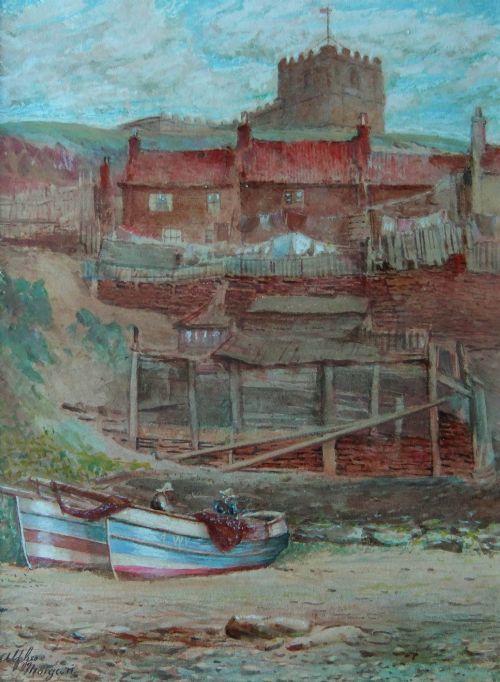
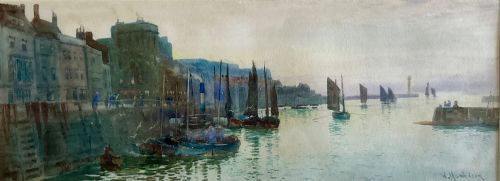
A whitby harbour watercolour presents maritime views of the Yorkshire coast, typically featuring the historic abbey, harbour piers and local fishing craft such as cobles. These works range from late Victorian compositions to mid twentieth-century interpretations, reflecting shifting stylistic approaches to landscape and marine subjects.
The pieces most frequently encountered on this page date from the turn of the twentieth century into the nineteen-thirties, executed by regional and nationally exhibited British artists. Such watercolours record the changing topography of the harbour, the east cliff and the river esk against varied atmospheric conditions.
Compositions often encompass specific local landmarks, including St Mary's Church, Tate Hill Pier and the marine hotel, providing a clear topographical record alongside artistic merit. Collectors find works spanning Victorian realism through to British impressionist treatments of the northern light.
Materials and Technique
Artists executed these works using watercolour pigment and watercolour paint applied to paper supports, occasionally incorporating bodycolour for highlights on marine foam or vessel rigging. The primary medium relies on transparent washes layered to build depth in the sea, sky and stone architecture of the town.
Surviving examples frequently retain their period framing, consisting of gilt wood mouldings and protective glass that shield the delicate paper and water-soluble pigments from environmental moisture and light degradation. Mounting boards and paper supports from the Victorian and Edwardian eras commonly display natural age toning appropriate to their age.
Listings feature paper supports, watercolour pigment and gilt wood framing across Victorian, Edwardian and mid-twentieth-century periods.
Assessing Quality
Quality in a whitby harbour watercolour depends upon the handling of light and atmospheric perspective, particularly how the artist renders the expansive Yorkshire skies and the reflective surface of the harbour water. Superior examples demonstrate confident brushwork and precise topographical rendering without descending into stiff illustration.
The distinction between standard works and exceptional pieces rests in the vibrancy of the pigment preservation and the strength of the composition, such as the placement of fishing boats and figures against the harbour backdrop. Provenance, clear signatures and framing integration further separate minor topographical sketches from major exhibition watercolours.
Alfred G. Morgan·William Matthison·Tom Clough·Fred Waugh·James Thomas Watts·Albert Robert Quinton·William Kay Blacklock·Harry Wanless·Thomas Clavering Alder·Frank Rousse·Rowland Henry Hill·Robert Leslie Howey·A.G. Stevens·John Syer·W Tetley·Julian E. Drummond·John Wynne Williams·Edwin Cockburn·Emily Prowde·Edward William Cooke·Henry Barlow Carter·Tom Simpson
The Whitby Harbour Watercolour Glossary
- Coble
- A traditional type of open fishing boat native to the north-east coast of England, frequently depicted in regional marine watercolours.
- Gilt wood
- Wood framing treated with gold leaf or metallic gilding, commonly found on period watercolours from the Victorian and Edwardian eras.
- Watercolour pigment
- Finely ground colour particles suspended in a water-soluble binder, forming the primary medium for these coastal paintings.
Whitby Harbour Watercolour: Frequently Asked Questions
What periods do these watercolours cover?
The available works span from the Victorian era through the Edwardian period and into the mid-twentieth century, capturing shifting artistic movements.
Most pieces concentrate around the turn of the twentieth century, reflecting a high point for British watercolour representation of northern ports.
How should I frame and display my painting?
Watercolours require conservation framing behind glass with acid-free mounts to prevent paper degradation and pigment fading from ultraviolet light.
Keep paintings away from direct sunlight and damp environments to preserve the integrity of the paper support and original gilt frames.
Are these works signed by the artists?
Many of the watercolours feature original signatures, monograms or inscriptions detailing the specific Whitby location by the artist's hand.
Signed pieces often provide a direct link to exhibited works from regional art societies active during the late nineteenth and early twentieth centuries.
What subjects besides the harbour appear in the art?
Artists frequently included Whitby Abbey, St Mary's Church, the East Cliff and local fishing craft operating around the river esk.
These varied viewpoints offer collectors distinct perspectives on the town's maritime heritage and architectural landmarks.