


Whitby Harbour Watercolour Art
These whitby harbour watercolour art works capture the historic Yorkshire port through pigment on paper, offering buyers a genuine window into maritime history.
Whitby Harbour Watercolour Art
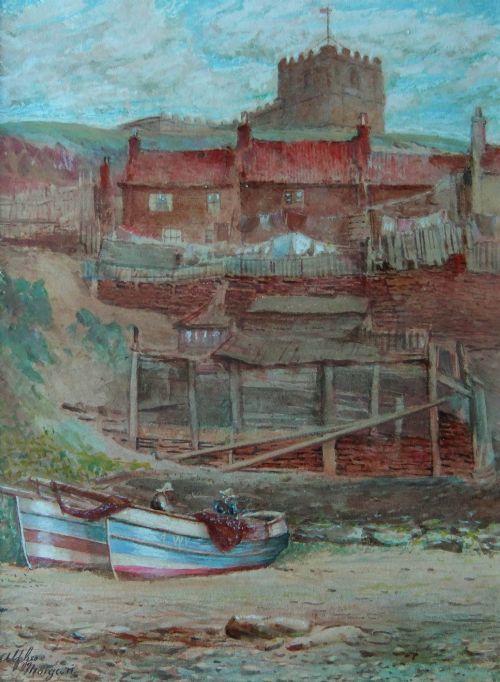
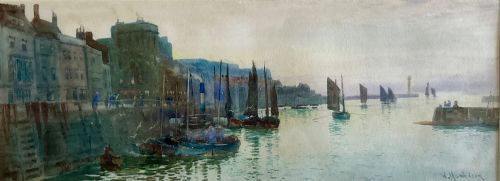
Whitby harbour watercolour art comprises original paintings on paper depicting the Yorkshire port, its abbey, and its fishing vessels. These works span from the Victorian period through the Edwardian era into the mid-twentieth century.
The most common examples encountered on this page date from around nineteen hundred to the nineteen thirties. They feature marine views, docks, and coastal scenes rendered by British artists working in watercolour pigments.
Subjects frequently centre on the harbour entrance, Tate Hill Pier, and the silhouette of the abbey overlooking the River Esk. Painters record local shipping, including cobles and fishing boats preparing for departure.
How They Were Made
Artists apply watercolour pigment and paint directly onto paper supports, often framed behind glass within gilt wood surrounds. The medium relies on the luminosity of the white paper shining through transparent washes of colour to create light and atmosphere.
Techniques range from loose British Impressionism to precise marine realism, depending on the period and hand of the painter. Pigments capture the shifting coastal light of Yorkshire skies and the dark stone of the harbour architecture.
Listings feature watercolours spanning the Victorian and Edwardian eras up to the nineteen fifties, executed on paper with pigment.
What Varies in Quality
Quality rests upon the artist's ability to command the watercolour medium and handle complex coastal architecture and shipping forms. Skilled hands achieve depth in marine skies and movement in harbour water without heavy overworking.
Provenance and signature clarity elevate specific examples, as do original period framing materials that protect the fragile paper surface. Works displaying confident brushwork and accurate topographical detail represent the higher tier of the genre.
Alfred G. Morgan·William Matthison·Tom Clough·Albert Robert Quinton·Frank Rousse·Rowland Henry Hill
The Whitby Harbour Watercolour Art Glossary
- Watercolour pigment
- Colouring material ground with a water-soluble binder for application on paper. It allows for transparent washes that capture light.
- Coble
- A traditional type of open fishing boat native to the North East coast of England. These craft frequently appear in local marine views.
- Gilt wood
- Wood framing finished with a thin layer of gold leaf or metallic gilt. It protects the watercolour painting and glass.
- British Impressionism
- A style of painting focusing on light and spontaneous brushwork. Practitioners recorded atmospheric coastal conditions rather than rigid detail.
- Marine realism
- An artistic approach emphasising accurate depiction of maritime subjects. Artists rendered vessels, rigging, and coastal geography with precision.
Whitby Harbour Watercolour Art: Frequently Asked Questions
How do I date a watercolour?
Dates rely upon artist signatures, period framing, and stylistic markers such as Victorian or Edwardian dress and shipping types. Archive records and inscriptions on the reverse of the paper also provide clues.
Changes in paper manufacture and pigment chemistry across the nineteenth and twentieth centuries help narrow the decade of creation.
Where should I hang these paintings?
Watercolours require careful placement away from direct sunlight to prevent the pigments from fading over time. Interior walls with stable humidity protect the fragile paper and gilt wood frames.
Positioning them at eye level in well-lit rooms allows the fine details of the harbour and shipping scenes to be appreciated.
What subjects appear most often?
Views of Whitby Harbour, the River Esk, and the abbey dominate these works. Artists frequently painted fishing boats, piers, and local maritime life.
Coastal landscapes featuring the East Cliff and harbour entrance recur across multiple decades of artistic output.
How do I care for antique paper?
Keep works behind glass in sealed frames to block atmospheric pollutants and dust. Avoid areas of high moisture and sudden temperature shifts.
Professional framing using acid-free mounts ensures the watercolour paper remains stable for years to come.