
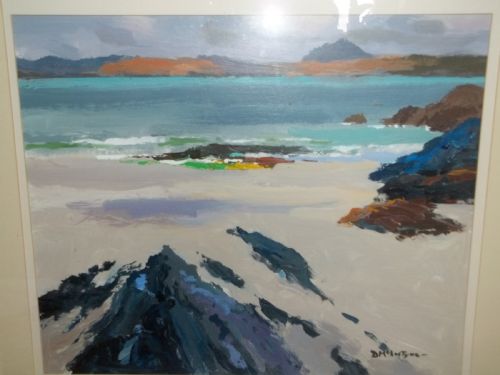
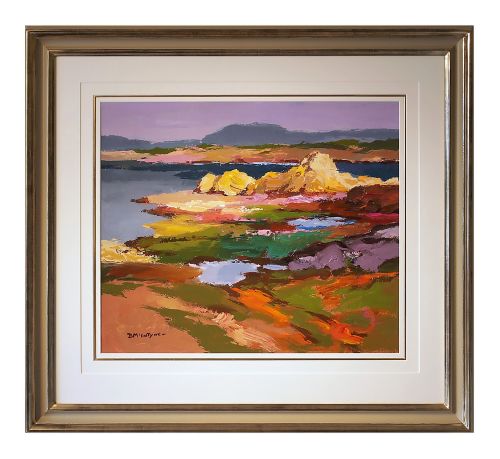
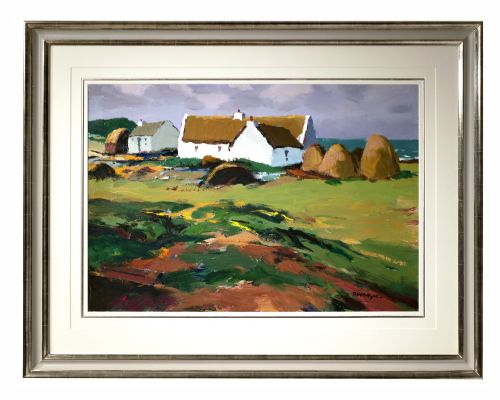


Welsh Landscape Oil
A welsh landscape oil captures the mountains, rivers, and valleys of Wales through decades of shifting artistic styles.
Welsh Landscape Oil
A welsh landscape oil brings the topography of Snowdonia, river valleys, and coastal scenes into focus through painted canvas and board.
The selections span from the nineteenth century into the mid-twentieth century, moving from detailed Victorian pastorals toward modern British interpretations.
Buyers encounter depictions of specific locations such as Betws-y-coed, the Conwy river, and Cardiganshire valleys alongside more generalized rural views.
Materials and construction
Artists utilised oil paint applied to stretched canvas, wooden panels, or card supports to build up texture and depth.
Many surviving examples retain their original frames constructed from giltwood, wood, and gesso moulded details.
Several canvases capture passing summer showers hovering precisely over the Snowdon range.
Distinctions in quality
Quality rests on the fidelity of the topography, the assurance of brushwork, and the handling of atmospheric light over mountain ranges.
Works by established named painters command greater attention than anonymous studio output due to their recorded provenance and stylistic confidence.
Donald McIntyre·Sidney Richard Percy·William Mellor·Benjamin Williams Leader·Alfred de Breanski
The Welsh Landscape Oil Glossary
- Oil on Canvas
- A traditional painting medium where pigment mixed with drying oil is applied to a woven fabric support stretched across a wooden frame.
- Giltwood
- Timber carved and coated with gold leaf or gold paint, frequently used for traditional picture frames.
- Gesso
- A plaster-like mixture applied to wood or canvas as a smooth base before gilding or painting.
- Panel
- A rigid support made from wood or card utilised by artists in place of flexible canvas.
Welsh Landscape Oil: Frequently Asked Questions
What periods do these paintings cover?
The selections range from the late eighteenth century through the Victorian era and into the mid-twentieth century.
Most pieces originate from the nineteenth and early twentieth centuries, reflecting changing British landscape traditions.
Where are the locations depicted?
Depicted locations focus heavily on North Wales, including Snowdonia, the Conwy valley, and coastal inlets.
Artists frequently recorded specific riverbanks, mountains, and country mills recognizable to travellers.
How should I frame an antique oil?
Many works retain period giltwood or wood frames that complement the palette of the canvas.
Care should be taken to preserve original framing elements where the maker or framer marks remain intact.
Are these paintings signed?
Numerous works feature artist signatures, monograms, or period inscriptions on the canvas, stretcher, or reverse.
Archival records and signature styles help attribute unsigned works to specific regional schools.