

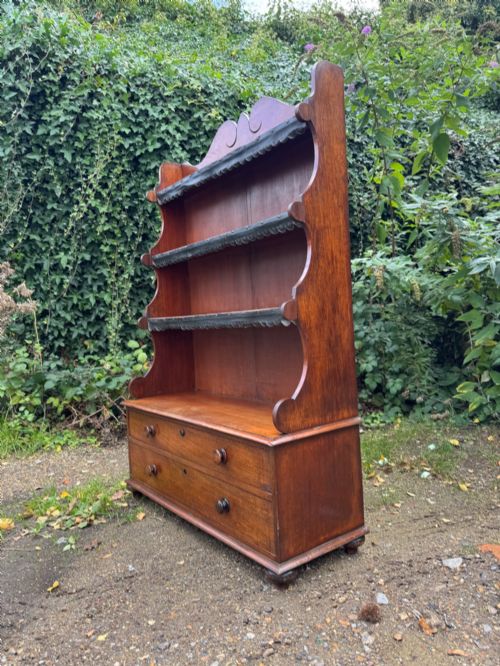
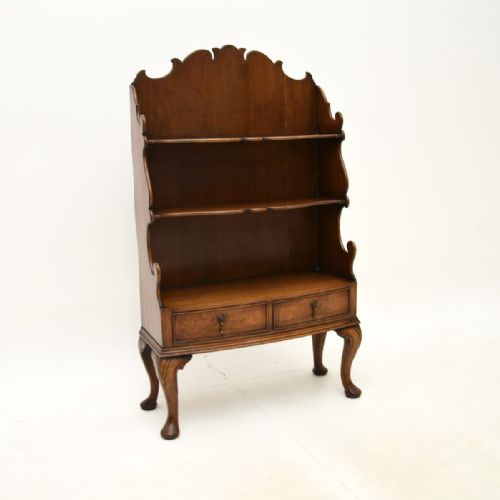
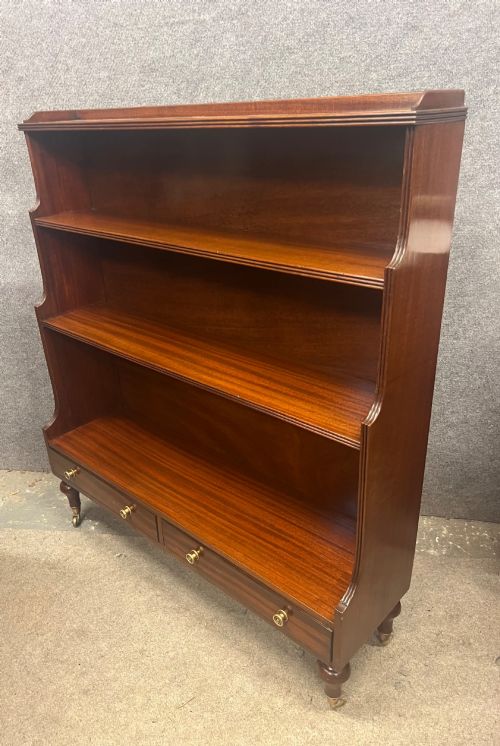
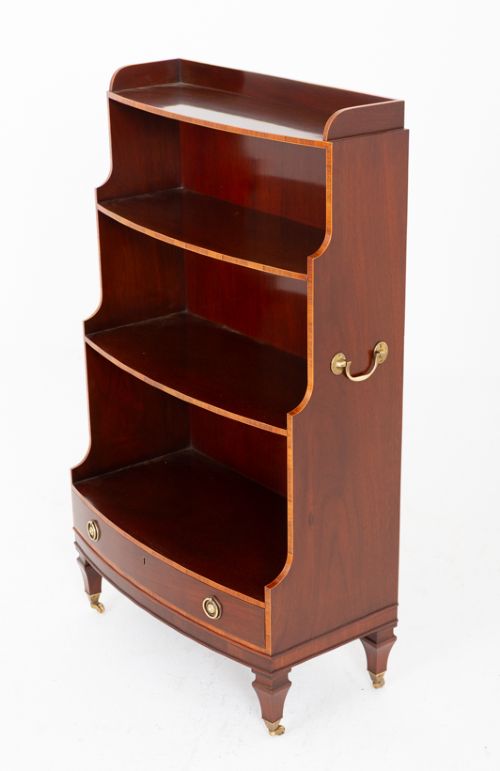
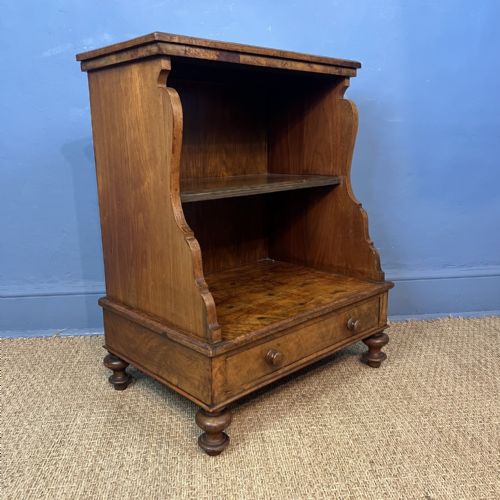


Waterfall Bookcase with Drawers
A waterfall bookcase with drawers offers tiered shelving and lower storage, combining architectural elegance with practical display.
Waterfall Bookcase with Drawers
A waterfall bookcase with drawers is a tiered shelving unit featuring graduated shelves that step back from bottom to top, paired with one or more lower storage compartments. These pieces appear across several periods, including Georgian, Regency, and Victorian eras, as well as around 1800, 1880, 1900, 1910, and 1920.
Makers and origins span various traditional English cabinet-making traditions, resulting in both freestanding designs and matched pairs. Buyers encounter woods such as mahogany, burr walnut, walnut, and satinwood, often enhanced with brass details.
How they were made
Cabinet-makers constructed these pieces using solid timbers and wood veneers over sturdy carcases, applying mahogany, burr walnut, walnut, and satinwood to the exterior surfaces. Brass hardware appears on drawers and fixtures, while wire work occasionally integrates into the design.
The stepped shelves are graduated in depth to create the signature cascading silhouette, joined securely to side panels that support the weight of heavy volumes. Timber selection prioritised decorative grain patterns, particularly in burr walnut and figured mahogany editions.
Waterfall Bookcase with Drawers Retail Price Guide 2026
Typical asking prices for waterfall bookcase with drawers among the pieces listed under this phrase on Sellingantiques today, from the lower quarter to the upper quarter. They describe what is for sale here now, not the wider market.
Some shelves step back so gradually they create an architectural staircase for a very small library.
What varies in quality
Quality differences stem from the choice of timber veneer and the precision of the graduated joinery along the stepped tiers. Superior examples display carefully matched grain patterns across the shelves and drawer fronts, alongside refined proportions.
The integration of supplementary elements like lower drawers and integrated compartments distinguishes standard shelving from finer cabinet-work. Hardware execution and the crispness of edge mouldings further separate workshop standards.
Gillows
The Waterfall Bookcase with Drawers Glossary
- Waterfall bookcase
- A tiered shelving unit where each shelf is narrower than the one below it, creating a cascading silhouette. This format maximises vertical display space.
- Dwarf bookcase
- A low shelving unit designed to sit beneath dado height, keeping books within easy reach. These pieces often incorporate drawers in the lower section.
- Canterbury
- A low stand featuring partitioned sections for holding books, music sheets, or newspapers, frequently incorporated into the base of larger shelving units.
- Veneer
- A thin slice of decorative wood applied to a secondary timber carcase to create a figured surface. Burr walnut and mahogany veneers are typical examples.
Waterfall Bookcase with Drawers: Frequently Asked Questions
What is a waterfall bookcase with drawers?
A waterfall bookcase with drawers is a tiered shelving unit featuring graduated shelves that step back toward the top. The base incorporates storage drawers for smaller items.
These pieces combine open display space with enclosed storage, appearing in mahogany, walnut, and satinwood across multiple historical periods.
How do I style a waterfall bookcase?
Place the bookcase against a flat wall where the stepped profile and grain patterns remain visible. Use the graduated shelves to arrange books by height, keeping heavier volumes near the bottom.
The lower drawers accommodate small items, allowing the open tiers to remain uncluttered for decorative objects.
Are these bookcases freestanding?
Most examples are designed to stand independently against a wall without requiring permanent wall fixings. Their solid timber construction provides natural stability.
Freestanding display shelves and dwarf bookcases offer flexibility for placement within living spaces and libraries.
How do I identify the period?
Period identification relies on timber selection, structural proportions, and decorative details like brass fittings. Georgian and Regency pieces often feature figured mahogany and restrained classical lines.
Later Victorian and early twentieth-century examples introduce burr walnut veneers and alternative proportions while maintaining the cascading format.