

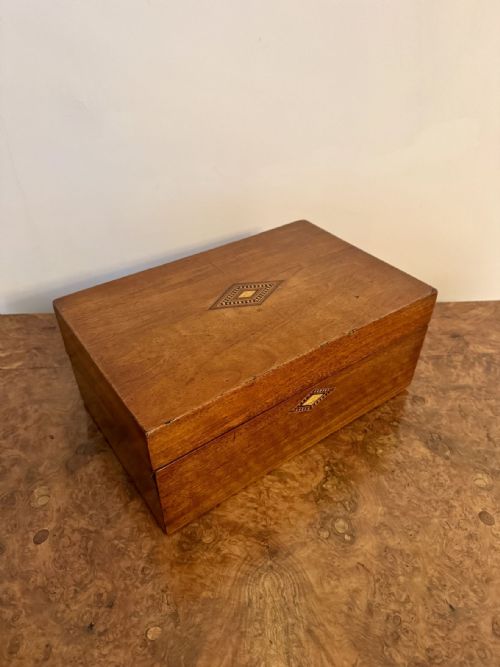
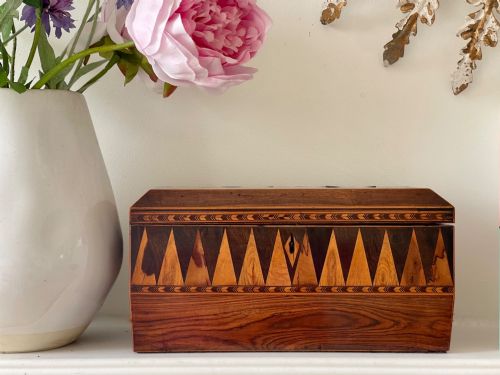


Walnut Tunbridge Box
A walnut tunbridge box offers intricate mosaic woodwork encased in rich timber, prized for its detailed inlaid panels and practical Victorian forms.
Walnut Tunbridge Box
A walnut tunbridge box brings together the dense, figured grain of walnut timber with the celebrated mosaic woodwork originating from Tunbridge Wells. These objects span tea caddies, writing slopes, and work boxes produced primarily during the Victorian and Georgian periods.
The most common examples on this page are table boxes, stationery boxes, and ladies' boxes featuring geometric parquetry or floral mosaic panels set into walnut lids and bodies.
How they were made
Craftsmen utilised solid walnut and burr walnut for the primary carcass, applying fine wood veneers and brass hardware to structure writing slopes and caddies. The characteristic mosaic decoration relied on bundling thin strips of diverse woods including boxwood, holly, and rosewood, then slicing them transversely to produce thousands of identical pictorial tesserae.
These tiny wooden tiles were assembled by hand into intricate pictorial or geometric bands and pressed into recessed channels within the walnut timber.
Walnut Tunbridge Box Retail Price Guide 2026
Typical asking prices for walnut tunbridge box among the pieces listed under this phrase on Sellingantiques today, from the lower quarter to the upper quarter. They describe what is for sale here now, not the wider market.
Some nineteenth-century examples double as playing card containers for the traditional card game bezique.
What varies in quality
The distinction between standard containers and exceptional pieces rests upon the density and complexity of the mosaic inlay work. Finer items display a vast array of natural timber colours forming complete pictorial scenes or meticulous parquetry borders, whereas simpler examples rely on sparse geometric banding.
Interior fittings also dictate standard, with superior items retaining fitted compartments, velvet linings, and original brass inkwells or writing equipment.
Henry Hollamby·Edmund Nye·Faudels Of London
The Walnut Tunbridge Box Glossary
- Tunbridge Ware
- Woodware decorated with mosaic veneer formed from thousands of tiny tinted wood blocks. This mosaic technique creates intricate geometric patterns or pictorial panels.
- Parquetry
- Geometric mosaic woodwork arranged in regular patterns like cubes or herringbone. It differs from pictorial inlay by focusing on repeating symmetrical motifs.
- Burr Walnut
- Timber taken from a walnut tree growth showing swirling, highly figured grain patterns. Cabinet makers prized this wood for its decorative surface on box lids.
- Writing Slope
- A desk accessory featuring a hinged sloping lid that opens to reveal a writing surface and compartment storage. Many examples include internal pen trays and inkwell recesses.
Walnut Tunbridge Box: Frequently Asked Questions
What was a walnut tunbridge box used for?
These boxes served multiple domestic purposes depending on their internal fittings, functioning as repositories for tea, stationery, letters, sewing equipment, or jewellery.
Owners kept them on tables in drawing rooms and studies to organise personal correspondence and valuables.
How do I care for my box?
Keep wooden boxes away from direct sunlight and sudden temperature changes to protect the delicate mosaic veneers and prevent timber warping.
Apply a minimal amount of appropriate wax polish occasionally to maintain the natural lustre of the walnut surface.
Are all these boxes Victorian?
The majority of pieces date from the Victorian era and the nineteenth century, though a smaller number originate from the Georgian period.
Stylistic cues and construction methods help distinguish the earlier Georgian items from later nineteenth-century manufacturing.