


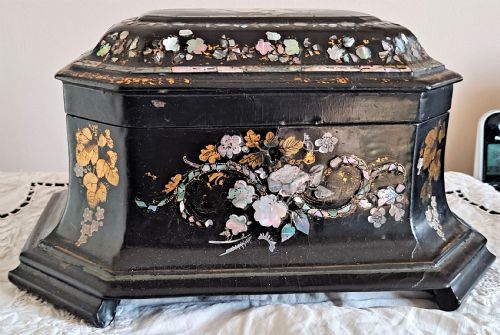


English Inlaid Tea Caddy
An english inlaid tea caddy brings domestic history to life, offering a tactile connection to the tea rituals of Georgian and Victorian parlours.
English Inlaid Tea Caddy
An english inlaid tea caddy serves as a specialised box designed to store loose leaf tea safely away from humidity and light. These pieces frequently take the form of sarcophagus boxes, rectangular chests, or dome-topped containers originating from the Georgian, Regency, and Victorian periods.
The varieties met most often on this page combine dense tropical hardwoods with contrasting light wood stringing, geometric Tunbridge mosaic panels, or intricate brass inlay. Makers constructed these items to sit prominently on the sideboard or table during formal social gatherings.
Many survivors retain internal compartments, mixing lidded canisters with spaces for loose leaf storage or glass mixing bowls. Alongside standard tea caddies, related forms such as teapoys and keepsake boxes appear frequently in the selection.
Materials and Construction Methods
Cabinetmakers built the structural carcass of each english inlaid tea caddy using timbers such as mahogany, rosewood, walnut, or satinwood, often applied as fine veneers over a secondary wood base. They incorporated boxwood, fruitwood, and bone to create sharp linear stringing and pictorial medallions.
Makers utilised specialist techniques like Tunbridge mosaic to assemble thousands of tiny tinted wood blocks into intricate geometric or floral patterns. Brass stringing and inlaid motifs were carefully embedded into channels carved directly into the hardwood surfaces.
English Inlaid Tea Caddy Retail Price Guide 2026
Typical asking prices for english inlaid tea caddy among the pieces listed under this phrase on Sellingantiques today, from the lower quarter to the upper quarter. They describe what is for sale here now, not the wider market.
Certain Victorian boxes conceal secret drawers triggered by hidden wooden latches, designed to guard the tea key from grasping servants.
Distinctions in Quality
The standard of an english inlaid tea caddy rests on the precision of its decorative marquetry and the integrity of its timber selection. Superior examples display tightly fitted mosaic panels and balanced grain patterns without warping across the lid and sides.
Interior completeness dictates much of the standing within this category, as pieces retaining original mixing bowls, internal lids, and functional locks command greater attention. The refinement of brass escutcheons and working hinges further separates standard workshop production from finer cabinet work.
Henry Hollamby
The English Inlaid Tea Caddy Glossary
- Sarcophagus caddy
- A box shape resembling a miniature stone coffin, featuring a steep pitched lid and often resting on bun feet. This form became particularly popular during the Regency period.
- Tunbridge ware
- Woodware decorated with mosaic patterns created by gluing together many small strips of naturally coloured woods before slicing them into veneers. The technique reached a high standard in Kent during the nineteenth century.
- Teapoy
- A pedestal table fitted with a heavy storage box on top, designed to hold tea canisters and mixing vessels. These freestanding pieces replaced tabletop caddies in formal drawing rooms.
- Escutcheon
- A protective plate surrounding the keyhole of a box, commonly cast in brass and occasionally engraved. It serves both a functional purpose and a decorative role on the front panel.
- Stringing
- Thin lines of contrasting wood inlay used to outline panels, borders, and lids on antique cabinetry. This detail defines the geometric geometry common to Georgian and Regency designs.
English Inlaid Tea Caddy: Frequently Asked Questions
What was inside an antique tea caddy?
Original interiors typically featured two or three lidded compartments to separate green and black teas, keeping the precious leaves dry and aromatic.
Some layouts also included a central glass bowl used for blending different teas or washing leaves before brewing.
How do I date an inlaid tea caddy?
Georgian examples generally rely on mahogany with shell or floral marquetry and simpler rectangular proportions.
Regency and Victorian pieces introduce rosewood, elaborate brass inlay, or complex Tunbridge mosaic work alongside sarcophagus shapes.
Why are some caddies shaped like furniture?
Cabinetmakers occasionally created novelty forms, such as miniature chests of drawers or scaled-down wardrobes, to showcase their technical skill.
These whimsical designs functioned identically to standard boxes while adding conversational charm to the parlour.
Are these boxes still suitable for storing tea?
Historic caddies lack modern airtight seals, meaning dry tea stored inside can lose its flavour over time.
Owners today primarily use them as decorative display items or secure containers for modern keepsakes and jewellery.