





Walnut Spoonback Armchair
These walnut spoonback armchairs bring rich Victorian character and comfortable seating to any room through curved wooden frames and traditional upholstery.
Walnut Spoonback Armchair
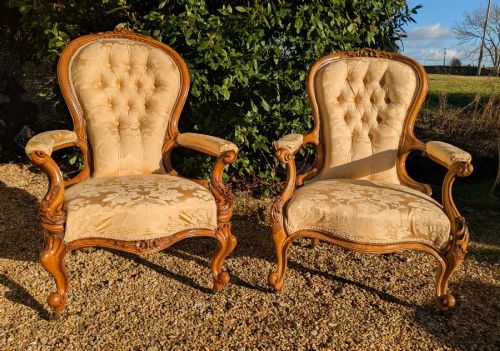
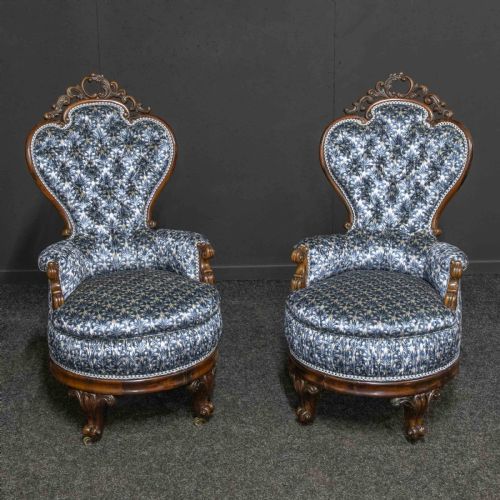
When you search for a walnut spoonback armchair, you are looking at nineteenth-century seating shaped with distinctive curved backs that resemble the bowl of a spoon. These pieces emerge predominantly from the Victorian period, spanning decades from eighteen fifty to eighteen seventy, and include parlour chairs, ladies chairs, and open arm varieties.
The versions you are most likely to meet on this page feature carved wooden frames made from walnut, often highlighting a show wood border around buttoned upholstery. Makers of the era constructed these chairs in Victorian and Victorian Rococo Revival styles, incorporating cabriole legs and supportive armrests designed for formal parlour use.
Materials and construction
Cabinet makers utilised solid walnut for the show wood frames, taking advantage of the timber's grain and strength to carve intricate ornamentation along the crest rail and frame borders. This wood was shaped and polished to create the characteristic spoon-shaped back that supported the occupant while displaying the natural warmth of the material.
Frames were fitted with textile and velvet upholstery, frequently secured with buttoning techniques over internal padding supported by metal and brass components. Workshops occasionally combined ceramic or porcelain castors on the cabriole legs to ease movement across nineteenth-century floor coverings.
Walnut Spoonback Armchair Retail Price Guide 2026
Typical asking prices for walnut spoonback armchair among the pieces listed under this phrase on Sellingantiques today, from the lower quarter to the upper quarter. They describe what is for sale here now, not the wider market.
Some nineteenth-century makers concealed porcelain castors beneath cabriole legs, allowing parlour chairs to glide across carpets without disturbing polite conversation.
Assessing quality
Quality in these chairs rests upon the depth and crispness of the carved walnut decoration around the show wood frame and crest. Superior examples exhibit fluid, hand-carved motifs that integrate seamlessly into the structural lines of the spoonback.
The integrity of the frame construction and the fidelity of the period upholstery finish dictate the standing of an individual piece. Finer items maintain robust joinery in the cabriole legs and arms alongside balanced proportions suited to nineteenth-century domestic interiors.
Holland and Sons
The Walnut Spoonback Armchair Glossary
- Spoonback
- A chair back featuring an oval or concave upholstered centre that curves inward to resemble a spoon. This shape became popular during the nineteenth century for parlour and drawing-room seating.
- Show wood
- The exposed polished timber frame of an upholstered chair that remains visible around the padded sections. Cabinet makers used walnut to highlight this decorative wooden border.
- Cabriole leg
- A furniture leg that curves outward in a convex arc and tapers inward in a concave arc to a foot. This form draws inspiration from classical animal limbs and frequently appears on Victorian seating.
- Buttoning
- An upholstery technique where tightly pulled tufts are secured with buttons through the padding to create a diamond pattern. This method adds firmness and texture to the chair back.
- Parlour chair
- A smaller Victorian seating form designed for entertaining guests in a formal reception room. These pieces often feature open arms or delicate frames suitable for domestic placement.
Walnut Spoonback Armchair: Frequently Asked Questions
What is a walnut spoonback armchair?
A nineteenth-century seating form defined by an oval, concave upholstered back resembling a spoon, set within an exposed walnut timber frame.
These chairs date from the Victorian era and typically include carved ornamentation, cabriole legs, and traditional fabric or velvet upholstery.
How were these chairs used originally?
Victorian households placed them in parlours and drawing rooms as both functional seats for reading or conversation and decorative statements of taste.
Ladies chairs and parlour variants offered comfortable upright support suitable for formal entertaining and domestic life.
How do I live with one today?
They fit naturally into both traditional and contemporary interiors as reading chairs or accent pieces in sitting rooms and studies.
Their compact nineteenth-century proportions allow them to sit comfortably alongside modern furnishings without overwhelming smaller spaces.
How can I tell the period?
Look for construction characteristics typical of the mid-nineteenth century, including solid walnut frames, hand-carved Victorian detailing, and traditional upholstery methods.
Stylistic cues such as Rococo Revival curves and cabriole legs help distinguish pieces from the eighteen fifties, sixties, and seventies.