
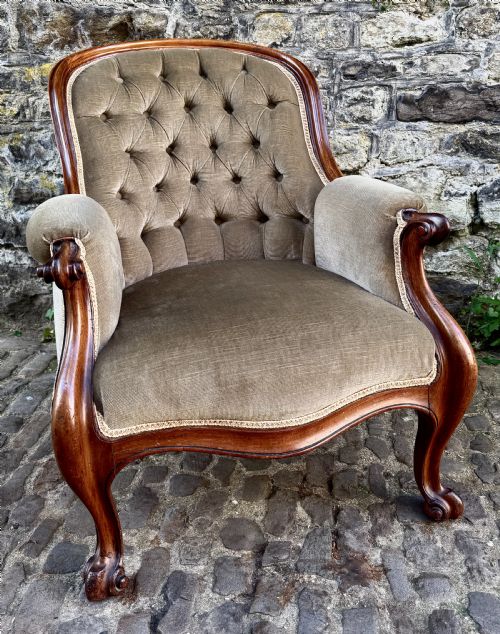
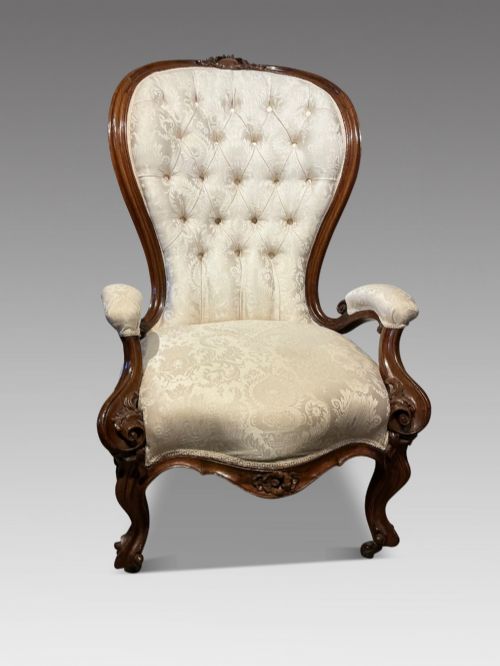


Walnut Spoon Back Armchair
A walnut spoon back armchair brings organic curves and rich timber grain to a parlour or fireside, combining comfort with Victorian refinement.
Walnut Spoon Back Armchair
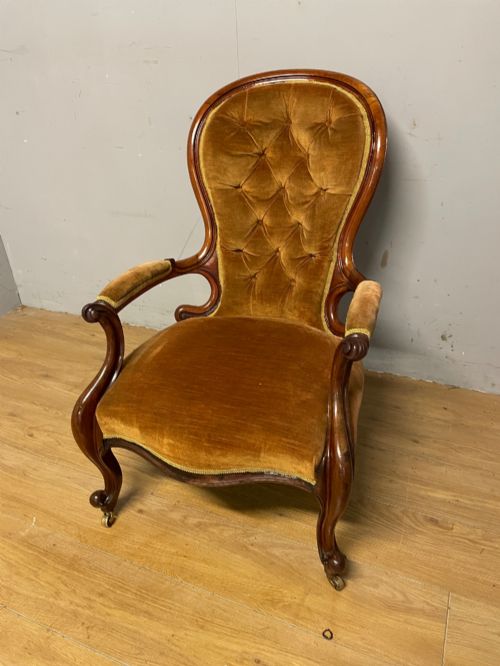
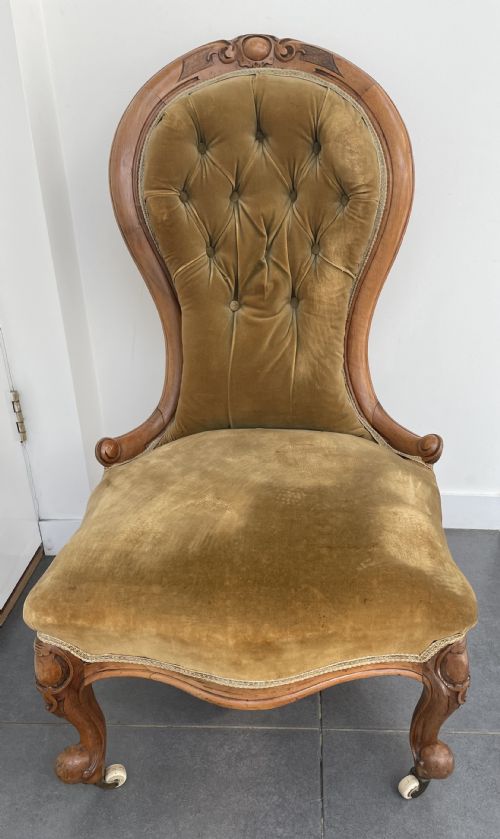
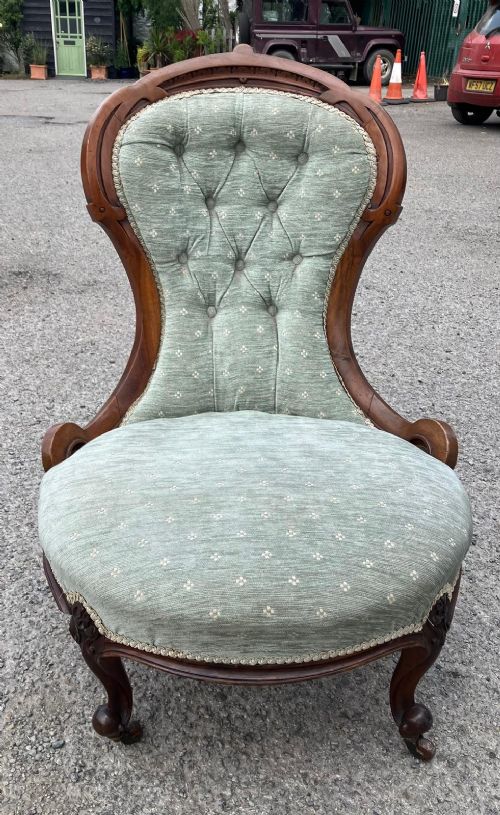
A walnut spoon back armchair is a seating form defined by its concave, oval backrest shaped like the bowl of a spoon, designed to cradle the sitter's spine. These chairs appear predominantly in Victorian guises, spanning salon chairs, nursing chairs, ladies and gentlemen's chairs, and fireside seating.
The pieces on this page draw heavily from the nineteenth century, with particular concentrations in the mid-Victorian decades alongside occasional later revivals. Formats range from low-slung fireside models and open armchairs to button-backed salon examples resting on cabriole or turned supports.
How they were made
Cabinet makers built the structural frames primarily from solid walnut, often utilising exposed show wood frames that display elaborate hand-carved foliate details along the crest rail and cabriole legs. Brass components occasionally reinforce internal joints or mountors on specific variations.
Upholstery techniques combined traditional stuffing with textiles such as velvet, damask, leather, needlepoint tapestry, and modern fabric alternatives secured with deep buttoning. Button-backed versions required meticulous tensioning to create the characteristic tufted surface pattern.
Listings span the seventeenth through the twentieth centuries, anchored primarily by Victorian production alongside French influences and occasional 1930s revivals.
What varies in quality
Quality rests in the depth and crispness of the timber carving, particularly along the flowing curves of the spoon back frame and the grace of the cabriole legs. Superior examples exhibit tightly figured walnut grain and substantial timber scantlings rather than thin, flat mouldings.
The execution of the show wood frame joinery and the proportion between the open arms and the upholstered seat determine the structural integrity and visual balance of the finished chair.
The Walnut Spoon Back Armchair Glossary
- Spoon back
- An upholstered chair back curved in three dimensions to resemble the bowl of a spoon, designed to fit the human spine. This contour defines the primary aesthetic of the seating type.
- Show wood
- The exposed polished wooden framework of an upholstered chair that surrounds the padded portions. It highlights the quality of the walnut timber.
- Cabriole leg
- A furniture leg that curves out at the knee and tapers inward to an ankle, finishing in a scroll or simple foot. This form appeared frequently on mid-Victorian seating.
- Button back
- An upholstery style where buttons are pulled tight through the padding at regular intervals to form geometric diamond patterns. It provides both structural tension and decoration.
- Salon chair
- A light, decorative armchair intended for formal reception rooms rather than heavy daily use. These chairs often feature open arms and slender frames.
Walnut Spoon Back Armchair: Frequently Asked Questions
Where should I place a spoon back armchair?
These armchairs suit drawing rooms, bedrooms, and studies where their curved profiles can be viewed from multiple angles. Their compact footprints make them effective as occasional seating beside a fireplace.
Because many examples feature finished backs and decorative show wood, they sit comfortably away from walls rather than tucked tightly into corners.
How do I identify a Victorian walnut frame?
Victorian walnut exhibits a rich, warm brown colour with dark grain patterns that differ from the reddish tones of mahogany or the lighter hues of oak. The timber is dense and took fine detail during the carving process.
Examining the underside reveals older hand-cut screws, traditional joinery methods, and the natural ageing of the wood surface over time.
Are these chairs comfortable for daily seating?
Many nineteenth-century examples provide upright support tailored to the posture of the period, particularly the nursing and ladies chairs designed with lower seats. The curved backrest offers targeted lumbar support.
Comfort levels depend heavily on the internal webbing and padding condition, which varies across pieces retained in original state or later reupholstered.
What is the difference between ladies and gents chairs?
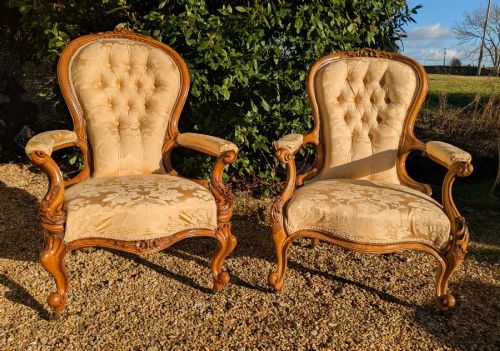
Gentlemen's chairs were built with broader proportions and open arms to accommodate men's clothing and larger statures during the Victorian era. Ladies chairs typically featured narrower seats, lower profiles, and often lacked arms to allow room for wide crinoline skirts.
Pairs of these matching chairs frequently appeared together in formal Victorian parlours as companion seating.