



Walnut French Settee
A walnut french settee brings continental curves and rich timber grain to a room, offering both seating and ornamental presence.
Walnut French Settee
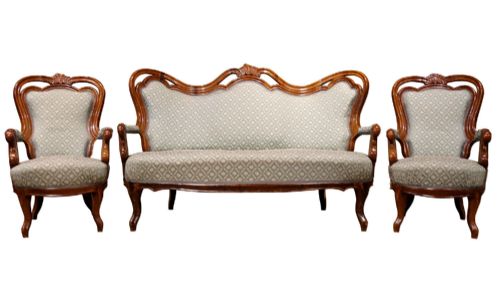
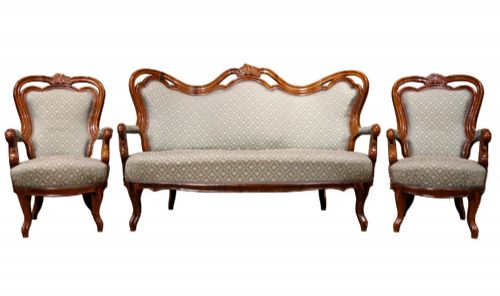
The walnut french settee appears across several distinct revival styles, most notably Louis XV and Louis XVI, alongside general nineteenth-century interpretations. These pieces range from compact two-seater salon seats to larger three-piece suites complete with matching armchairs.
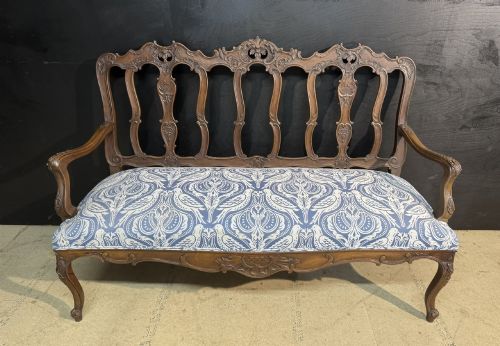
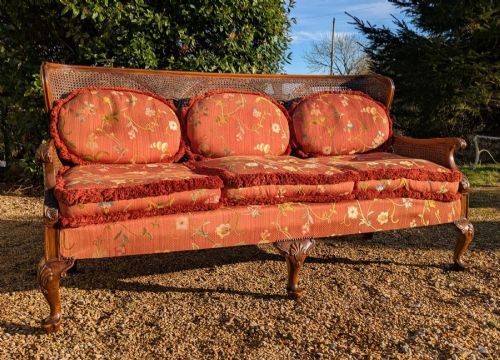
Makers and manufacturers produced these frames utilising walnut timber, often shaped with scrollwork, cabriole legs, and carved floral motifs. Caned panels and upholstered cushions in velvet, silk damask, or textile finish the seating areas.
Materials and Construction Methods
Craftsmen shaped solid walnut frames by hand, employing traditional joinery to support the curving lines characteristic of French revival designs. Timber surfaces often display natural grain patterns or pale finishes.
Upholstery methods varied from traditional horsehair stuffing and fabric covers to cane work woven tightly through drilled frame apertures. Feather cushions and brass details frequently supplement the main structural upholstery.
Upholstery materials recorded on these frames include silk damask, paisley textiles, leather, and traditional cane.
Distinguishing Quality and Execution
The depth and crispness of the wood carving dictate the distinction between standard production and superior examples. Fine execution reveals itself in undercut foliage, balanced proportions, and smooth, flowing scrollwork.
The integration of the frame with its supporting materials, such as tight cane panels or hand-stitched upholstery, determines the structural integrity of the piece. Superior examples maintain harmony between the timber chassis and the textile components.
The Walnut French Settee Glossary
- Canapé
- A traditional French term for a long upholstered sofa or settee, usually featuring an exposed wooden frame.
- Bergere
- An enclosed upholstered armchair or sofa with wooden framing and cane or upholstered sides.
- Cabriole leg
- A furniture leg that curves outward and then tapers inward, finishing in a small foot, typical of Louis XV styling.
- Marquetry
- Decorative inlay work using various woods fitted into veneer patterns across flat surfaces.
- Salon suite
- A matching set of seating furniture, typically comprising a settee and multiple armchairs for a drawing room.
Walnut French Settee: Frequently Asked Questions
How do I identify a Louis XV style settee?
These pieces display asymmetric curves, cabriole legs, and carved floral motifs along the crest rail and apron.
The woodwork typically exhibits flowing lines without straight structural elements.
What is the difference between a canapé and a settee?
A canapé is simply the French terminology for an upholstered sofa or settee with an exposed wooden frame.
Both terms often describe similar nineteenth-century continental seating forms.
Are these settees suitable for daily seating?
Many pieces feature robust walnut frames and supportive upholstery suitable for regular living room use.
Cane panels and antique textiles require more mindful care than modern materials.
How do I care for antique walnut frames?
Maintain the timber by dusting regularly with a dry cloth and avoiding direct sunlight.
Wax polish can be applied sparingly to nourish the exposed walnut grain.