


Walnut Desk Companion
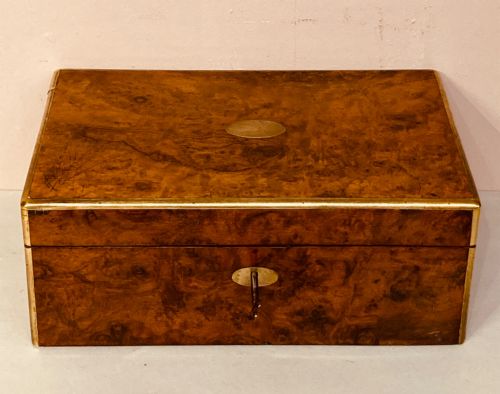
A walnut desk companion is a portable piece of heritage engineering, offering compartments and fittings to keep your correspondence and writing tools organised.
Walnut Desk Companion
The pieces on this page lean heavily towards Victorian and nineteenth-century examples, alongside select late Georgian and Regency designs. Common forms include brass-mounted double-sided desk sets, rotary bookstands, and carved wooden tobacco boxes utilising distinct regional styles.
Originating as essential tools for correspondence and private study in homes and offices, these items combine practical storage with decorative presence. Whether you seek a fitted writing box or a revolving book companion, each object reflects the stationery habits of past eras.
How they were made
Cabinet makers constructed these pieces using solid walnut and highly figured burr walnut veneers applied to stable secondary woods. The grain patterns of the timber form the primary visual appeal of the exterior surfaces.
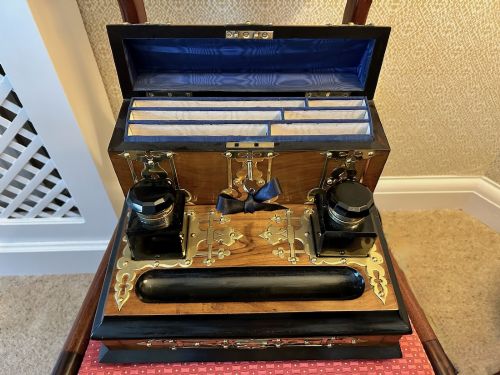
Metalwork played a crucial structural and decorative role, with heavy brass mounts, hinges, and carrying handles fitted to withstand daily use. Glass was integrated via cut glass inkwells, while interior fittings frequently incorporated silk, leather, and carved wood details.
A carved dog peers out from a nineteenth-century Black Forest tobacco box, proving that Victorian desk habits included a distinct touch of canine charm.
What varies in quality
The hierarchy of quality rests primarily in the selection of the timber and the complexity of the interior fit-out. Plain walnut surfaces sit at the simpler end, whereas richly figured burr walnut with precise brass inlay represents a more ambitious standard of cabinet work.
Degree of original furnishing distinguishes better examples, particularly where matching cut glass inkwells, original leather writing surfaces, and intact silk linings survive. The precision of the joinery and the robustness of the locking mechanisms further separate standard utilitarian objects from luxury desk furniture.
The Walnut Desk Companion Glossary
- Burr walnut
- A prized timber harvested from the irregular growth knots of the walnut tree, displaying swirling grain patterns used for decorative veneer.
- Writing slope
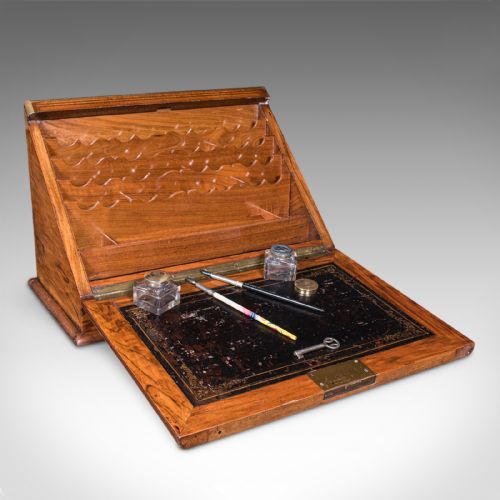
- A portable box with a slanted lid that opens to reveal a velvet or leather-lined writing surface and compartments for pens and paper.
- Inkstand
- A tray or stand designed to hold one or more inkwells, often accompanied by pen troughs and sanders for drying wet ink.
- Black Forest carving
- A distinct nineteenth-century style of ornate, highly detailed wood carving, frequently depicting animals or naturalistic foliage originating from central Europe.
- Stationery case
- An upright desk cabinet featuring tiered compartments designed to hold envelopes, writing paper, and documents upright.
Walnut Desk Companion: Frequently Asked Questions
What is a walnut desk companion?
A walnut desk companion is a collective term for portable or tabletop accessories made of walnut, designed to hold writing materials, ink, books, or tobacco.
These pieces range from fitted writing slopes and inkstands to rotary bookstands and cigar boxes, serving both practical and decorative functions in nineteenth-century studies.
How were nineteenth century writing boxes used?
Nineteenth-century writing boxes provided a portable desk space for correspondence before the widespread adoption of fitted stationary desks.
Owners opened the sloped lid to reveal compartments for paper, nibs, and inkwells, allowing them to write letters while travelling or in different rooms of a house.
How do I care for antique walnut furniture?
Antique walnut requires stable environmental conditions away from direct heat sources and strong sunlight to prevent the timber and veneer from drying out.
Applying a traditional beeswax polish periodically helps maintain the lustre of the wood without building up synthetic residues on the antique finish.
How can I tell a Victorian desk set from an Edwardian one?
Victorian pieces often feature heavier brass mounts, Gothic Revival influences, or ornate Black Forest carvings, reflecting the robust taste of the mid to late nineteenth century.
Edwardian items tend towards lighter, rotary designs such as revolving book companions, mirroring the changing domestic interiors of the early twentieth century.