
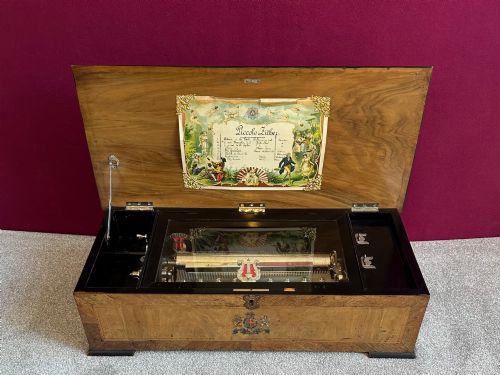


Walnut Cylinder Music Box
A walnut cylinder music box is a mechanical marvel of the nineteenth century that brings the complex, automated melodies of the parlour directly into the modern home.
Walnut Cylinder Music Box
A walnut cylinder music box is typically encountered as a Victorian or Edwardian table-top cabinet housing a pinned brass cylinder, a tuned steel comb, and often a spring-driven clockwork movement. The form reflects the peak of Swiss and British musical engineering from the mid-nineteenth century through to the early twentieth century.
Most examples found in these listings date from the Victorian era, spanning the decades between eighteen sixty and nineteen hundred, with occasional Edwardian pieces appearing from nineteen ten. These instruments range from plain wooden cases to elaborate boxes featuring marquetry inlay, boxwood stringing, and ebonised wood details.
The primary origin represented is nineteenth century Swiss craftsmanship, often imported and housed in rich walnut or burr walnut cabinetry. Buyers will discover everything from compact six-air boxes to larger, multi-air orchestration models bearing the signatures of celebrated makers.
How they were made
The exterior casework relies heavily on walnut and burr walnut veneers applied to solid timber foundations, frequently embellished with boxwood stringing, ebonised wood accents, and detailed marquetry. These materials provided both structural stability and a resonant acoustic enclosure to project the sound.
Internal mechanical assemblies combine cast and machined brass cylinders set with countless precisely positioned steel pins that strike the teeth of a tuned steel comb. Each air, or tune, is programmed onto the rotating cylinder by hand before being driven by a powerful steel spring and gear train.
Listings feature walnut, burr walnut, ebonised wood, and boxwood across Victorian and Edwardian periods.
What varies in quality
Quality in a walnut cylinder music box is determined by the precision of the musical arrangement and the complexity of the movement, such as the number of airs it can play and whether it incorporates a mandolin effect. Master makers achieved richer tonality and greater mechanical longevity through superior comb tempering and pin setting.
Cabinetwork also dictates value, where finely figured burr walnut veneers and intricate marquetry separate standard production pieces from exhibition-grade instruments. The crispness of the exterior joinery matches the meticulous alignment found inside the brass and steel movement.
Langdorff & Fils·B A Bremond·Nicole Freres
The Walnut Cylinder Music Box Glossary
- Cylinder
- The rotating metal barrel pinned with tiny projections that pluck the teeth of the comb to produce the notes. Its precise rotation dictates the timing of the tune.
- Comb
- The tuned flat plate of steel cut into individual vibrating teeth that sound the notes when struck by the pins on the cylinder.
- Air
- A distinct musical tune or melody played during one rotation of the cylinder. Boxes are commonly described by how many airs they hold, such as six or twelve.
- Marquetry
- The art of applying pieces of veneer to a structure to form decorative patterns and pictures. It frequently decorates the lid of the walnut case.
- Boxwood
- A dense, pale wood utilised for fine stringing and contrasting inlay details on the cabinet exterior.
Walnut Cylinder Music Box: Frequently Asked Questions
How do I wind the movement?
Most walnut cylinder music boxes utilise a side-mounted winding lever or a key that attaches directly to the spring arbor.
Turn the mechanism smoothly until you feel firm resistance, avoiding over-winding to protect the historical spring.
Where should I place the box?
Position the piece on a stable, level surface away from direct sunlight and sudden temperature fluctuations.
Solid wooden furniture acts as an ideal sounding board, enhancing the acoustic projection of the steel comb.
How do I identify the maker?
Inspect the brass bedplate and the underside of the movement for stamped serial numbers and maker signatures.
Paper tunesheet labels pasted inside the lid also provide valuable documentation regarding the origin and list of airs.