



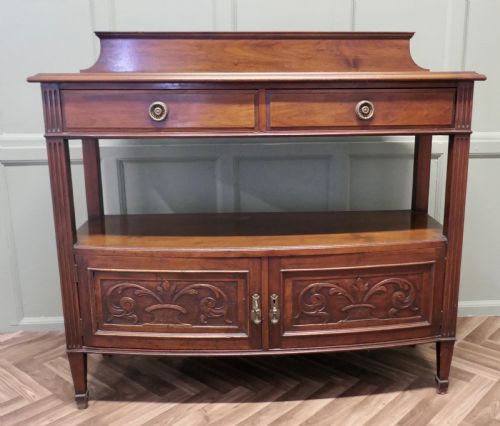
Walnut Bow Fronted Drawers
Walnut bow fronted drawers bring gentle curves and rich grain to a room, offering practical storage through pieces shaped in walnut and burr walnut across multiple eras.
Walnut Bow Fronted Drawers
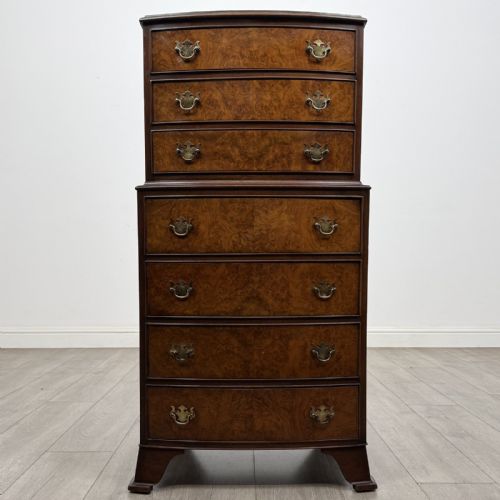
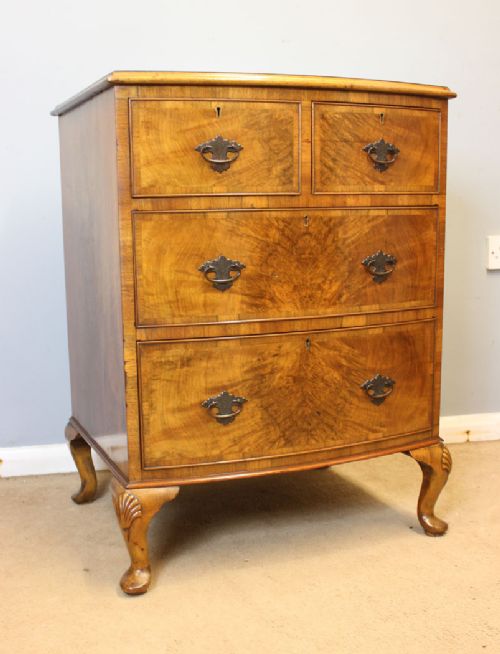
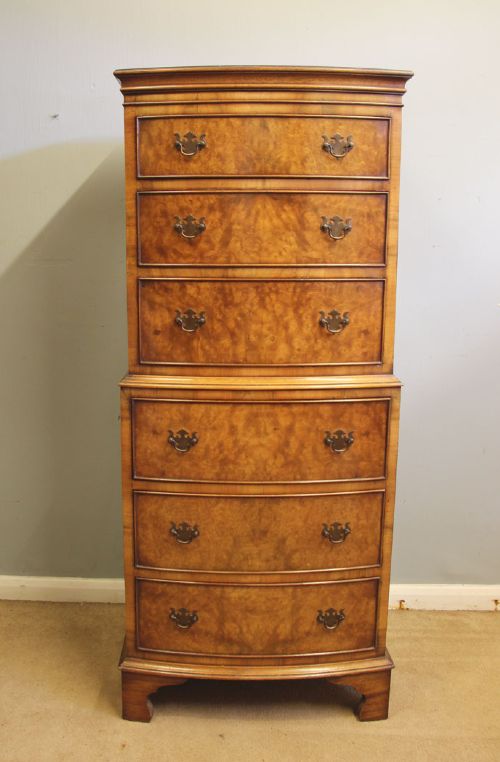
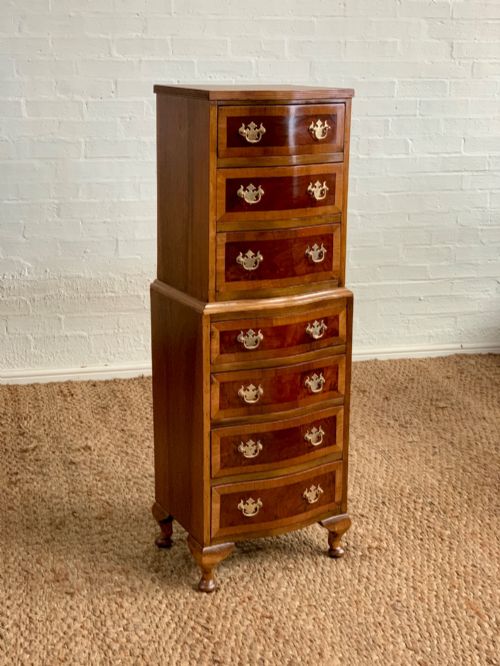
When you search for walnut bow fronted drawers, you are looking at case furniture featuring a convex curved front that projects forward, constructed primarily in walnut and burr walnut. These pieces include chests of drawers, tallboys, chests on chests, sideboards, and side tables.
The selection on this page ranges from 18th century French provincial commodes and 19th century carved sideboard forms to Edwardian examples and 1930s revival pieces. You will frequently meet smaller chests and tallboys dating to the 1920s and 1930s executed in burr walnut.
Makers and designers drew upon Georgian style, Queen Anne style, and Art Nouveau influences to shape these items. Painted wood and oak also appear alongside brass hardware to complete the construction of these functional storage items.
How they were made
Cabinet makers utilised solid walnut, oak, and painted wood for the primary structures while applying decorative burr walnut veneers to the visible exterior surfaces. Cross-banding frequently frames the drawer fronts to accentuate the curved outlines.
Brass handles, escutcheons, and keyplates are fitted to the drawer faces to operate the sliding mechanism of the graduated drawers. Carving appears on specific stylistic examples such as Art Nouveau sideboards and provincial commodes.
Walnut Bow Fronted Drawers Retail Price Guide 2026
Typical asking prices for walnut bow fronted drawers among the pieces listed under this phrase on Sellingantiques today, from the lower quarter to the upper quarter. They describe what is for sale here now, not the wider market.
Listings feature items spanning the 18th century, 19th century, Edwardian era, 1920s, and 1930s, constructed in walnut, burr walnut, oak, and painted wood.
What varies in quality
The visual appeal of the burr walnut veneer dictates much of the distinction between pieces, with intricate figuring and matched grain patterns marking superior work. The smoothness of the curve on the bow front and the precision of the cross-banding also separate simpler items from finer examples.
The choice of secondary timbers like oak for internal drawer linings and the quality of the brass hardware indicate the care taken during construction. Proportion and scale in smaller chests and tallboys determine how successfully the curved silhouette is balanced.
The Walnut Bow Fronted Drawers Glossary
- Bow front
- A convex front projection on a cabinet or chest of drawers that curves outward in a gentle arc. This shape softens the rectangular lines typically found in case furniture.
- Burr walnut
- A veneer sliced from the knot or growth on a walnut tree that yields swirling, highly decorative grain patterns. Cabinet makers prized this wood for its distinctive appearance on drawer fronts.
- Tallboy
- A tall chest of drawers standing higher than a standard chest, sometimes constructed in two stacked sections as a chest on chest. These units maximise vertical storage space.
- Cross-banding
- A narrow strip of veneer laid around the border of a drawer front or table top with the grain running at right angles to the surrounding wood. This technique creates a neat framing effect.
- Graduated drawers
- A series of drawers arranged vertically where each drawer decreases in depth from bottom to top. This arrangement provides stability and balance to the piece.
Walnut Bow Fronted Drawers: Frequently Asked Questions
What rooms suit walnut bow fronted drawers?
These pieces fit well in bedrooms as chests for clothing or in hallways and living rooms as compact storage units. Their curved fronts soften corners and fit easily into narrower spaces.
Smaller tallboys and side tables provide useful surface area without dominating the floor plan of a domestic interior.
How do I care for burr walnut furniture?
Burr walnut benefits from regular dusting with a soft, dry cloth and occasional treatment with quality furniture wax to nourish the wood. Keep the surfaces away from direct sunlight and heat sources to prevent the veneer from drying out.
Avoid using silicone-based polishes which can build up a residue and dull the natural grain over time.
What is the difference between a tallboy and a chest on chest?
A tallboy typically refers to a single tall chest of drawers, while a chest on chest consists of two separate cabinet sections stacked one on top of the other. Both forms offer substantial vertical storage capacity.
The two-piece construction of a chest on chest makes moving the heavy walnut furniture significantly easier during relocation.
How do I identify a revival style piece?
Revival pieces combine historical design characteristics like those from the Georgian or Queen Anne periods with the manufacturing techniques of their actual production era, such as the 1920s or 1930s. They replicate earlier proportions and decorative motifs.
Examining the internal timbers, drawer construction, and hardware usually reveals the true age of the piece regardless of the stylistic inspiration.