
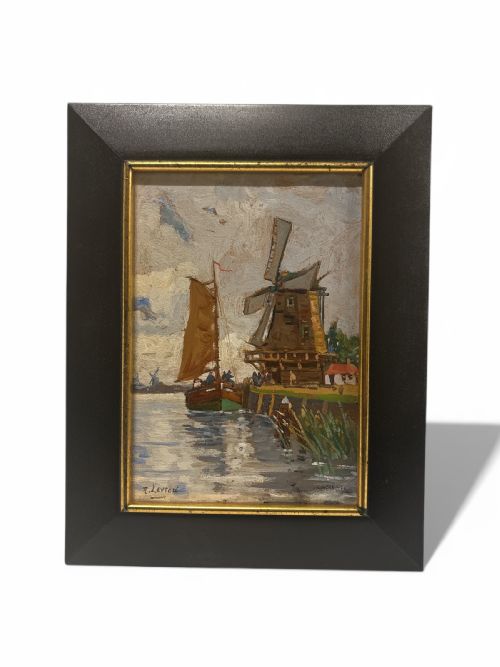
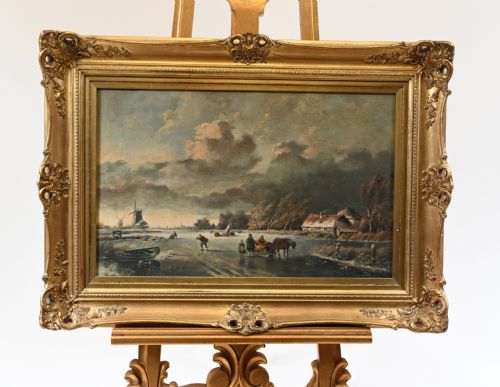
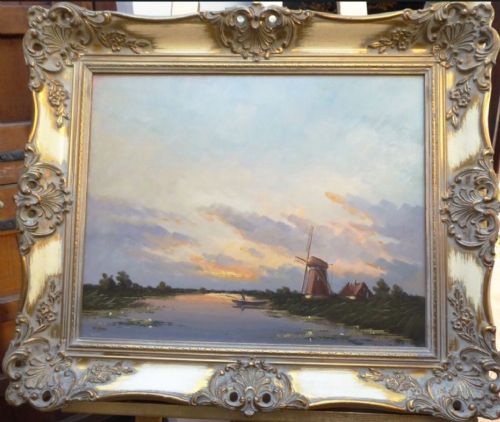


Vintage Windmill Oil Painting
A vintage windmill oil painting brings the quiet turn of rural sails and wide open skies directly into a room.
Vintage Windmill Oil Painting
A vintage windmill oil painting captures agricultural and coastal vistas, frequently centred on Dutch canals, Norfolk broads, and rural waterways. These works range from late Victorian realism and Edwardian impressions to mid-century naive interpretations and post-century traditional views.
The compositions on this page lean heavily towards Dutch School traditions and British marshlands, depicting river landscapes, frozen winter scenes, and sunset horizons. Buyers encounter both smaller framed studies on wood panel and large canvas works intended as principal wall art.
Originating across the nineteenth and twentieth centuries, including specific decades such as the 1850s through to the 1960s, these pieces reflect regional European landscape traditions. The forms vary from intimate village taverns with distant sails to grand polder expanses dominated by a single towering mill.
How they were made
Artists painted primarily with oil paint on stretched canvas or prepared wood panels, building up texture with layered brushstrokes or thick impasto. Canvas works often sit within heavy giltwood or moulded plaster frames that complement the period of the painting.
The supporting structures utilise solid wood stretchers and timber panels, occasionally retaining historic maker stamps or handwritten inscriptions on the reverse. Gilt frames combine carved wood with decorative plaster mouldings, finished with gold leaf or metallic paint.
Listings span from the 1860s to the 1960s, utilising oil paint on canvas and wood panel.
What varies in quality
Quality rests in the confidence of the brushwork and the handling of atmospheric light, particularly how the artist manages the pale glow of sunset or grey winter skies. Stronger pieces show genuine depth in the water reflections and dynamic movement in the windmill sails.
The harmony of the original frame and the preservation of the paint surface dictate the standing of an individual work. Superior examples maintain stable oil pigment without excessive craquelure, housed in period giltwood that suits the scale of the canvas.
R Leyton·T Bergman·Edward Seago·John Holland Snr·Kershaw Schofield·Osmond Hick Bissell·Von Goring
The Vintage Windmill Oil Painting Glossary
- Impressionist
- A style of painting emphasising loose brushwork and the accurate depiction of light in its changing qualities. These works prioritize overall visual mood over tight photographic detail.
- Polder
- A low-lying tract of land enclosed by dikes that forms an artificial hydrological entity. The term frequently appears in titles describing reclaimed Dutch agricultural terrain.
- Giltwood
- Wood carved and subsequently covered with a thin layer of gold leaf or gilt powder. It forms the traditional material for ornate picture frames.
- Naive Art
- Art produced by a self-taught artist typically characterised by a childlike simplicity in perspective and line. These works offer direct charm and unacademic interpretations of rural life.
- Panel
- A rigid support for a painting, commonly made of wood rather than stretched fabric. Historic pieces often utilise mahogany or oak boards.
Vintage Windmill Oil Painting: Frequently Asked Questions
Where were these paintings typically displayed?
These works hung primarily in domestic reception rooms, parlours, and studies throughout the nineteenth and twentieth centuries. Owners favoured rural landscapes to bring a sense of open countryside into urban homes.
Today, they suit living rooms, hallways, and dining spaces where traditional or mid-century interior aesthetics prevail.
How do I identify a Dutch School painting?
Dutch School paintings often feature characteristic low horizons, expansive cloudscapes, and waterways framing a traditional windmill. The palette frequently relies on muted greys, earthy browns, and pale yellows.
Signatures on these works may include continental naming conventions or specific regional gallery labels on the reverse of the stretcher bars.
Are these works painted on canvas or wood?
The evidence shows a split between traditional woven canvas stretched over timber frames and solid wood panels. Canvas allows for larger, expansive compositions while panels tend to appear in smaller cabinet-sized pieces.
Both supports received primed grounds before the application of oil paint by the artist.
How should I care for an oil painting?
Keep oil paintings away from direct sunlight and fluctuating humidity to protect both the canvas and the wooden support. Gentle dusting with a soft, dry brush is sufficient for routine maintenance.
Avoid using water or chemical cleaners on the paint surface or antique gilt frames.