




Vintage Upholstered Window Bench
A vintage upholstered window bench brings low, comfortable seating to a bay or narrow hallway, combining period timber frames with textile seats.
Vintage Upholstered Window Bench
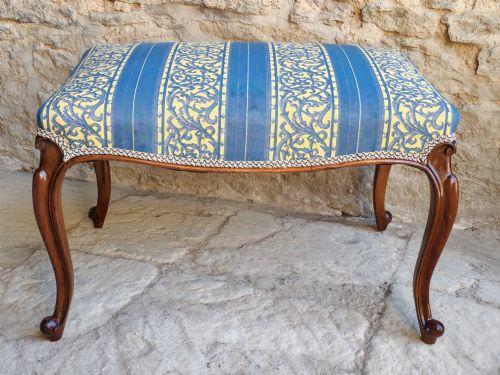
When you search for a vintage upholstered window bench, you encounter a variety of long stools, window seats, and duet piano stools spanning from the nineteenth century into the 1930s. The selection relies heavily on Edwardian mahogany frames alongside earlier Regency, Victorian, and Georgian revival examples, often adapted for placement beneath low sills.
The forms range from compact single stools and chair-back end-of-bed seats to long country house storage ottomans and French gilt duet stools. Many pieces double as hallway boot stores or day beds, reflecting the practical domestic uses of past decades across English and French workshops.
How they were made
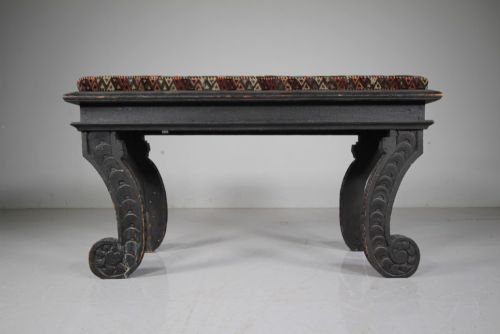
Makers constructed these frames predominantly using dense hardwoods such as mahogany, walnut, and painted pine, frequently incorporating inlaid details, carved elements, and ebonised finishes. Brass hardware and gilt accents occasionally highlight the structural woodwork on French and Regency models.
The upholstery technique brings together traditional fabric, textile, velvet, and leather coverings secured over padded seats. Many pieces retain period kilim, tapestry, or plain upholstery, whilst others invite re-upholstery to suit contemporary interiors.
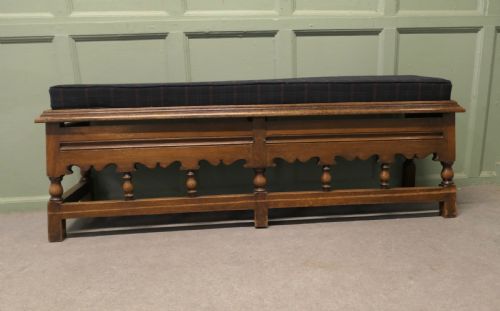
One Edwardian window bench moonlights as a boot store and a tweed resting place, proving Victorian practicality survived into the twentieth century.
What varies in quality
The distinction between standard production and finer examples rests upon the execution of the timber framing and the integrity of the joinery. Superior pieces display crisp carving, thoughtful mahogany or walnut grain selection, and substantial structural weight rather than thin or hastily assembled joints.
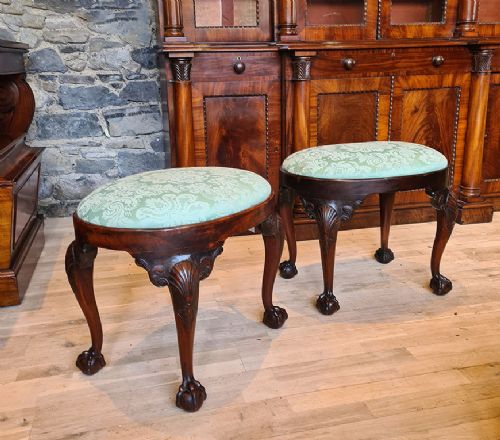
Detailing such as ball and claw feet, fine inlay work, and original painted or gilt surfaces elevate a piece. The choice of covering also shifts the character, from utilitarian tweed and painted pine to decorative tapestries and structured leather.
Hallett & Sons·Morris & Co.
The Vintage Upholstered Window Bench Glossary
- Window seat
- A long, narrow form of seating designed specifically to sit low beneath a window aperture. These often feature arms or upholstered backs to fit restricted spaces.
- Duet stool
- An extended seat originally made to accommodate two musicians at a piano. They frequently appear as long upholstered benches suitable for the foot of a bed.
- Curule stool
- An ancient Roman magistrate's chair form adapted into X-frame seating during the Regency and nineteenth-century revival periods. They offer a distinct cross-legged architectural profile.
- Ottoman
- A padded, upholstered seat without arms or back, sometimes incorporating internal storage for household items. Country house examples often provide substantial length.
- Inlay
- A decorative technique where contrasting woods or materials are set flush into the primary wooden surface of the frame. Edwardian mahogany pieces frequently employ this for visual refinement.
Vintage Upholstered Window Bench: Frequently Asked Questions
Where do you put a vintage window bench?
These benches sit naturally beneath low window sills, along narrow hallways, or at the foot of a bed. Their slender proportions allow them to occupy circulation spaces without blocking light.
They also serve as occasional seating in living rooms or dressing areas where a full-sized sofa proves too deep.
How do I tell an Edwardian window bench from a Regency one?
Edwardian pieces, built around 1900, often feature lighter mahogany framing, string inlay, and simpler Edwardian or Georgian revival lines. Regency examples, dating from the early nineteenth century, typically display heavier classical proportions, bolder timber grains, and structural forms influenced by ancient Greek or Roman design.
Examining the underside, timber shrinkage, and secondary woods helps confirm the true manufacturing period against later revival copies.
Can I use these benches for storage?
Certain forms, particularly country house ottomans and specific hall benches, incorporate internal storage beneath the hinged or lift-off upholstered seat. These were historically built to hold blankets, boots, or textiles.
Standard window seats and piano stools are solid-frame structures intended purely for seating rather than concealment.
Are piano stools comfortable for daily seating?
Duet and piano stools provide firm, stable seating designed for upright posture at a keyboard. Their padding tends to be shallower than a deep lounge armchair.
Placed in a hallway or bedroom, they offer a convenient perch for changing shoes or placing garments.