

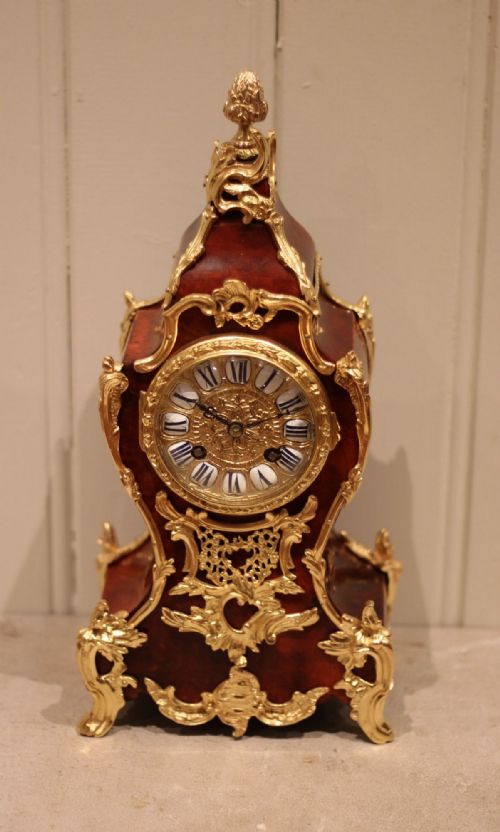


Vintage Tortoiseshell Clock
A vintage tortoiseshell clock brings rich amber warmth and gilded metal into a room, offering both reliable timekeeping and decorative presence.
Vintage Tortoiseshell Clock
A vintage tortoiseshell clock is an ornamental timepiece featuring genuine shell veneer or faux finishes, typically housed in wooden or metallic frames. These pieces originate predominantly from the nineteenth and early twentieth centuries, spanning Victorian, Edwardian, and French revival periods.
The most common forms on this page include mantel clocks, bracket clocks, and smaller boudoir or desk timepieces. Many incorporate classical European styling, such as Louis XIV or Louis XV rococo motifs, pairing the mottled dark shell with cast brass or ormolu mounts.
Makers and cabinetmakers built these clocks for domestic display in parlours, studies, and drawing rooms. Buyers seeking this phrase will find both genuine tortoiseshell veneered bodies and painted faux tortoiseshell alternatives across various nineteenth-century decades.
Materials and construction methods
Makers constructed these timepieces by applying thin tortoiseshell veneers or decorative faux tortoiseshell finishes over a wooden carcase. They accented the rich, translucent brown and amber patterns with brass, ormolu, and silver fittings.
Clockmakers fitted mechanical movements inside these decorated housings, often utilising brass plates, enamel dials, and glassbezels to protect the face. Ormolu mounts were frequently cast, chased, and gilded to frame the mottled shell panels.
One petite boudoir clock carries a distinct sporting pedigree, having been presented by a Victorian magazine called Sporting Sketches.
Factors of craftsmanship and execution
Quality varies significantly in the depth of the tortoiseshell veneer and the crispness of the cast ormolu mounts. Finer examples display meticulous matching of the shell patterns and heavy, well-chased bronze or brass ornamentation.
The standard of the interior clock movement also distinguishes the work, with fusee movements and signed mechanisms representing higher production tiers. Simpler faux tortoiseshell or unmarked platform escapements occupy more modest levels of the range.
William Comyns·J Batson & Son·Payne London
The Vintage Tortoiseshell Clock Glossary
- Boulle
- A form of marquetry using tortoiseshell and brass inlay, developed in seventeenth-century France and revived during the nineteenth century. This technique creates a striking contrast between dark amber shell and gleaming metallic scrolls.
- Ormolu
- Gilded bronze used extensively for decorative mounts on clock cases. The technique involves applying a gold amalgam to bronze before heating to fix the metallic finish.
- Fusee
- A conical pulley used in spring-driven clocks to maintain even power delivery as the mainspring unwinds. This mechanism improves the timekeeping accuracy of the clock.
- Bracket clock
- A portable mantel clock originally designed to sit on a wall bracket or table. These pieces often feature sturdy wooden carcases with decorative handles.
- Escapement
- The internal mechanism that controls the release of power in a clock and gives the tick. Different types dictate the precision of the timepiece.
Vintage Tortoiseshell Clock: Frequently Asked Questions
Are these clocks suitable for daily use?
Most antique mechanical clocks function well with regular professional servicing and careful handling of the mainspring. Setting them up on a stable surface ensures the pendulum or escapement operates without interference.
Because these are nineteenth-century and early twentieth-century objects, gentle winding and proper placement away from direct heat sources will keep them running reliably.
How do I care for tortoiseshell?
Tortoiseshell requires protection from strong direct sunlight, which can fade and dry out the organic material. Dusting gently with a soft cloth keeps the surface clean without needing harsh chemical polishes.
Keeping the clock in a room with stable humidity prevents the wooden carcase beneath the veneer from expanding and cracking the shell.
How can I tell the period of a clock?
Stylistic clues such as Louis XV rococo curves or Edwardian proportions offer initial indicators of a clock's era. Movement types, dial construction, and materials also help narrow down the decade of manufacture.
Signatures or stamps on the brass backplates often provide direct evidence of the maker and active working dates.