







Vintage Temple Jars
These vintage temple jars bring enduring craft to a room, offering covered forms that transition easily from traditional mantel displays to contemporary shelving.
Vintage Temple Jars
When you search for vintage temple jars, you encounter a curated selection of lidded vessels, ginger jars, and covered vases spanning the nineteenth and twentieth centuries. These pieces originate primarily from Japanese and Chinese workshops, showcasing distinct regional forms developed for display and storage.
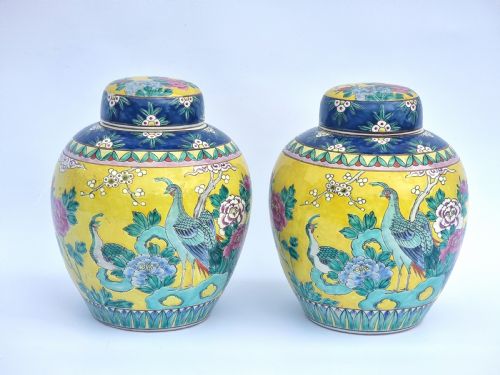
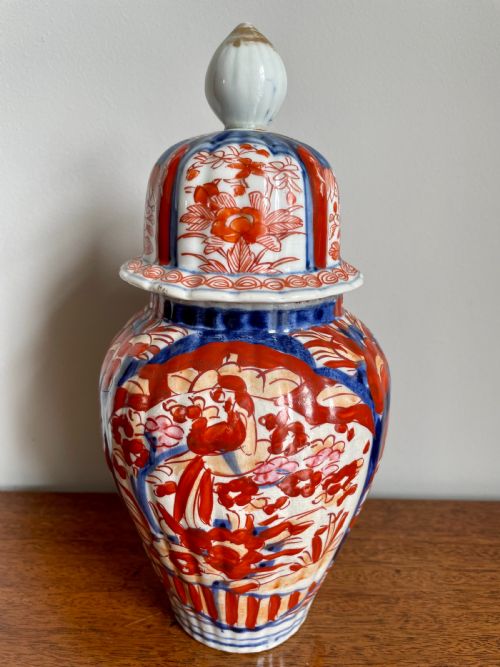
The most common examples you will meet on this page are Japanese cloisonne enamel ginger jars and porcelain Imari vases from the late nineteenth century. Alongside these, you find twentieth-century Chinese pieces and larger Satsuma or Kutani lidded vessels designed with prominent decorative surfaces.
Forms range from compact lidded ginger jars to substantial floor vases and converted table lamps. Most retain their original fitted covers, though some survive as standalone urns or paired sets intended for symmetrical placement.
Assessing quality and execution
The distinction between ordinary and exceptional pieces lies in the precision of the hand-painted brushwork or the tightness of the metal wire cells. Superior cloisonne work displays uniform compartments and smooth, polished enamel surfaces without pitting or misalignment.
Porcelain quality reveals itself in the clarity of the cobalt underglaze, the fineness of the potting, and the balance of the painted composition across the curve of the body. Well-matched pairs with original, undamaged lids command greater attention from collectors than mismatched or heavily restored examples.
Vintage Temple Jars Retail Price Guide 2026
Typical asking prices for vintage temple jars among the pieces listed under this phrase on Sellingantiques today, from the lower quarter to the upper quarter. They describe what is for sale here now, not the wider market.
Many lidded ginger jars spent decades hiding mundane household biscuits before finding new life as grand mantel ornaments.
The Vintage Temple Jars Glossary
- Cloisonne
- A decorative metalwork technique where thin wire partitions form cells that are filled with enamel paste and fired. This method creates intricate mosaic-like patterns across vases and jars.
- Imari
- A traditional style of Japanese porcelain featuring distinctive cobalt blue, iron red, and gold decoration. These wares were heavily exported during the late nineteenth century.
- Ginger jar
- A ceramic vessel characterised by a broad shoulder, tapering base, and a domed cover. Originally made for spices, they evolved into purely decorative display pieces.
- Satsuma
- A type of earthenware pottery with a crackle-glaze finish, typically decorated with elaborate polychrome enamels and gilding. Originating in Japan, these pieces often depict historical or natural scenes.
- Kutani
- A style of Japanese porcelain known for bold colour palettes and pictorial designs. The palette frequently incorporates deep greens, purples, and yellows alongside iron red.
Vintage Temple Jars: Frequently Asked Questions
What is a temple jar?
A temple jar is a large, lidded ceramic or metal vessel originally utilised in Asian households for storage or ritual purposes. Over time, Western interiors adopted them purely for decorative symmetry and architectural presence.
Today, they serve as focal points on sideboards, mantels, and tables, bringing height and texture to interior schemes.
How do I date a vintage temple jar?
Dating relies on examining the material composition, base marks, and manufacturing techniques visible on the piece. Nineteenth-century examples often exhibit heavier potting, hand-beaten metal bases, or specific regional styles like Meiji period cloisonne.
Comparing the glaze characteristics and wear patterns against documented periods helps establish a reliable timeframe for each item.
Are these jars waterproof?
Many older ceramic and metal jars were constructed for dry storage or decorative display rather than holding water. Thermal shock from fresh water can potentially stress antique glazes and internal bodies.
If you plan to use them for fresh flowers, place a smaller glass or plastic vessel inside rather than pouring water directly into the antique body.
How do I care for cloisonne and porcelain?
Maintenance requires only gentle dusting with a soft, dry cloth to prevent dust accumulation within recessed enamel cells or painted crevices. Avoid chemical cleaners, abrasive sponges, or immersion in water.
Keep pieces away from direct, harsh sunlight to protect vulnerable enamel pigments and gold leaf accents from gradual fading.